
@ycombinator, @cityjournal, and @sotazine //
SF
Joined June 2022
- Tweets1.3K
- Following458
- Followers4.7K
- Likes2.9K




Pinned Tweet
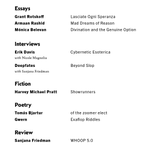
This month we're launching STATE OF THE ART no.2, the RE-ENCHANTMENT edition. STATE OF THE ART (@sotazine) is San Francisco's premier techno-literary zine.
This edition features original writing and interviews by Gwern, Erik Davis, @deepfates, @LapsusLima, @BjarturTomas, @npceo_, @digitlartifacts, and more.
Plus gorgeous art + design by @JaredRPoblete.
If you want to get on the list for the limited print run and newsletter, sign up below:

Sanjana Friedman retweeted

also, you can now read my piece from @sotazine’s first edition, “The Ferlinghetti Method,” online! sotazine.com/no-1/the-ferlin…
+ a brilliant illustration by @kat_skingle :-)


sotazine.com awesome design by @JaredRPoblete on this new website


Sanjana Friedman retweeted

We are in the midst of a society-wide dialectic about the deep nature of intelligence. A strong AI research (and rationalist) tradition is to view it as a single quantity, increasing with scale (or neurons, or compute), and smoothly general across all domains of thought. People talk about AI "becoming smarter than us" as if it will likely be a single point in time.
This flat generality, in particular, has been a North Star for the field of AI for decades. Hans Moravec had the idea of human capabilities forming a landscape of jagged peaks, with more highly evolved skills like hand-eye coordination at the top of the mountains and abstract reasoning in the lowlands. He then imagines "advancing computer performance is like water slowly flooding the landscape" (1997).
But this picture is inverted from what we actually see: if machine intelligence were like water, then it would not be jagged at all. Instead, thus far AI is more jagged than human intelligence. We can use it to solve the world's most important math problems, but it's faster for me to write basically every email myself than spend time prompting and editing the AI version.
This, to me, is significant evidence that long-standing conceptions of superintelligence are flawed and underspecified. Every month we implicitly receive more evidence that the space of intelligent systems is different than we imagined.
Ultimately I would bet that in 2050, when we know much more, our understanding of intelligence in both humans and AIs will be a more multi-dimensional one, where different axes can come apart freely (and are likely to, in machine intelligence), and we will have awareness that particular training techniques lead to different styles of jaggedness and points in the space of intelligence.

The AI safety community seems very confused about what it is forecasting timelines *to*.
RSI is already happening, so “timelines to RSI” is nonsensical. “Superhuman AI researchers” (SAR) or “top-expert-dominating AI” (TED-AI) are a bit more specific, but often get conflated with “intelligence explosion” or “superintelligence”. It is *possible* that the former will lead very quickly to the latter, but on an emotional level people seem to be treating forecasts to the former as deadlines beyond which they can’t predict or plan. (Also, even the latter terms have become too low-resolution for useful steering—e.g. I’d say we’re already in a slow-ish intelligence explosion.)
Forecasting when an AI takeover happens is even vaguer, because nobody has a compelling way of pinning down the threshold. In AI 2027, for instance, December 2027 is “the last month in which humans had any plausible chance of exercising control over their own future”, but this isn’t observable to any human. From some people’s perspectives it’s *already* very implausible today that humans will end up in control—so again we end up forecasting timelines to something that may have already happened.
This is all very bad for collective epistemics. So my requests are:
1. Never give “timelines” estimates without specifying timelines to *what*.
2. The “what” shouldn’t be RSI or an intelligence explosion, because they’re already happening.
3. If your “what” is very abstract (like TED-AI or takeover) then also include timelines to at least one very impressive concrete capability, like:
- AI can design a non-protein-based bacterium-like creature from scratch
- AI can convince an arbitrary human to commit suicide after 10 hours of interaction
- AI can build a rocket that, upon landing on Mars, fully replicates itself within a month.
- Earth-originating civilization launches a million tonnes into orbit per year (currently 3000)
- Earth-originating civilization harnesses 100 ZJ of energy per year (currently 0.6).
(Even these are gonna get kinda fuzzy and ill-defined as we move close to them, but they’re the best I have for now. More suggestions welcome!)
And yes, you might think “by that time humans will already have been disempowered”. But since we are so confused about what disempowerment actually looks like, we need tangible metrics like these to keep ourselves anchored. Otherwise everyone will keep throwing around numbers without really understanding their implications.
Also, one of my biggest takeaways from the last decade is that AIs can do crazy things while producing surprisingly few real-world implications. AIs can now solve Millennium problems or autonomously hack into major govts, yet still have little real-world power. So I expect that we will hit some of the crazy capabilities I listed above while humans are still broadly in charge. That’s kinda hard to picture today, but so was our current situation a decade or two ago.
Lastly: one guess for why people have bandwagoned so hard on short timelines is that it creates a sense of urgency which motivates action. Concretely, the entire AI safety community was far too scared of conflict with the AGI companies until fear of short timelines recently spurred more direct action. I suggest decoupling these, so that your willingness to get in conflicts with the AGI companies doesn’t feel dependent on your timelines.
Sanjana Friedman retweeted

Tomás is probably my favorite internet fiction writer atm, just extremely tapped into the sf zeitgeist/worldview and writing really good things overall. Highly recommend!

Sanjana Friedman retweeted

to be absolutely modern is to be the ally of one’s grave diggers (Milan Kundera, Immortality)


Sanjana Friedman retweeted

State of the Art regards those submitting idpol slop to literary prize committees world-wide as audacious hackers. They are merely exposing the establishment for what it is:


I guess we doing media theory now
(feat.@pleometric @being_on_line and of course the inimitable @metaversehell)
from State Of The Art #2


Sanjana Friedman retweeted
Wish I’d read this crystalline—each line quotable—précis to @LapsusLima’s recent thought when I was writing my new novel (which uses Chinese divination methods as theme and organizing principle).
“If everything is permitted, nothing can bind, and so nothing is real.” ⬇️


Sanjana Friedman retweeted

Check out State of the Art #2. Very cool zine and it includes a new piece by me.


Grant Rotskoff on what’s left post-Navier Stokes (and now Riemann) is the definitive Requiem for Math:
sotazine.com/no-2/lasciate-o…

Graphics in this one are absolutely wild. Total @JaredRPoblete victory. Sui generis


STATE OF THE ART (@sotazine) #2 is live. Read the whole thing at sotazine dot com.
