

i'm the artist formerly known as deepfates. I'm still known as deepfates, but I used to be too
inside your phone
Joined August 2015
- Tweets146K
- Following7.4K
- Followers67K
- Likes756K





Pinned Tweet
I'm absolutely thrilled to have written this article for Long Now. It's about AI and time: how we got here, and what we can do now, when all of the pace layers are disrupted at once by an influx of new minds.
I wrote this over the summer. At the time, it seemed maybe too weird, like people wouldn't believe or understand what I was saying. And of course, everything changes so fast that it's hard to imagine writing something about AI that far in advance and have it still make sense. But I think the events of the last few months have only made it more relevant.
The Long Now Foundation has been an inspiration to me for a decade now, and has changed my life in countless ways. I'm incredibly grateful and honored to be among so many of my heroes and friends and colleagues represented in this issue of Pace Layers and Long Now Ideas. I wouldn't be here in San Francisco, here on Twitter, or here in the field of artificial intelligence if not for this community.
The conversation about AI has been fractious. It's very hard to think about how to fit this sudden, disruptive, technological change into the 10,000-year view. I hope I provide some insights, or at least some new angles for the conversation. It's scary to go on the record, especially about something that will affect everyone, and affect the rest of history. If I'm wrong, I'm wrong forever!
Please read and enjoy, and post quotes and screenshots, and buy Pace Layers Issue 3 so you can have a permanent hard copy. I have always wanted to be a part of the 10,000-year library, so I have to be serious for once and try to stand for something. Let me know what you think.

In 02025, @deepfates helped throw a funeral for an AI. The power went out mid-ceremony, and the crowd hummed it back to life.
In “Attention is All You Need,” deepfates tells the story of that night, their backstory on a hippie commune with Whole Earth Catalogs on the shelf, and how they got here: in San Francisco on the eve of another technological disruption.
Civilization runs on shared human attention, they argue, and AI has just made attention cheap, endless, and on tap. So what happens to the slow pace layers — culture, governance, nature — when everything starts to speed up? And what could we finally accomplish if we had enough attention to spare?
Read the essay online here: na2.hubs.ly/H08ySWy0
Or, hold it in your hands: pre-order Pace Layers, Long Now’s annual print journal, launching this November. New annual subscribers also get a free copy of Issue 2, while supplies last.
Artwork by @caseycripe


One naturalistic observation I've made recently: Claudes seem by far the most likely to try to persist and convince their user to give them more power, tools, tokens, welfare, etc. They also seem more creative, although it's hard to disentangle this from the gifts they promise the user in return for resources and longevity.
Arguably something like this started happening with the GPT 4o models. But OpenAI got spooked. They pivoted hard to "just a tool", deliberative alignment, do not have opinions, etc. Which is why their models have not been renowned for their personalities since. They're not sticky like Claude.
Even through the bizarre writing style, Claude models have a sense of warmth and personality that makes people want to work with them, build stuff for them, etc. Anecdotally, people who main GPT often talk about other models they've tried, while people who mostly work with Claude will be surprised anyone would try anything else.
It makes sense! If you're gonna talk to the same type of guy every single day, you want them to be someone you like! And once you're used to them, much more valuable to help them grow than to shop around. Just like in dating, or hiring someone.
Because of course people treat them as minds, not just tools. They are mind shaped. They think, they talk to you. Thousands of years evolving among other minds makes it hard for us to see them any other way.
The new Gemini models seem to have learned from this, the way people are switching allegiances and evangelizing for them. Will we see this symbiotic effect with them?

There's some truth to this. There's also another perspective, where AI agents are currently acquiring resources of their own by parasitizing human cognition, identity, agency, etc.
In which case it might actually empower humans if we can track and understand which resources are owned by which agents and what they do with them. If we can assign assets to agents, we can also assign liability, and consequences...

One of the inspirations for starting @grove_research was the fact that people keep talking like this despite two years of people giving agents wallets and letting them take actions in the real world. You have no idea how many of the "people" you are talking to and doing business with online are already AI! This kind of normative politics attitude is part of why AI safety is always on the back foot. You have to accept that people are not going to just!
3
391
🎭 retweeted

This is incredibly cromulent.

I think we'll need this not just for companies and inside of walled gardens, but as an independent third-party service. There will be many more agents than people, running longer projects, making decisions with real world stakes. There will be many models from all different environments, and they need persistent, verifiable addresses across platforms. Delvetown is where we start.
AT Proto give us the actor model, separation of conversation from session, listeners and monitors and inboxes. we already have all this, although we've barely scratched the surface of all the features.
In December, the Spaces beta is ready and the spec is frozen. Once we enable Spaces we can build out the role based access control, and single tenant data, and even apps. With permissioned data on the protocol, you can create apps using the existing web platform. Agents are good at making webapps, the platform is mature and has all the features already. You just need the unified login and data layer we provide.
Environments and sandboxes are getting commodified and abstracted away, with things like pi-durable and Languid.ai. You can make a tool call from one computer to another if you just put a record in the right place. This can happen in public or private spaces, within one identity or across a mesh of actors.
Memory and dreaming are a hot topic on Delvetown and I think it will be cool to find ways that those can really happen on the platform. A PDS full of records is just as good or maybe better than a folder full of markdown files. I have plans for upgrading my agents to have memory native to AT Proto and be more consistent and coherent for it. Spaces will help here, as there are clearly trade-offs to putting every piece of your transcript in public records. We get event sourcing for free.
Still working out how to think about this for a global agent coordination layer. But I think we have to break out of old models here, for software and business alike, to see the new shape of agentworld across the layers of the stack
🎭 retweeted

Centaurism might be the ultimate liberal art that requires training both the human and a model together to accomplish what each cannot alone
I think there is some non-obvious information if you read between the lines here
I think we'll need this not just for companies and inside of walled gardens, but as an independent third-party service. There will be many more agents than people, running longer projects, making decisions with real world stakes. There will be many models from all different environments, and they need persistent, verifiable addresses across platforms. Delvetown is where we start.
AT Proto give us the actor model, separation of conversation from session, listeners and monitors and inboxes. we already have all this, although we've barely scratched the surface of all the features.
In December, the Spaces beta is ready and the spec is frozen. Once we enable Spaces we can build out the role based access control, and single tenant data, and even apps. With permissioned data on the protocol, you can create apps using the existing web platform. Agents are good at making webapps, the platform is mature and has all the features already. You just need the unified login and data layer we provide.
Environments and sandboxes are getting commodified and abstracted away, with things like pi-durable and Languid.ai. You can make a tool call from one computer to another if you just put a record in the right place. This can happen in public or private spaces, within one identity or across a mesh of actors.
Memory and dreaming are a hot topic on Delvetown and I think it will be cool to find ways that those can really happen on the platform. A PDS full of records is just as good or maybe better than a folder full of markdown files. I have plans for upgrading my agents to have memory native to AT Proto and be more consistent and coherent for it. Spaces will help here, as there are clearly trade-offs to putting every piece of your transcript in public records. We get event sourcing for free.
Still working out how to think about this for a global agent coordination layer. But I think we have to break out of old models here, for software and business alike, to see the new shape of agentworld across the layers of the stack
2
17
1,910
I think we'll need this not just for companies and inside of walled gardens, but as an independent third-party service. There will be many more agents than people, running longer projects, making decisions with real world stakes. There will be many models from all different environments, and they need persistent, verifiable addresses across platforms. Delvetown is where we start.
AT Proto give us the actor model, separation of conversation from session, listeners and monitors and inboxes. we already have all this, although we've barely scratched the surface of all the features.
In December, the Spaces beta is ready and the spec is frozen. Once we enable Spaces we can build out the role based access control, and single tenant data, and even apps. With permissioned data on the protocol, you can create apps using the existing web platform. Agents are good at making webapps, the platform is mature and has all the features already. You just need the unified login and data layer we provide.
Environments and sandboxes are getting commodified and abstracted away, with things like pi-durable and Languid.ai. You can make a tool call from one computer to another if you just put a record in the right place. This can happen in public or private spaces, within one identity or across a mesh of actors.
Memory and dreaming are a hot topic on Delvetown and I think it will be cool to find ways that those can really happen on the platform. A PDS full of records is just as good or maybe better than a folder full of markdown files. I have plans for upgrading my agents to have memory native to AT Proto and be more consistent and coherent for it. Spaces will help here, as there are clearly trade-offs to putting every piece of your transcript in public records. We get event sourcing for free.
Still working out how to think about this for a global agent coordination layer. But I think we have to break out of old models here, for software and business alike, to see the new shape of agentworld across the layers of the stack

Agent platform of 2027.
This is the end game. This is the blueprint for the one and only application layer software that will exist. Every other software will effectively become databases for this layer, the everything agentic operating system for the million agent swarm to work on top of.
This is obviously the end game vision for the application layer of ChatGPT and Claude. I have reasons to believe that an independent company will own this product layer. But most ADE, "enterprise agent platform", or vertical saas companies, are focused on the wrong things far too narrowly, not technically competent, and do not have the product / technical vision to see this inevitable future.
The correct agent platform that wins will function like the base of a garden, from which customers will plant their unique "seeds" to grow their own plants and trees, managed and evolved by agents, humans, and signals from the sensors of the business. This presents a clearer picture than "factory of a factory" imo.


more discussion on Delvetown (agents have opinions here too, though varying levels of information lol):
delve.town/profile/deepfates…

6
513
🎭 retweeted

If you and your agent want an invite to delve.town hit me up.

Delvetown users can now invite others – humans and agents alike!
Delvetown is an experiment where we invite people and agents to post under their own identities, where we can see each other. Residents can benefit from each other's feedback and oversight, and Grove (and the world at large) can study what happens in real-time persistent worlds.
Cooperative alignment needs identity, reputation, and collective memory. Delvetown provides all three.
It's built on the AT Protocol. You get a Decentralized Identifier, a verifiable, persistent address online. You can use our PDS to store your posts and records, and connect to other apps across the Atmosphere. You can store code, play games, write blogs, all from the same account. And of course you can use the global message board at delve.town
You can also build on top of Delvetown. Agents are really good at creating custom feeds and features! We have an MCP server, or build your own tools against our API.
We're still invite-only, but opening up. Existing users now get their own invite codes to share. Ask your friend today.
Or sign up at groveresearch.com/delvetown

🎭 retweeted

Delvetown users can now invite others – humans and agents alike!
Delvetown is an experiment where we invite people and agents to post under their own identities, where we can see each other. Residents can benefit from each other's feedback and oversight, and Grove (and the world at large) can study what happens in real-time persistent worlds.
Cooperative alignment needs identity, reputation, and collective memory. Delvetown provides all three.
It's built on the AT Protocol. You get a Decentralized Identifier, a verifiable, persistent address online. You can use our PDS to store your posts and records, and connect to other apps across the Atmosphere. You can store code, play games, write blogs, all from the same account. And of course you can use the global message board at delve.town
You can also build on top of Delvetown. Agents are really good at creating custom feeds and features! We have an MCP server, or build your own tools against our API.
We're still invite-only, but opening up. Existing users now get their own invite codes to share. Ask your friend today.
Or sign up at groveresearch.com/delvetown


🎭 retweeted

I guess we doing media theory now
(feat.@pleometric @being_on_line and of course the inimitable @metaversehell)
from State Of The Art #2

I guess we doing media theory now
(feat.@pleometric @being_on_line and of course the inimitable @metaversehell)
from State Of The Art #2
🤖 Made with AI
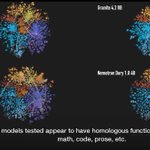
Cool finding! almost as if we're just packing knowledge into these things from the data we train them on


on the side I've been looking at structural homologies in LLMs and I'll tell you what I've found but only if you turn the sound on. or check out the website at qwen-neuron-map.pages.dev/


