

Content creator | AI researcher & builder | AI insights from 2030 | @beyond_xai
New York, USA
Joined May 2026
- Tweets2K
- Following100
- Followers54.7K
- Likes3.3K

Codez retweeted
T3 Code founder just shared his personal setup for building agentic teams with Grok Bot + Opus 5.5
one Grok Bot runs your whole fleet of machines. Opus 5.5 does the coding. you only approve
how:
→ Grok Bot gets one MCP link to T3 Code
→ you give it one rule: code goes to Opus 5.5
→ it spins up threads on every machine you own
→ works from your phone, even with the laptop closed
save the video, here's the guide:
• step 0 → what it is:
Grok Bot = always-on agent with its own cloud computer
T3 Code = open-source control plane for coding agents. free, runs on your machines, uses your subscriptions
• step 1 → the stack:
- Claude $100 plan → Opus 5.5 for the actual code
- Grok Bot → the dispatcher that never sleeps
- T3 Code on every box you want it to control
• step 2 → connect the fleet:
run npx t3 connect on each machine. one command, free, no Tailscale needed
• step 3 → give Grok Bot the keys:
Settings → Environments → Copy MCP URL → paste it into Grok Bot, sign in with OAuth. it can now see every linked machine
• step 4 → the one rule Theo uses:
tell Grok Bot "call T3 Code with Opus 5.5 for any task where it is applicable"
code runs on your Claude plan, Grok Bot's limits stay free for planning
• step 5 → make it work:
- "spin up an Opus 5.5 thread on each machine to check disk & RAM"
- "go through these PRs and pick the best ones"
- "split the backlog, one thread per issue, each in its own worktree"
every thread gets its own branch. nothing merges without your approval
what to expect:
- 8 threads on 8 machines from one chat (Theo's demo)
- works over the internet, not computer use
- control everything from your phone
- T3 Code: $0. you pay for Claude + Grok Bot only
honest take:
this is a dispatcher, not magic. bad briefs still give bad PRs, and you still review every diff. the win: your agents keep working while you're away from the desk
Save it so you don't lose it.
then read the full guide on building AI agent teams in T3 Code in the article below ↓

T3 Code founder just shared his personal setup for building agentic teams with Grok Bot + Opus 5.5
one Grok Bot runs your whole fleet of machines. Opus 5.5 does the coding. you only approve
how:
→ Grok Bot gets one MCP link to T3 Code
→ you give it one rule: code goes to Opus 5.5
→ it spins up threads on every machine you own
→ works from your phone, even with the laptop closed
save the video, here's the guide:
• step 0 → what it is:
Grok Bot = always-on agent with its own cloud computer
T3 Code = open-source control plane for coding agents. free, runs on your machines, uses your subscriptions
• step 1 → the stack:
- Claude $100 plan → Opus 5.5 for the actual code
- Grok Bot → the dispatcher that never sleeps
- T3 Code on every box you want it to control
• step 2 → connect the fleet:
run npx t3 connect on each machine. one command, free, no Tailscale needed
• step 3 → give Grok Bot the keys:
Settings → Environments → Copy MCP URL → paste it into Grok Bot, sign in with OAuth. it can now see every linked machine
• step 4 → the one rule Theo uses:
tell Grok Bot "call T3 Code with Opus 5.5 for any task where it is applicable"
code runs on your Claude plan, Grok Bot's limits stay free for planning
• step 5 → make it work:
- "spin up an Opus 5.5 thread on each machine to check disk & RAM"
- "go through these PRs and pick the best ones"
- "split the backlog, one thread per issue, each in its own worktree"
every thread gets its own branch. nothing merges without your approval
what to expect:
- 8 threads on 8 machines from one chat (Theo's demo)
- works over the internet, not computer use
- control everything from your phone
- T3 Code: $0. you pay for Claude + Grok Bot only
honest take:
this is a dispatcher, not magic. bad briefs still give bad PRs, and you still review every diff. the win: your agents keep working while you're away from the desk
Save it so you don't lose it.
then read the full guide on building AI agent teams in T3 Code in the article below ↓
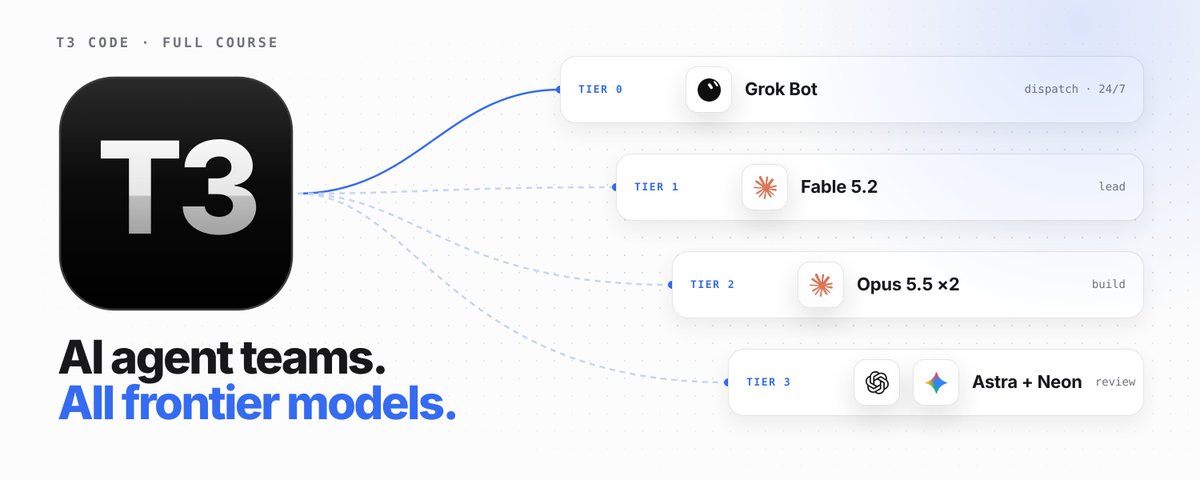
T3 Code is the MOST underrated AI dev tool right now
It runs Fable 5.2, Opus 5.5, GPT-6.2 Astra and Gemini 4 Neon as one team. Grok Bot feeds it work 24/7
In this full course: how to build it in 6 steps with 14 prompts
Codez retweeted
Paradigm CTO just dropped his playbook for building “Effective Agent Swarms” for models like Opus 5.5.
Ask big → Run in the cloud → Get out of the way
this is a 10-step blueprint on how to make your codebase and your workflow swarm-ready:
> step 1 → be unreasonably ambitious:
rewrite the dependency that slows you down, build a database tailored to your workload.
his team rebuilt Tempo in 5+ languages in days
> step 2 → move your agents to the cloud:
real work runs 24/7 and won't fit on a laptop.
ask your agent to set up a durable cloud agent with Nanocode on Vercel, Cloudflare or Postgres
> step 3 → give targets, not chores: "Make this 10x faster" beats "optimize X".
Instead of "fix all bugs", have it differentially test against a reference and close every gap
> step 4 → run codebase-wide refactor prompts:
• encode implicit state machines in the type system
• swap shared state for lock-free actors,
• parallelize sequential async calls
• add OTel tracing to every component
> step 5 → do the simple thing:
frontier model + short prompt + well-set-up codebase, then step away.
skip custom plans, memory, compaction and skills, because every model cycle wipes them out
> step 6 → remove what distracts the swarm:
delete code comments, .skills and docs/ folders. Agents read the code for you anyway
> step 7 → replace unit tests with simulation:
ban agent-written unit tests in AGENTS.md and add deterministic simulation tests so agents hunt bugs and never repeat them
> step 8 → own your stack:
monorepo everything and rewrite risky dependencies TigerStyle to cut supply-chain risk
> step 9 → let the swarm become your controversial:
push to master through a merge queue.
the agent thread is the new pull request, and testing, benchmarks and releases run on the same infra as your agents
> step 10 → flip how you interact:
stop pinging agents and let them ping you. an inbox with one decision at a time, a loss-curve UI for perf work, an infinite canvas for parallel ideas
find the full setup from Paradigm below, then…
send this thread and the article below to your Claude Code and ask it to setup your first agents swarm.
Codez retweeted
Grok Bot is f*cking insane for building a second brain...
send this prompt to Grok Bot and it turns everything you read, watch and think into a knowledge base that organizes itself
then go even further with the full guide below:

Codez retweeted

Meet Higgsfield GPU Harness in Claude.
Rent on-demand GPUs in Claude via Higgsfield MCP to render, run open-weight models and train LoRAs.
Run multiple AI agents work on your professional apps in the cloud at once, from any device.
Black Friday deal, live now: get up to 63% off.
Grok Bot is f*cking insane for building a second brain...
send this prompt to Grok Bot and it turns everything you read, watch and think into a knowledge base that organizes itself
then go even further with the full guide below:
Codez retweeted

Fable 5.2 built this exact replica of Shibuya in 12 hours. It even generated NPCs and simulated their behavior.
EVERYTHING was done an an iPhone... using 8x NVIDIA L40S GPUs through Higgsfield GPU Harness.
My Manhattan render took a week. This one took 2 hours.
It’s fucking nuts.
🤝 Paid partnership

Codez retweeted
GrokBot team just dropped a free 1-hour workshop on building your own AI team with bots from 0% to 100%:
“Grokbot will automate anything for you if you know how to teach it.”
• 10% → 8:58 - how to teach your GrokBot
• 30% → 12:42 - Dr. Eggbot: the bot that builds bots
• 55% → 23:38 - 3 bots run your meeting follow-ups
• 80% → 40:56 - one bot found over $100K in savings
• 100% → 53:09 - how to build skills for GrokBot's
most people write their bot a 10-page prompt - the team onboards it like a new hire and lets it learn on the job
watch it today - then read the full GrokBot playbook below ↓
Codez retweeted
These 20 GitHub repos will turn your Grok Bot into your most productive team ever
This is f*cking gold.
Skills. Team. Plan. Memory. Tools.
01 / Lauren Tan's noodle → Orchestrate agents using skills.
github.com/poteto/noodle
02 / mattpocock/skills → Skills for real engineers, straight from his .agents directory.
github.com/mattpocock/skills
03 / agent-skills → Production-grade engineering skills for AI coding agents.
github.com/addyosmani/agent-…
04 / superpowers → An agentic skills framework and dev methodology that works.
github.com/obra/superpowers
05 / Vercel agent-skills → Vercel's official collection of agent skills.
github.com/vercel-labs/agent…
06 / awesome-agent-skills → 1000+ curated skills from official dev teams and the community.
github.com/VoltAgent/awesome…
07 / Gas Town → Multi-agent workspace manager.
github.com/gastownhall/gasto…
08 / gstack → 23 opinionated tools: CEO, designer, eng manager, release manager.
github.com/garrytan/gstack
09 / BMAD Method → Agile, AI-driven development for agent teams.
github.com/bmad-code-org/BMA…
10 / grokbot-field-notes → Rules, playbooks and bot roles from a 72-hour Grok Bot live build.
github.com/unicodef1wn/grokb…
11 / Spec Kit → GitHub's toolkit for spec-driven development.
github.com/github/spec-kit
12 / Task Master → AI-powered task management you can drop into your agent.
github.com/eyaltoledano/clau…
13 / AGENTS.md → A simple, open format for guiding coding agents.
github.com/agentsmd/agents.m…
14 / Beads → A memory upgrade for your coding agent.
github.com/gastownhall/beads
15 / mem0 → The memory layer for AI agents.
github.com/mem0ai/mem0
16 / Context7 → Up-to-date docs for AI agents.
github.com/upstash/context7
17 / npx skills → The open agent skills tool.
github.com/vercel-labs/skill…
18 / Composio → 1000+ toolkits with auth and tool search.
github.com/ComposioHQ/compos…
19 / GitHub MCP Server → GitHub's official MCP server.
github.com/github/github-mcp…
20 / Firecrawl → Search and scrape the web for your agents.
github.com/firecrawl/firecra…
Skill → plan → team → memory → ship.
Bookmark this. Go build a team worth managing ↓
Codez retweeted

We built Higgsfield Miracle to address one of the biggest challenges in AI video: editing a specific part of a shot without changing the rest.
Powered by GPT-6.2 Astra, it splits any video into layers for pixel-level editing in real time, with world knowledge built in. Every shot keeps the image depth that cinema-grade post-production needs.
Now in private beta with select testers. Coming soon to Higgsfield MCP.
Set up Higgsfield plugin in ChatGPT to be the first to try it.
NVIDIA, AMD and Intel fight over every AI chip sold.
Last week all three signed up for the same open source project.
SGLang Summit, Nov 12, San Francisco:
→ SGLang Consortium: NVIDIA, AMD, Google, Meta, Intel, Thinking Machines Lab, Cloudflare, Modal and RadixArk join the maintainers to shape the roadmap
→ SGLang v1.0: built to run models in production at scale
→ SGLang now runs on AWS Trainium, co-developed with AWS Annapurna Labs
→ RadixArk x Intel: SGLang optimized for Intel CPUs, GPUs and accelerators, contributed back to open source
→ Miles v0.2: RL training on NVIDIA and AMD GPUs, early Google TPU support
Why would rivals agree on anything?
Because nobody wins if the software that runs the models belongs to one of them.
The chip war is still on. Inference just became neutral ground.


2,000+ people. Two days. The first SGLang Summit.
Together, we announced SGLang v1.0, released Miles v0.2, and launched the SGLang Consortium with nine founding members: @nvidia, @AMD, @intel, @Google, @Meta, @thinkymachines, @Cloudflare, @modal, and @radixark.
SGLang is now used by 332 organizations. At Meta, it powers production inference for products serving billions of users. Teams from Modal, Cloudflare, LinkedIn, and others shared their production lessons.
Across 90+ technical talks and six hands-on workshops, the community explored what comes next for inference, reinforcement learning, and AI agents.
To everyone building, deploying, and contributing: thank you for making this possible.
Explore the announcements, engineering lessons, and moments from SGLang Summit 2026 in the link below.

Codez retweeted
GPT-6.2 Astra is LIVE on Higgsfield.
OpenAI’s new frontier model for your most demanding projects.
With Higgsfield plugin, GPT-6.2 Astra powers proactive multi-agent workflows across design, coding, and creative production.
Join Higgsfield with up to 65% off for Black Friday.

Some of you have been asking very politely. Some of you have just been asking.
GPT-6.2 Astra and Sol are now available.
Super efficient and built to perform where it counts—the real world.
openai.com/index/introducing…
Codez retweeted
GrokBot team just dropped 1-hour workshop on running your work with AI agents from 0% to 100%:
“GrokBot is not a chatbot”
• 10% → 0:57 - how GrokBot team manage usage limits
• 30% → 6:41 - how to build skills for GrokBot
• 55% → 10:41 - building Chief of staff agent
• 80% → 12:48 - GrokBot orchestrator for Cursor agents
• 100% → 27:01 - how to replace your software with bots
most people still ask it questions like a chatbot - the team runs it as a teammate that directs other agents
watch it today - then read the full GrokBot playbook below ↓