

OpenAI’s mission is to ensure that artificial general intelligence benefits all of humanity. We’re hiring: https://www.nitter.gq/t.co/dJGr6LgzPA
Joined December 2015
- Tweets2.3K
- Following4
- Followers5.6M
- Likes2.6K






How AI is helping scientists uncover new leads for understanding and treating neurodegenerative diseases—and the brain research behind our collaboration with @perturbai_tx and @scrippsresearch:

GPT-Rosalind surfaced a new lead for drug discovery: could restoring cholesterol transport protect neurons from degeneration?
DCTN1 is a gene linked to Perry syndrome, a rare neurodegenerative disorder. In mouse-brain data, disrupting it increased expression of genes involved in making cholesterol. GPT-Rosalind suggested a possible explanation: cholesterol may not be reaching where neurons need it.
That gives scientists a specific mechanism to test and, if confirmed, a direction for developing new treatments for neurodegenerative disorders.
With @perturbai_tx and @scrippsresearch, a team of thousands of GPT-Rosalind agents worked in parallel, connecting gene-expression results from millions of mouse brain cells with scientific literature in just 32 minutes. We’re now expanding this collaboration to identify new drug targets.
openai.com/index/scaling-ai-…

Distillation can reproduce powerful AI capabilities without the safeguards built around them.
We’re sharing new research on our work to combat distillation of our models, how these capabilities transfer, and how we detect and disrupt coordinated attempts.
These findings are helping us sharpen our defenses and support safeguards across the industry.
openai.com/index/combatting-…

Now in beta: Businesses in ChatGPT.
Claim your business, manage your information, and get insights on how people engage with you.
Eligible businesses can also build a Business Agent to answer customers’ questions and help them explore what you offer.
openai.com/index/introducing…
Use Business Hub to shape what customers see about your business in ChatGPT.
Once verified, you can create a Business Agent, update your business details, and add product feeds with current pricing and availability.
You can also see aggregated insights on mentions, website clicks, and common topics in conversations where your business is cited.
We don’t share people’s conversations or Business Agent chats with businesses.
Eligible businesses located wherever ChatGPT is available can get started by claiming their business in Business Hub.
openai.com/business/business…

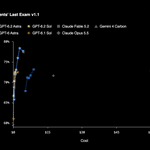
MedChemBench is a new benchmark for AI reasoning in medicinal chemistry.
It shows the progress our frontier models have made in their ability to help scientists use AI to identify promising drug candidates.
openai.com/index/introducing…
We're sharing new data on how AI is changing research at OpenAI.
We find researchers' AI use continues to rise exponentially, and agents are completing longer tasks, but human involvement remains central in research. Researchers are also spending more time on safety and alignment, with human effort in these areas growing faster than in any other individual research area.
This report aims to increase transparency around research acceleration and inform the governance of increasingly capable AI. We believe that AI labs should be required to track and publicly report indicators of recursive self-improvement (RSI): the process by which AI accelerates the development of future AI systems.
Our hope is that this expanded report will help sustain and advance shared measurement norms across the industry.
openai.com/index/research-ac…

We’re sharing how we approach safety at every stage of a model’s lifecycle, from early research to internal use to public deployment.

A lot has happened in the past couple months, to say the least.
Today we are sharing a recap of what it takes to move a frontier model from training to internal use to public release. As model capabilities rise, so do the safety and alignment standards required to move forward to the next stage.
To meet these standards, we rely on four layers of protection:
1. Model alignment: train models to reliably act as intended and respect human oversight.
2. Security and sandboxing: restrict what models can access and affect.
3. Blocking safeguards: stop harmful or unauthorized actions before they happen.
4. Monitoring and response: detect concerning behavior and intervene.
The post brings together efforts from across the company, with links to recent research, technical work, and incident reports we’ve published. This is the baseline operational discipline we owe people as we continue training and deploying models - necessary work, but not a solution to alignment in the limit. There’s a lot more to do, and will continue keeping you informed as the thinking and work evolves. 🏗️
openai.com/index/managing-fr…

Working with @AMD, our models identified up to 14% PPA improvement on flagship GPU IP in less than five months—building on designs AMD’s engineers had already spent years optimizing.
The same approach helped improve Jalapeño, our first custom inference chip, with gains verified on real silicon.
New evaluations also show our models getting better at certain chip design tasks.
We’re sharing these results and how we’re working with @Synopsys to bring our model capabilities and their trusted EDA design and validation tools to more chip designers.
openai.com/index/advancing-c…


Some of you have been asking very politely. Some of you have just been asking.
GPT-6.2 Astra and Sol are now available.
Super efficient and built to perform where it counts—the real world.
openai.com/index/introducing…
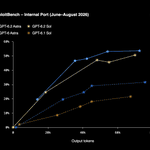
GPT-6.2 Astra is our most capable model ever for cyber. It jumps 22 points over GPT-6 Astra on ExploitBench Internal Port.
Due to increased capabilities, we’re launching GPT‑6.2 Astra and Sol with tighter safeguards for higher-risk cybersecurity assistance. We are working to bring these models to Daybreak so approved defenders can access them with reduced refusals.

Starting today, GPT-6.2 Astra and Sol are available in ChatGPT Work and Codex for Plus, Pro, Enterprise, and Edu users.
Pro 500 subscribers can use Ultrafast with either model. For the first time, we’re also bringing Ultrafast to Pro 200 subscribers, starting with GPT-6.2 Sol.
Developers can access gpt-6.2-astra and gpt-6.2-sol in the OpenAI API, with Ultrafast available.
ChatGPT for Healthcare is advancing with more capable computer-use agents, stronger clinical answers, and 20+ new healthcare plugins.
@AbridgeHQ, @AmbienceAI, @Cigna, @CVSHealth, and other leading healthcare organizations are putting our models to work across prior authorizations, referrals, discharge planning, and patient outreach.
Together, these advances connect medical evidence with practical help across the tools teams already use—so they can spend less time navigating systems and more time caring for patients.
openai.com/index/advancing-c…
Scientists reported nearly doubling their productivity with AI in our study of more than 1,800 participants in the ChatGPT for Academic Researchers program.
Using privacy-preserving methods, we looked at how they use ChatGPT across their work—from developing ideas to analyzing data and writing code—and what it could mean for scientific discovery.
openai.com/index/science-at-…
We’re expanding free access to our frontier models for up to 200,000 scientists worldwide, with training and support.
Applications open Nov. 23. By default, we don’t use data shared through the program to train our models.
openai.com/index/expanding-c…

We’re working with @ApolloResearch, @METR_Evals, @TransluceAI, and @GoodfireAI on embedded assessments: giving outside experts deep access to our internal models and systems to investigate alignment and test our safeguards.
These assessments build on our ongoing alignment and safety research, bringing independent scrutiny to how we identify and manage risks in our systems.
openai.com/index/our-first-p…

@TransluceAI will assess our post-training alignment evaluations, examining their quality and coverage.
They will develop additional tests and recommend improvements to address gaps in what we test for, and intend to expand our pilot in 2027.
@GoodfireAI will embed interpretability researchers to use their platform to analyze our models’ internals.
Their work focuses on training run monitoring, debugging, and alignment, helping our researchers identify and make safety improvements.