

Open infrastructure for building cloud software factories
Joined June 2021
- Tweets3.4K
- Following2
- Followers59.8K
- Likes4K



Warp retweeted

You version your code. What about the system writing it?
@zachlloydtweets of @warpdotdev on factories as code, recorded agent runs, evals on your own data, and improvements shipped as PRs.
From AI Engineer Code Summit.
Watch: youtu.be/0LeT996Hz3E

Warp retweeted

It feels like software engineering got replaced with... 20% management and 80% code review this year.
If you think engineering is just implementation, this is accurate. But that's not all there is to engineering! There's so much on the systems design side, the factory engineering, that's worth solving now:
- Planning: When should the agent involve humans to draft a plan or proceed with implementation? What questions should it ask? What goes into a good product or technical spec?
- Implementation: Now that agents are writing code, how do we optimize the cost and quality of that code? What access permissions do agents have across secrets, MCPs, and skills?
- Review: How do we give agents the tools to verify their own work end-to-end before tagging us for review? How can agents assess the risk of a PR and include that assessment in the pull request to save humans time?
These are some of the most important problems for engineers to solve this next year.

Warp retweeted

Our team put together a great hands on introduction course for learning about and building your own software factory. For folks who are interested in getting hands-on with factories I highly recommend it: warp.dev/learn

Warp retweeted
After two years of rapid change in software development, we are again at a crossroads, with two competing visions for what the future might hold.
Vision one is software factories (e.g. Warp Factories), code-defined, closed-loop systems for continuously measuring and improving cloud coding agents. Software factories are developer infrastructure. Platform teams do “factory engineering” on them to optimize development across an entire product, getting the most productivity from agents while minimizing cost and improving quality. It’s a system design mindset for deploying agents.
Vision two is agent teams (e.g. Devin Bots). In this approach, individuals manage agents to orchestrate complex tasks. For example, you might have a “chief of staff” agent and ask that agent to do a coding project. It decomposes the project into subtasks that different agents take on (e.g. a designer, an implementer), reports on progress, and eventually ships. These teams can also have “always on” agents that proactively fix things, respond to events, and so on. Unlike with software factories, the user experience is more about “managing” agents, akin to how you might manage a person or a team.
Which one is better depends on how you conceive of the problem.
I view the problem as: how do you securely deploy coding agents to maximize product throughput and quality, while minimizing cost? I believe this is what businesses care about – there is this magical new technology for building software at scale and they want to make sure they are using it to get the biggest possible competitive advantage.
Put simply: this is an optimization problem. We have a new engineering primitive, the coding agent, and we want to use that primitive as well as we can.
Framing it in terms of optimization immediately leads to a need for measurement; after all, you can only optimize what you can measure. In order to get to measurement, you need reliable, standardized data. In order to get data, you need some amount of centralization and standardization, otherwise that data would be too noisy and heterogenous to do anything with. In order to centralize, you need to move to the cloud and define what a factory is in code. Your factory needs to be open and flexible so you have degrees of freedom for testing different models, harnesses and skills. You need ways of experimenting to see if different configurations perform better. And then you need to be able to feed those learnings back into the system, so it improves over time.
When you frame the problem clearly, the shape of the solution becomes much more obvious. Compared to agent teams, the factory engineering approach is much better suited to solving the optimization problem because it puts measurement, repeatability, and standardization at the center. It allows for a principled approach to improvement in the long run that is missing with agent teams. You want your factory to scale like an engineered system, not like an increasingly large organization (don’t make your agents work in a big company!).
The engineering approach is possible precisely because agents are not people; for the first time in the history of software development we can directly measure, grade and improve how code and products are shipped. We shouldn’t waste this opportunity by anthropomorphizing the technology and treating it like a teammate.
Also, wouldn’t you rather engineer an agent system than manage a team of agents? I’ve been both a builder and a manager for most of my career. You can guess which I prefer.
Warp retweeted
Software engineering is becoming factory engineering.
If you're new to that term, let's discuss:
- What problems a "factory engineer" tries to solve
- What a software factory loop includes
- How to use metrics to measure and improve your agent's quality

Warp retweeted
My definition of a software factory:
A measurable, improvable cloud-based system for scaling coding agents for maximum ROI and productivity across your organization.
Warp retweeted
I just wrapped up a keynote at @aiDotEngineer Code Summit on how Software Engineering is becoming Factory Engineering.
The core idea is this: using coding agents is an engineering problem, not a prompting problem. Every company should strive to define the system in code, measure what it produces on your codebase, and keep iterating.
Everyone has agents. The hard (and fun) part is engineering the factory around them so they reliably ship better software.

ALT Zach presents at the Code Summit, with a large audience and slides discussing software factory concepts and engineering innovations.

ALT Zach presents "The Factories Stack" diagram at the Code Summit, highlighting various stages of engineering and data management.

ALT Zach presents at the AI Engineer Code Summit, discussing software engineering’s evolution with a focus on coding agents.

ALT Zach presents at the Code Summit, showcasing a blueprint interface for engineering workflows on a large screen.
Warp retweeted
I recorded a session on addressing code review bottlenecks! Especially relevant if you're building a software factory. We cover:
- Building your own code review agent
- Verification with e2e computer use checks
- Risk assessment using /merge-risk
youtu.be/uPCH2axUpbc

Warp retweeted
I started having agents run a /merge-risk assessment skill as a last-mile step to catch risky changes before it makes a PR:
- Strip out unaligned changes to avoid drive-by fixes
- Add error monitoring on new paths for better tracking
- Break up high-impact changes into stacked PRs for simpler review
- Avoid code sensitive paths if it can achieve the same outcome
- And of course, verify work end-to-end with screenshots and recordings
Warp retweeted
I was talking to an engineer the other day about this question:
How do you make a codebase easy-to-navigate by both agents and humans, when everything from the hello world is agent-built?
The answer is system architecture. Agents (like humans) copy bad patterns like a virus. It's a ball of clay that needs constant reshaping.
You can write down best practices into your factory's skills, yes, but keeping the codebase itself on the right path is the real goal.
It's too expensive to have an agent review the universe constantly, spitting out architecture change PRs no one wants to look at. But, say, a weekly automation with a frontier reasoning model (Fable 5.2 is a good one to try) that pulls out one improvement to your system architecture is a start. I like @steveruizok's prompt to "look for implicit state machines."
Will experiment with a factory automation like this and see how it goes.


Warp retweeted
Get code review agents off of GitHub! I don't want to see the noise in my PR description.
Agents should run through their own internal code review process before a PR ever reaches a teammate.
Warp retweeted
Lots of discussion about what a "software factory" is.
Also useful to call out what a software factory is not:
1/ A loose collection of automations around cloud agents
2/ A team of "AI Engineers" that developers manage interactively
3/ A set of skills and MCPs that individual engineers all adopt across a team
4/ A personal agent swarm
These are all useful things, but they aren't the right primitives for engineering scalable agent systems across an organization.
The right primitives allow you to define all your agentic workflows in code, run them entirely in the cloud, and, crucially, measure, test and improve those workflows over time to maximize agent productivity while minimizing cost.
If you start thinking from first principles "what is the system we should build as a company to get the most out of coding agents" you will end up with something like this.
Warp retweeted
I'll be live in just a moment to talk code review bottlenecks! We'll break down:
- Code review loops and how to benchmark their usefulness
- End-to-end verification skills
- A /merge-risk skill to mitigate risk ahead of PR
RSVP to join: warp.dev/events/solving-the-…


Warp retweeted
Inspired by @poteto I benchmarked Warp's factory to see if adversarial code review was worth it.
On the task set I checked it increased cost by 140% while moving quality up by 7.5%. So, probably not, although maybe for really impt changes (many caveats here, you should watch the video if curious).
I still believe though that benchmarking is 100% the right approach and everyone should try to set up a factory where they can measure rather than go on vibes.

Warp retweeted
It's worth building your own verification tools for agents: code review loops, e2e simulations, and merge risk checks.
I'll be hosting a live session next week to build these together!
Tue, Nov 10th at 2pm ET
RSVP: luma.com/warp-daxp

Warp retweeted
Your team should have a shared configuration for your agents that lives in code. The same way you use Terraform to deploy cloud infrastructure, you use a factory configuration to deploy your software factory.
This gives you the typical advantages of version controlled systems: check in changes with code owners, test changes with rollback support, and review updates as diffs.
Warp retweeted
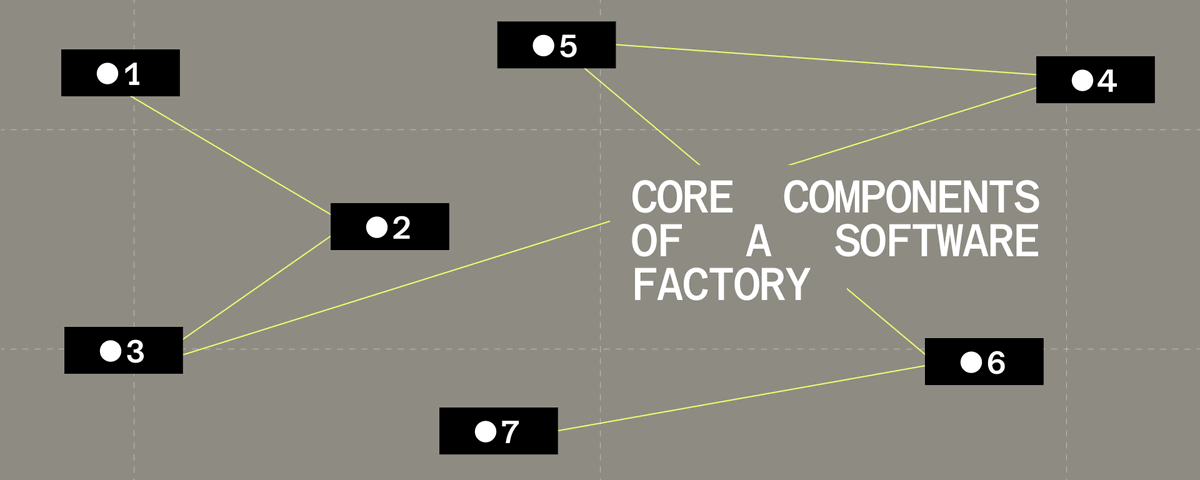
We've landed on 7 core components to building a good software factory. Here's the full overview:
Warp retweeted
There are many ways to define “software factory”, and here’s the one we’ve settled on: centralizing your system of agents into one place to build software. This means going from custom coding setups on everyone's machines to a single definition in code that runs in the cloud. The same way engineers agree on CI, we should agree on how agents are run.
Why is this important? Better security management, better ROI tracking, and mainly, improving agent efficiency as a team – instead of copying config to everyone’s local setups and trying to manage individual skill sprawl.
Warp retweeted
On Friday, we became aware of what we believe to be an active and narrow-banded exploitation of a vendor in Warp's infrastructure. We detected the operation within hours and were able to remediate and mitigate the impact. We have been in touch with the vendor about the vulnerability.
Everyone who uses Warp places a lot of trust in us and that’s not something we take lightly. I’m very sorry that this incident has occurred.
The attack appears to have come from an agent swarm using a very sophisticated penetration and escalation technique, likely starting with a hole in a vendor dependency, and ultimately accessing a limited amount of agent trace and telemetry data.
We have been working over the weekend and we have notified anyone who we have positively identified as impacted. As of today, we believe an upper bound of roughly 1% of Warp users may have been impacted.
We are working closely with the team at Crowdstrike to do a more extensive and comprehensive investigation and have engaged law enforcement.
Anyone who has been impacted will receive instructions from us on action they need to take. We will continue to post updates as we learn more.