

Helping thousands of clients secure 100,000+ bitcoin—providing white-glove service to help you manage your bitcoin wealth since 2016. ✉️ [email protected]
Austin, TX
Joined November 2016
- Tweets10.7K
- Following864
- Followers58.3K
- Likes8.7K




Pinned Tweet
Today we launched the Bitcoin Security Stress Test.
Pick a custody setup, throw incidents at it, and see what survives.
Here's what happens when your custodian gets hacked, and how it compares with other custody approaches.
unchained.com/custody-stress…

A new analysis by @bitschmidty suggests a majority of bitcoin nodes are running software affected by one or more bugs.
"If you run a node, check your version. 32.1, 31.3 and 30.5 are the releases with every published fix."

How out of date is the Bitcoin network?
I lined up Bitcoin Core's security advisories against a Bitnodes snapshot from this morning.
The short version:
- 59% of reachable nodes (about 12,800) are missing the October 27 fixes for two bugs that let peers exhaust a node's memory
- 16% (about 3,450) are on 28.x or older, without the fix for a high-severity crash
- About 500 on 24.x or older can be crashed by any peer with a few messages.
Apart from the 28.x crash, no hashpower/mining is needed. Any peer that can connect to your node can execute these.
Today added one more. Bitcoin Core 31.3 and 30.5 shipped this morning alongside the disclosure of CVE-2026-117348 (medium, easily discoverable). A peer can freeze your node for over a dozen seconds at a time (~Raspberry Pi nodes, even longer), again and again, by spamming announcements for one orphan transaction.
Nearly all of these crash, stall or slow down a node. None is a known way to steal coins. A stall is milder than a crash for one node, but it costs an attacker almost nothing to repeat. Someone who connects to every reachable node and stalls them all, over and over, degrades block and transaction relay for the whole network.
Below, I list what vulnerabilities each version is exposed to. Each version also has the bugs listed under the newer versions above it (sans a few that only exist in newer code). Today's bug, for example, starts at 29.0. Knots is counted by the Core version it is built on.
On 29.x, 30.x or 31.x, and not on 31.3 or 30.5? (12,004 nodes, 55%. 31.3 and 30.5 came out today.)
- A peer can freeze your node, over and over, by spamming announcements for one orphan transaction (CVE-2026-117348, medium).
Not on at least 32.1, 31.2, 30.4 or 29.5? (12,820 nodes, 59%)
- A malicious peer can make your node queue announcements for it forever, slowly eating memory (up to 2MB per hour per connection) until it runs out (CVE-2026-117349, medium).
- On macOS, Windows and BSD, a peer can run you out of memory with TCP urgent data (CVE-2026-117350, medium).
29.x (4,697 nodes, 21%; 8,146 or 37% on this line or older)
- A peer can stall your node for a few seconds at a time, as often as it likes, with crafted invalid transactions. That can delay block propagation (CVE-2025-46598, low).
- On 29.0 and 29.1, a peer can hold up your block processing for 10 minutes at a time with a tampered compact block (CVE-2025-62859, medium).
- On 29.0 and 29.1, miners can get stuck unable to build block templates after a reorg until restart (CVE-2025-62861, high).
28.x (1,370 nodes, 6%; 3,449 or 16% on this line or older)
- An attacker who mines a block can crash your node through a memory bug in script validation. Code execution is called unlikely but not ruled out (CVE-2024-52911, high).
- Every 28.x also has the stalls and memory bugs listed above, apart from today's orphan stall. That includes the compact block stall on all of 28.x, since its fix was never backported.
- 28.0 to 28.2 have the TRUC reorg bug.
25.1 to 27.x (662 nodes on 27.x, 601 on 26.x, 131 on 25.1 to 25.2; 6% together, 2,079 or 9.5% on these lines or older)
- Same as 28.x minus the TRUC bug. Nothing new has been disclosed for these lines yet. Medium and high issues fixed in 31.0 and 32.x stay under embargo until the older lines go end of life.
25.0 and older (685 nodes, 3%)
- A peer can delay your blocks about 10 minutes at a time by announcing and then withholding them (CVE-2024-52922, medium).
24.x and older (494 nodes, 2.3%)
- A single peer can crash you with a few crafted compact block messages (CVE-2024-35202, high).
- Mutated blocks can clear your download state and delay blocks (CVE-2024-52921, medium).
- Heavy transaction traffic can choke the node's ability to talk to peers (medium).
22.x and 23.x (183 nodes, 0.8%; 359 or 1.6% on these lines or older)
- A peer can crash the node by feeding it a long chain of low-difficulty headers. Building the chain costs a small fraction of mining one block, and it can be reused against every node (CVE-2019-25220, high).
0.21 and older (176 nodes, 0.8%)
- A peer can crash the node by spamming addresses (CVE-2024-52919, high).
- 0.20 adds a netsplit via timestamp manipulation and transaction censorship by a single peer.
- 0.15.0, 0.15.1 and 0.16.0 to 0.16.2 have the inflation bug (CVE-2018-17144).
How hard are these to pull off?
Most need no mining and no reorg, just a connection to the victim node. None of those require much skill to pull off, and an LLM will write the script from the advisory text.
Every version, including 32.1, has bugs nobody has found yet. But LLM-driven vulnerability scanning over the past year or so has been pointed almost entirely at current code, and I'm not aware of anyone running it against old releases. Old releases contain code that has since been rewritten or removed, so a bug that lives only there has never been through that scanning and has no fix coming. The reverse is also true. A bug introduced in newer code is not in the old releases, and today's CVE is an example, since a 28.x node does not have it. Version diversity limits the blast radius of an undiscovered bug in 32.x. The difference is that the bugs in old versions are known, and anyone who can connect to the node can trigger a bunch of these.
What about Knots? Knots is a Core fork, so the above applies by the Core version it is built on, in theory.
If you run a node, check your version. 32.1, 31.3 and 30.5 are the releases with every published fix.

NEW: Spiral, which has funded bitcoin projects since 2019, is offering grants for open-source AI projects as well.
“[Our] world needs open money, but it needs open intelligence to go with it.”

Open intelligence needs all the help it can get.
Spiral has $$ to fund non-commercial open source AI projects that make intelligence more useful, open, and secure. We’re looking globally.
Apply for a grant: spiral.xyz/grants/
Read more ↓

2
4
1,563
NEW: Progress on bitcoin’s quantum defenses.
@kudinov_mikhail of @blksresearch has released a draft security analysis of SHRINCS, a proposal to protect bitcoin transactions from future quantum attacks. Independent review is still needed.

Unchained retweeted

If you want to understand the attacks happening on the Internet right now you should read "The Stars My Destination" by Alfred Bester.
In "The Stars My Destination" people have the ability to "jaunt" -- to teleport up to 1000 miles instantly at no cost to any location they can visualize. The world is completely changed by the advent of jaunting.
Continuous, round-the-clock crime waves circle the world as criminals jaunt to stay in perpetual darkness. Law enforcement becomes ruthless and abandons due process in attempt to keep society in order. Banks and other places that require physical security become labyrinths to prevent people from visualizing their interiors and jaunting in and stealing things. No one feels safe in their homes. There are no such things as good neighborhoods anymore because the entire world is connected and attackers can jaunt into your living room in an instant, for free. What a terrible world to live in....
Thankfully, in the real-world, we can't teleport! The simple fact that moving material things in our physical world costs money, requires energy, and takes time means that we are immune to the terrors of "The Stars My Destination".
Except online. On the Internet, we're jaunting all the time. You're doing it right now. Your phone jaunted through cyberspace and fetched this tweet for you to read. It a minute your phone will jaunt somewhere else, perhaps so you can read an article, or check the bitcoin price. And all these jaunts were instant and free.
The Internet is becoming an increasingly dangerous place because it was designed for the convenience of digital jaunting without considering the consequences of constant, instant, and free communication. We cannot simultaneously get all our content and services instantly for free and not expect attackers to jaunt in take advantage.
If we want to keep the Internet but avoid the dystopia of constant online crime, labyrinthine computer security, and the degradation of our rights and our privacy by our well-meaning protectors, then we need to attach at a *cost* to online communication. We must make moving through cyberspace more like moving through physical space. No more jaunting for free.
If we pay for the Internet, for each network request, with money rather than attention, then we will create a much needed distance on the Internet between attackers and us. This distance is not measured in meters, but in money, and its presence will allow us to build and defend good online neighborhoods, just as we are accustomed to doing in the physical world.
And, do I even need to say it? Fine, I will: BITCOIN.
NEW: The Bitcoin Policy Institute (BPI) has expanded into the Finney Foundation for Open Technology.

The Finney Foundation’s remit includes the full range of open technology: from open source AI to digital cash and encrypted messaging. Bitcoin remains a primary focus, and our Bitcoin programming under the BPI moniker will only expand.
As BPI does for Bitcoin, Finney will make the case in Washington that individuals should control the tools on which they rely, and that American strength comes from building in the open. We will champion open source software, privacy tools for all, and an optimistic vision of machines that serve their users, not corporate or state authorities.
The Finney Foundation thinks around corners. We provide our leaders with novel research, policy ideas, and educational programs that will, in the words of our namesake, make the computer a “tool to liberate and protect people, rather than to control them.”

Sv2 (@StratumV2) is gaining momentum, with several notable announcements in the past week from mining pools that make up ~35% of hashrate.
Sv2 can help secure mining connections, and further decentralize bitcoin by letting miners choose which transactions go into blocks.

While everyone was busy selling their Bitcoin to invest in the Anthropic IPO, Bitcoin showed huge momentum towards mining security and decentralization:
(a) Foundry announced testing of Sv2
(b) MARA mined their first block using Sv2
(c) Luxor announced they now supported Sv2
(d) P2PoolV2 beta is working well as a substantial portion of Testnet5 hashpower
While only the last one is an immediate mining decentralization win, supporting Sv2 in pool-work mode is an important first step towards miner Job Declaration and shows commitment by the mining industry to finally move forward, not to mention is a huge security upgrade for the entire Bitcoin system.
"I think what happens is: if the distribution mechanisms that we use to broadcast intellectual property become decentralized and peer-to-peer and pay-to-play, intellectual property itself dies. And that sounds terrifying, and anti-artist, but I don't think it is." - @dhruvbansal
1
3
1,542
If you want bitcoin to be a part of your long-term plan, consider where you hold it, too.
This November, your first year with an Unchained Bitcoin IRA is free. The first 21 clients also receive complimentary basic onboarding.
Use code BF2026 by 11/30:
my.unchained.com/sign_up
746
Unchained retweeted

The Binance security incident report mentions their hot wallet utilized MPC (multi-party computation) as a security method.
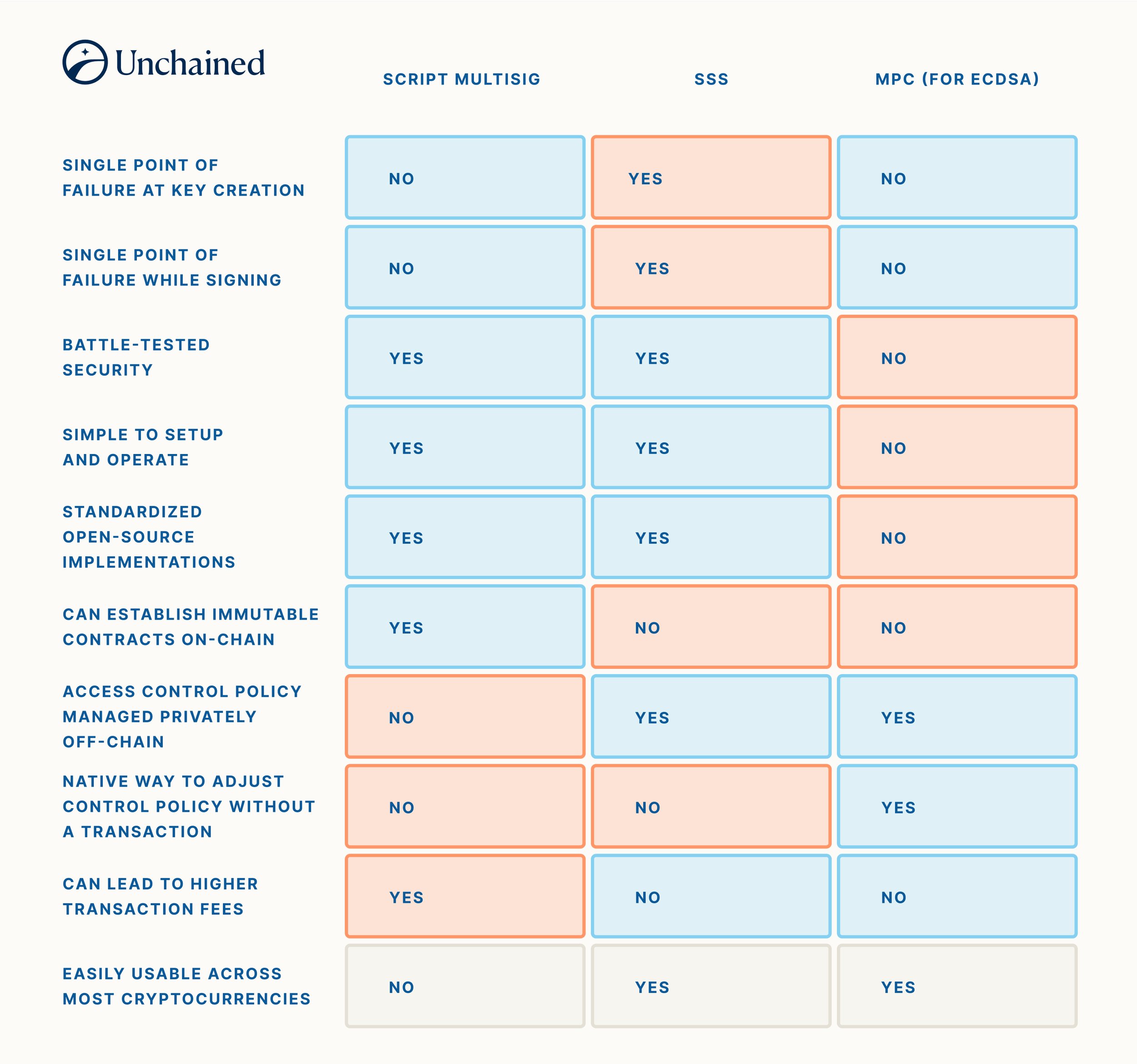
What's MPC? It's a way of creating threshold security, different from typical bitcoin multisig. With multisig, the threshold (e.g. 2-of-3) is enforced at the blockchain level, while MPC enforces thresholds at the key level.
This creates some tradeoffs. Keys can be used across different cryptocurrencies and blockchains, so MPC might be attractive to an exchange managing a bunch of altcoins, if they don't want to manage a separate setup for different coins. Operating at the key level also allows for more private management and security adjustments without public transactions.
However, MPC also sacrifices some of the simplicity, standardization, and transparency that can be achieved with script multisig. Multisig has proved robust for a longer period of time.
It's unclear whether MPC played a role in Binance's lost bitcoin, and I wouldn't make that assumption.
But some of the richest bitcoin addresses (controlling more than 550k BTC, or $40B) are attributed to Binance, and they all appear to be singlesig on the surface, while presumably utilizing MPC under the hood.
It could be interesting to see if they eventually decide to migrate those bitcoin balances to proper script multisig addresses (which MPC can optionally be used on top of).
Learn more about MPC, SSS (Shamir's secret share), multisig, and how they can be used together, here:
unchained.com/blog/mpc-vs-mu…

Satoshi Nakamoto built on contributions from various fields in the preceding years, many of which can be explored on the @NakamotoInst:
nakamotoinstitute.org/librar…
The video above pulls from this library, and was inspired by an original timeline image by @danheld.

If you participate in the tradition of reading the whitepaper today, you may be interested to take note of several errata that have been identified by @hrdng, as seen on the @NakamotoInst:
nakamotoinstitute.org/mempoo…

3
722
Unchained retweeted

This is probably one of the most wildly under-explored and under-implemented concepts in the space: unchained.com/features/bitco…
h/t @dhruvbansal