

An Adobe Company. Helping 28M+ marketers be found everywhere search happens
- Tweets215K
- Following10.7K
- Followers315K
- Likes38K






ALT A digital welcome card for someone named Robert, who is joining as a Senior Marketing Manager. The card includes a photo, start date, reporting line, and lighthearted facts about Robert - their favorite film is "Twilight" and they have a hidden talent of being a Gen Z despite being in their thirties. The text encourages people to say hi to Robert.

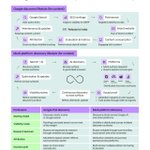
ALT Google multi-platform discovery infographic by SEMrush. It compares traditional Google-first discovery with multi-platform discovery, highlighting differences in starting model, visibility, research behavior, decision-making, and optimization focus. Features include search engines, paid search, and cross-surface visibility for Google-first, and AI discovery, multiple resources/apps, and personalized suggestions for multi-platform. Key concepts are search, AI, platforms, connectivity, and content distribution.


ALT Infographic titled "9 steps to get ahead in AI search in 2026" from SEMRUSH. It lists steps such as checking total search visibility, benchmarking AI performance, finding competitive gaps, discovering what people ask AI, monitoring brand sentiment, creating citation-worthy content, tracking helpful prompts daily, auditing for readiness, and reporting unified performance.

ALT Bar chart titled "Share of local searches with an AI Overview." - Round 1: 38%, same 8 markets. - Round 2: 66%, same 8 markets. - Round 3: 60%, same 4 markets. - Round 4: 99%, same 4 markets. Markets listed: Philadelphia, Phoenix, Worcester, Spokane, White Plains, Naperville, Thomaston, Marshall, Nashville, Toledo, Cedar Park, Cottonwood. Source: Semrush study of 480 local searches across 12 US markets. SEMrush logo at the bottom right.

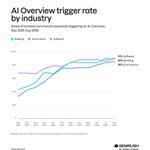
ALT Line graph titled "AI Overview trigger rate by industry" shows the share of tracked commercial keywords from Sep 2025 to Aug 2026. It features three colored lines: purple for Banking, blue for Ecommerce, and green for Software. The vertical axis represents percentages from 0% to 100%, and the horizontal axis spans months from Sep 2025 to Aug 2026. By Aug 2026, Software leads at 91%, followed by Banking at 89%, and Ecommerce at 85%. Source: Semrush. Logo at the bottom says "SEMRUSH An Adobe Company.

ALT A split-screen image displaying a Google Maps search result for plumbers. The left side shows a list of businesses with red location markers on a Toronto map. The right side highlights Royal Plumbing Services Ltd., featuring a collage of plumbing-related photos, contact information, a website link, directions, and reviews.

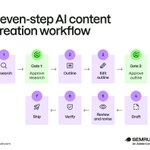
ALT The image depicts a flowchart titled "Seven-step AI content creation workflow" with steps in numbered order: 1. Research, 2. Outline, 3. Edit outline, 4. Draft, 5. Review and revise, 6. Verify, 7. Ship. Two green checkpoints labeled "Gate 1: Approve research" and "Gate 2: Approve outline" follow steps 1 and 3, respectively. The chart is branded with the SEMRUSH logo and a note "An Adobe Company" at the bottom right.


ALT This infographic compares Google Ads and ChatGPT Ads, presented in two columns. Key differences include search queries vs. user prompts, keyword signals vs. research prompts, and ad placement. Google Ads uses structured signals and direct ads, while ChatGPT Ads use conversational prompts and integrated content. The image highlights the need to understand audience needs, capture attention, test, and embrace creative strategies. The infographic is from SEMrush.

ALT Purple circle on the left with the text "Best CRM software for a distributed team?" Arrows point to the right side with a list of five queries: "Best enterprise CRM," "[CRM A] vs [CRM B] for enterprise," "CRM with data compliance," "CRM integrations with ERP," and "[CRM A] enterprise pricing.

ALT This image is an infographic by SEMrush titled "SEO has moved beyond your website." It outlines various stages of SEO focus with a curved timeline. Key phrases are highlighted, such as "Visibility = everywhere AI looks," "Content needs to engage," and "Backlinks drive content discovery." Visual elements include icons representing ecosystem, AI, creators, social, backlinks, SERPs, and websites. A purple line with markers connects these points, indicating progress and evolution in SEO strategy.

ALT A pyramid diagram titled "How content optimization drives SEO growth" with four levels. From bottom to top: "Content library" with text stating "Historic content forms the foundation"; "Content grounding" explaining it "Finds, validates, and prioritizes pages to optimize"; "Refresh engine" stating it "Applies updates to improve accuracy and performance"; and the top labeled "Refresh cycles" explaining it "Transforms outdated content into renewed relevance." The diagram includes the SEMrush logo at the bottom.

ALT The image is an illustrative diagram showing a topic cluster linking example by Semrush, an Adobe company. It includes a central pillar page titled "Interactive dog toys: The ultimate guide" with links to three cluster pages: "Tug toys," "Chew toys," and "Interactive toys." Each cluster page links to subtopics like "Interactive pet toys," "Sensory chews," and "Toys for high energy dogs.