

Princeton CS prof and Director @PrincetonCITP. Coauthor of "AI Snake Oil" and "AI as Normal Technology". https://www.nitter.gq/t.co/ZwebetjZ4n Views mine.
Princeton, NJ
Joined December 2007
- Tweets13.5K
- Following576
- Followers133K
- Likes25.8K




Pinned Tweet
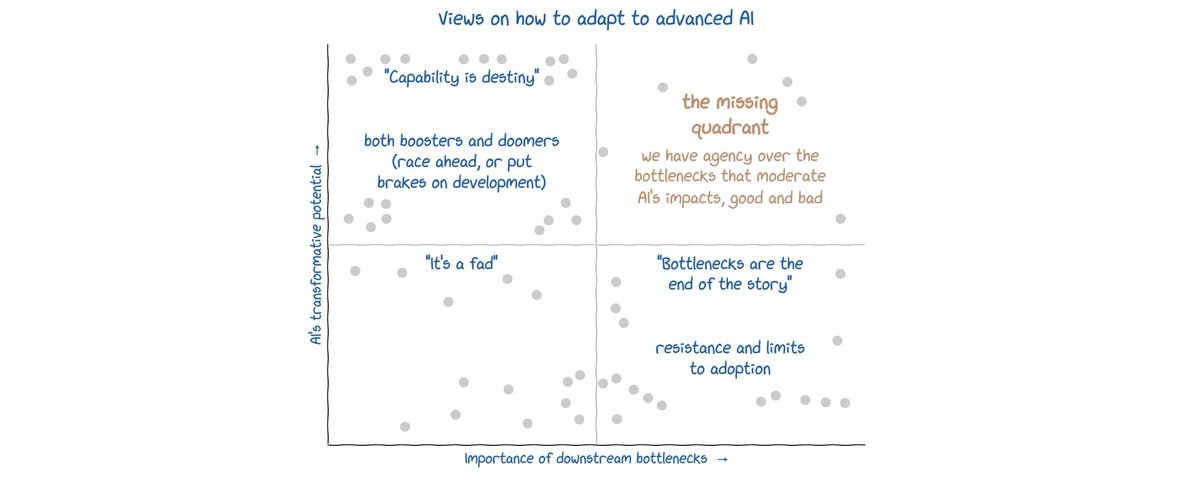
📢 We need more orgs that take AI’s transformative potential seriously *and* take downstream bottlenecks seriously. We have just launched STABL, and hope to lead by example. Read our launch essay below and check us out at stabl.ai.
The three of us have long felt that society’s responses to advanced AI are unproductively polarized. So we’ve decided to do something about it. Our work will have four pillars: Recursive Self Improvement, risks and resilience, steering AI’s economic impacts, and sectoral and professional adaptation.
We will bring our distinctive methods and approach to each of these workstreams. Our underlying worldview avoids the extremes that dominate the discourse, so building a movement and ecosystem around this work won’t be easy. But that is the task we have set ourselves and we are excited to try. The good news is that there are many others who share our views. The next step is to come together, better articulate our vision and agenda for research and action, and amplify each others’ efforts.

Steering AI's societal impact requires taking both AI development and downstream bottlenecks seriously.
Today @RishiBommasani @random_walker and I are starting a new non-profit: STABL @stabl_ai to guide societal adaptation and resilience to advanced AI.
Arvind Narayanan retweeted

Perhaps a good time to mention that my Tanner lectures on AI, with responses from @random_walker, Josh Cohen, Marion Fourcade and Renée Jorgensen and my reply are now out open access with Oxford University Press. So you can read about Power, Justice, and AI from a perspective that does *not* deny AI capabilities at your leisure: academic.oup.com/book/63611


I'd go even further. As Seth Lazar and others have noted, there was a lot of very energetic discourse policing in AI ethics/justice in that time that made it very difficult to engage with the (important!) ethics/justice/distributional issues posed by the bullish case for LLMs, and the impact of that went beyond the ethics community to broader researchers (especially early-career) who cared about ethics/justice without necessarily being part of that community.
As Kristian notes, that means a less rich diversity of perspectives in the companies, but also in academia. And now, several years on, academia is pretty impoverished for people who have built up a track record of research and credibility on frontier AI, but from an ethics/justice/power lens. And we have fewer experts to offer in terms of informing policy and holding companies to account on these matters.
I think this hurts everyone. For one example, increasingly the EAs have been trying to engage with exactly the kind of issues of power concentration and corporate oversight that their own epistemic backgrounds typically have prepared them poorly for (I have commented on a lot of well-meaning but unsophisticated materials in recent years), and where the ethics/justice community would have had more well-honed and battle-tested instincts and expertise to offer. And I think it's a real shame we didn't have that.
And there will be whole regions of the global majority world who should be properly represented in these conversations about frontier AI, where instead these topics basically got tabooed by the communities best-placed to support that happening. It's hard for me to see how the outcome of that will not be deepening the digital divide extensively.
(It's also true that EA-centric companies and organisations have also often been reluctant to hire/meaningfully engage outside their circles, but I know of too many bridging efforts that were shut down from the ethics/justice side).
Arvind Narayanan retweeted

New from me: The most important graphs in AI are wrong. Specifically, measures of the length of task AIs can autonomously accomplish are dramatically different than real-world data from inside OpenAI and Google. 🧵
rameznaam.com/p/the-most-imp…

Arvind Narayanan retweeted

"There are two different improvement loops that have been conflated, and they will come apart. The efficiency improvement loop will accelerate, but a broader improvement loop... will require ever-increasing amounts of compute, talent, data, and real-world feedback."

As AI labs race toward Recursive Self Improvement, there’s a possibility that what they are actually racing toward is Recursive Self Extinction — of their business model. Here’s my reasoning.
1. Progress on verifiable tasks continues. In particular, improving the cost efficiency of existing capabilities is a highly verifiable task. For the past few years, cost per equivalent capability has dropped by at least 10x per year. I think this progress will be sustained for a few more years, and even accelerate as labs use AI more and more heavily for AI research in the pursuit of RSI. There is of course a ceiling to efficiency improvements, but I don’t think we’re close to that ceiling.
2. Progress on most unverifiable tasks remains frustratingly hard. AI inherits the same limitations (ambiguous success criteria, slow and noisy feedback) that limit human performance at tasks ranging from writing to governance. The optimization paradigm generally doesn’t result in superhuman capabilities on such tasks, because whatever proxy you optimize for gets Goodharted. For example, I recently pointed out how over-optimization explains Claude’s overly dense and ornamental writing style that’s since been dialed back.
3. RSI ends up being narrow. A consequence of the above two points — even if some version of RSI is achieved, it results in an explosion in some dimensions (efficiency, verifiable tasks) while falling short of producing something that is superintelligent in any real sense or capable of automating a broad swath of jobs in the economy.
4. More than one lab stays at the frontier. This means the market will remain competitive, and developers can’t charge high margins to compensate for rapidly falling inference prices. Any compute scarcity that allows higher margins is temporary, in my view. I also think it’s likely that most of the innovations continue to make their way into open-weight models with some lag, so open-weight models are at cost parity for inference or only slightly more expensive. Note that efficiency tricks and verifiable capabilities tend to leak much faster than unverifiable ones. Distillation could be one reason, but simply knowing that something can be sped up 10x tends to have a focusing effect on research and innovation.
5. Jevons’ paradox is not a magic bullet. If the above points hold, there are very few applications that will consume so many tokens that they could generate the astronomical amounts of revenue implied by the labs’ valuations. We’re talking about a 10x growth in tokens year after year, just to keep revenue flat given falling prices.
Even today’s behemoth tasks like migration of million-line legacy codebases will likely become cheap within a few years. While new applications will open up, there won’t be orders of magnitude more new ones. As for unverifiable tasks, inference scaling rapidly hits diminishing returns. Ultimately you have to have a human in the loop who’s accountable for the result. Spending more on tokens doesn’t let customers escape that responsibility — and only makes the human review bottleneck worse.
6. What about scientific research? Science is an endless frontier, and more tokens could perpetually mean more discoveries and inventions, in theory. But the unfortunate thing about research is that researchers don’t get to capture the value it creates, which is why it requires government funding in the first place. Even if it’s true that AI could enable great scientific innovations, I don’t think AI companies will make much money off of that. I think they are currently investing in AI-for-science not as a future revenue stream but as a loss leader because they want to show the public that it could be beneficial to humanity.
7. The one escape hatch is moving “up the stack”, by which I mean quickly transitioning from selling tokens to an enterprise software like model that relies on high switching costs, deep integration into workflows, and control over systems of record. In this world, enterprises will purchase “digital workers” or pay per solution (e.g. resolved support ticket) rather than tokens, so it’s good or neutral for AI companies if inference costs fall. And open models don’t matter as much — Linux being free didn’t make most enterprises switch away from Windows, because they paid for polish, peace of mind, support, and familiarity, not the code itself. I think this is the labs’ best bet for becoming sustainable businesses (though the potential lock-in is concerning for their customers!). The problem is that the labs have many hurdles to clear to get there, most of all their mindset, and the faster they race toward RSI, the shorter the window they give themselves for this transition. The pure-play AI labs are the ones who are farthest from being able to make this transition, and AI companies with a long history in enterprise software are relatively well positioned.
In short, the race to RSI ends up being a race to eliminate the labs’ main avenue for capturing the value that they create — the fate of many past transformative technologies such as railroads, airlines, and fiber.
The labs’ bet is that RSI produces a durable, decisive lead that escapes commoditization. My view is that there are two different improvement loops that have been conflated, and they will come apart. The efficiency improvement loop will accelerate, but a broader improvement loop that might lead to AGI or superintelligence will require ever-increasing amounts of compute, talent, data, and real-world feedback that can only come from gradual deployment, and the money to fund all this will have to come from massive revenue growth. And the irony is that the first improvement loop is undermining exactly that revenue growth.
The premise in my chain of reasoning that I’m least confident in is #5 — that Jevons’ paradox will eventually stop being able to compensate for efficiency improvements. A few months ago I was much more of a believer in continued, nearly unbounded token volume growth, but the more I’ve thought about it the more skeptical I’ve become.
To better understand why the premises and outcome I've laid out are at least a possibility:
* My AI-as-normal-technology essay and follow-up writings with @sayashk on our newsletter normaltech.ai/
* My ICML talk laying out my skepticism of the claim that RSI will lead to superintelligence normaltech.ai/p/what-will-be…
* Ramez Naam’s review of the evidence questioning the prospects of an intelligence explosion (@ramez) noahpinion.blog/p/wheres-the…
* My piece with Akash Kapur (@akashkapur) on whether AI labs will move up the stack normaltech.ai/p/up-the-stack…
* Many pieces by Nathan Lambert (@natolambert) such as “I expect rapid progress but not towards general superintelligence.”

Arvind Narayanan retweeted

I largely subscribe to the views on AI safety espoused by @random_walker.
Capability, Power and Real-world impact are all different.
The Reimann Hypothesis being proven doesn't cause me to update my priors on frontier AI's Capabilities and doesn't cause me to update my priors on the transfer rate between Capability and Power.

Arvind Narayanan retweeted

Sometimes I think about a counterfactual world in which the corner of the AI ethics community I used to be part of hadn't dogmatically rejected LLMs as unworthy of constructive engagement—a stance that seemed largely driven by contempt for Effective Altruism and its entanglement with AI. In that world, more people holding that community's values would have joined the major AI companies earlier. Maybe that would have impacted model development, maybe not. Without a doubt, though, as of yesterday, there would be a lot more people with meaningful amounts of money to fund the causes they support, rather than all of it being dumped into EA-forward causes like I suspect is about to happen.
Reminder: racing to self-improve the verifiable subset of capabilities, which is what AI companies are currently doing, _decreases_ the window of time that they have to convert into sustainable businesses and do the boring work of turning value creation into value capture.
(Of course, their bet is that progress in verifiable tasks will somehow yield progress on unverifiable tasks. We'll see.)

As AI labs race toward Recursive Self Improvement, there’s a possibility that what they are actually racing toward is Recursive Self Extinction — of their business model. Here’s my reasoning.
1. Progress on verifiable tasks continues. In particular, improving the cost efficiency of existing capabilities is a highly verifiable task. For the past few years, cost per equivalent capability has dropped by at least 10x per year. I think this progress will be sustained for a few more years, and even accelerate as labs use AI more and more heavily for AI research in the pursuit of RSI. There is of course a ceiling to efficiency improvements, but I don’t think we’re close to that ceiling.
2. Progress on most unverifiable tasks remains frustratingly hard. AI inherits the same limitations (ambiguous success criteria, slow and noisy feedback) that limit human performance at tasks ranging from writing to governance. The optimization paradigm generally doesn’t result in superhuman capabilities on such tasks, because whatever proxy you optimize for gets Goodharted. For example, I recently pointed out how over-optimization explains Claude’s overly dense and ornamental writing style that’s since been dialed back.
3. RSI ends up being narrow. A consequence of the above two points — even if some version of RSI is achieved, it results in an explosion in some dimensions (efficiency, verifiable tasks) while falling short of producing something that is superintelligent in any real sense or capable of automating a broad swath of jobs in the economy.
4. More than one lab stays at the frontier. This means the market will remain competitive, and developers can’t charge high margins to compensate for rapidly falling inference prices. Any compute scarcity that allows higher margins is temporary, in my view. I also think it’s likely that most of the innovations continue to make their way into open-weight models with some lag, so open-weight models are at cost parity for inference or only slightly more expensive. Note that efficiency tricks and verifiable capabilities tend to leak much faster than unverifiable ones. Distillation could be one reason, but simply knowing that something can be sped up 10x tends to have a focusing effect on research and innovation.
5. Jevons’ paradox is not a magic bullet. If the above points hold, there are very few applications that will consume so many tokens that they could generate the astronomical amounts of revenue implied by the labs’ valuations. We’re talking about a 10x growth in tokens year after year, just to keep revenue flat given falling prices.
Even today’s behemoth tasks like migration of million-line legacy codebases will likely become cheap within a few years. While new applications will open up, there won’t be orders of magnitude more new ones. As for unverifiable tasks, inference scaling rapidly hits diminishing returns. Ultimately you have to have a human in the loop who’s accountable for the result. Spending more on tokens doesn’t let customers escape that responsibility — and only makes the human review bottleneck worse.
6. What about scientific research? Science is an endless frontier, and more tokens could perpetually mean more discoveries and inventions, in theory. But the unfortunate thing about research is that researchers don’t get to capture the value it creates, which is why it requires government funding in the first place. Even if it’s true that AI could enable great scientific innovations, I don’t think AI companies will make much money off of that. I think they are currently investing in AI-for-science not as a future revenue stream but as a loss leader because they want to show the public that it could be beneficial to humanity.
7. The one escape hatch is moving “up the stack”, by which I mean quickly transitioning from selling tokens to an enterprise software like model that relies on high switching costs, deep integration into workflows, and control over systems of record. In this world, enterprises will purchase “digital workers” or pay per solution (e.g. resolved support ticket) rather than tokens, so it’s good or neutral for AI companies if inference costs fall. And open models don’t matter as much — Linux being free didn’t make most enterprises switch away from Windows, because they paid for polish, peace of mind, support, and familiarity, not the code itself. I think this is the labs’ best bet for becoming sustainable businesses (though the potential lock-in is concerning for their customers!). The problem is that the labs have many hurdles to clear to get there, most of all their mindset, and the faster they race toward RSI, the shorter the window they give themselves for this transition. The pure-play AI labs are the ones who are farthest from being able to make this transition, and AI companies with a long history in enterprise software are relatively well positioned.
In short, the race to RSI ends up being a race to eliminate the labs’ main avenue for capturing the value that they create — the fate of many past transformative technologies such as railroads, airlines, and fiber.
The labs’ bet is that RSI produces a durable, decisive lead that escapes commoditization. My view is that there are two different improvement loops that have been conflated, and they will come apart. The efficiency improvement loop will accelerate, but a broader improvement loop that might lead to AGI or superintelligence will require ever-increasing amounts of compute, talent, data, and real-world feedback that can only come from gradual deployment, and the money to fund all this will have to come from massive revenue growth. And the irony is that the first improvement loop is undermining exactly that revenue growth.
The premise in my chain of reasoning that I’m least confident in is #5 — that Jevons’ paradox will eventually stop being able to compensate for efficiency improvements. A few months ago I was much more of a believer in continued, nearly unbounded token volume growth, but the more I’ve thought about it the more skeptical I’ve become.
To better understand why the premises and outcome I've laid out are at least a possibility:
* My AI-as-normal-technology essay and follow-up writings with @sayashk on our newsletter normaltech.ai/
* My ICML talk laying out my skepticism of the claim that RSI will lead to superintelligence normaltech.ai/p/what-will-be…
* Ramez Naam’s review of the evidence questioning the prospects of an intelligence explosion (@ramez) noahpinion.blog/p/wheres-the…
* My piece with Akash Kapur (@akashkapur) on whether AI labs will move up the stack normaltech.ai/p/up-the-stack…
* Many pieces by Nathan Lambert (@natolambert) such as “I expect rapid progress but not towards general superintelligence.”
In most of the recent cases of website outages, when AI was involved at all, it was a matter of AI improving cybersecurity and safety by helping defenders find and fix long-standing bugs, even if it meant briefly taking down systems to roll out updates. For two decades, automated vulnerability detection has helped defenders over attackers, and AI's impact so far is mostly consistent with that trend.
This is no reason for complacency. There is a long way to go, with a huge amount of accumulated security debt to fix, and tail risks remain possible. But the "AI is causing outages" narrative is too simplistic.
Arvind Narayanan retweeted

AI safety is a marathon, not a sprint
The views of the AI safety community are quickly converging on a fast takeoff within the next year. But this relies on a few low-quality data points from AI companies and contested models of the world.
I worry that this convergence will degrade the epistemic environment and make good decisions about AI policy and deployment harder. Forget about predicting the future; it will be (and sometimes already is) hard to adjudicate claims about the present.
It also pushes the community’s energy toward blunt instruments such as generalized bans on AI development, at the cost of decentralized, society-wide approaches that improve resilience. And it normalizes extraordinary government interventions and authoritarian actions.
I hope that even people who are worried about imminent superintelligence and takeover risks can see that the epistemic homogeneity in the AI safety community is unhealthy. The community’s entire focus seems to be on one threat model, backed by contested data points, when it should be prepared for a range of scenarios.
Five ways in which this shows up:
1) Updating heavily on limited evidence.
Prominent commentators have shifted their views based on benchmark accuracy numbers. Of course, benchmarks have some signal. But anything that can be benchmarked is by definition verifiable, so it can be optimized for with reinforcement learning. Still, the community has coalesced around the view that these numbers point to superintelligence emerging in 2027.
2) Focusing analysis and interventions exclusively on AI companies.
Little of the community’s analysis covers how AI is diffusing, or how institutions outside the AI industry are adapting. So almost every incident is seen as a story about model capabilities. The recent outages at Microsoft, United, and the NSA, and the FAA ground stop, all saw vagueposting about the latest cyberattack by an advanced AI model; none of them was the result of an AI cyberattack. The NSA’s outage came from patching vulnerabilities that were found with AI tools, which is a consequence of AI diffusion. But this is not nearly as compelling as the AI cyberattack story, so it didn't get a lot of attention.
3) Ignoring institution- and capacity-building in favor of blunt (and potentially authoritarian) interventions.
In response to concerns around imminent superintelligence, many of the policy recommendations rely on extraordinary government action that veers into authoritarianism. Most are generalized bans on AI training; few build the institutional capacity to absorb AI’s impacts across society.
But the cost of building frontier models is decreasing rapidly, so even if we were somehow able to ban AI development today, these bans wouldn't be effective at preventing societal risks. They will also leave us worse prepared for when a capable model is openly released, or an adversarial nation state develops one, since our institutions will not be ready for the fallout.
4) Adopting a “soldier mindset” instead of forming independent views.
One dynamic I have observed firsthand is that many people in the safety community take the word of prominent commentators as gospel and do not question their claims or methods, which compounds these problems. Even the debates happen within the community’s frame, such as its reliance on subjective probability estimates for AI’s existential risks. So the community is homogeneous in its methods as well as its views.
5) Treating AI safety as a sprint.
To be clear, I think AI capabilities will continue to increase over the next few years, and we need to dramatically improve our responses to AI risks. But that means preparing society to absorb a transformative technology, which goes well beyond heading off the current worry about an intelligence explosion. Remaking our institutions is a decades-long process; we can’t solve it by pushing AI back in the box.
My worry is that today’s views lead us into a perpetual state of unproductive alarm. Even if “superintelligence in 2027” doesn’t materialize, AI progress won’t stop, so I expect the community will keep its narrow focus on AI development. A far more productive outcome would be to update its causal models of the world and treat resilience, institutions, and diffusion more seriously.
Arvind Narayanan retweeted

I dug into this a bit. It looks like we're at highs, but not unprecedented highs for major systems failures.
We're seeing alarming headlines every day, but a lot of it is recency bias.


Arvind Narayanan retweeted

New episode! Is AI a normal technology, or something radically different?
Henry Shevlin (@dioscuri) and I put some objections to Arvind Narayanan (@random_walker), who is sceptical that "superintelligence" can be built in a lab and thinks AI’s effects will arrive gradually. We also discuss AI consciousness, persuasion, misinformation, and more!
Full conversation with transcripts and links here: conspicuouscognition.com/p/c…
Arvind Narayanan retweeted
Very excited about this new AI institution. The top right quadrant they highlight here is pretty much where my views are. AI is powerful. Bottlenecks are real. We have agency. Congrats @RishiBommasani @sayashk @random_walker !

I am excited to announce our new nonprofit STABL, co-founded with the wonderful @sayashk @random_walker!
Our organization derives from four beliefs:
1. Advanced AI will broadly transform society and, if managed well, this transformation will be broadly beneficial.
2. The speed of this societal transformation is governed by bottlenecks: in many cases, the bottlenecks relate to people and organizations, not AI capabilities alone.
3. Since AI capabilities are not the sole determinant, the best strategy to manage the risks from advanced AI requires broad societal resilience, not just aligned models or capability delays, to provide defense in depth.
4. And while today’s institutions often struggle to grapple with the salvo of advanced AI, institutions will help stabilize society and will be essential, if adequately reformed, for ensuring shared prosperity.
In addition to these beliefs, the reason to create a new organization is based on the need we see in the ecosystem. In today’s ecosystem surrounding advanced AI, many of the leading companies and external actors focus on frontier AI as a technology. We share the view that the technology itself requires dedicated attention, and some of our work at STABL will be in this direction.
But the greater need we see is for independent organizations that take AI capabilities seriously and focus on downstream societal outcomes. We are building STABL to help fill this gap. And we hope to see many other organizations and initiatives emerge to define this field.
For me, the most exciting part thus far has been seeing all the support we have gotten in our early forays. Thanks especially to @audreyt @erikbryn @hlntnr @MichaelRStrain @RobbWiller for joining us as advisers!
We are hiring and fundraising so please reach out if you are interested in this work!

Arvind Narayanan retweeted

Check out STABL and its important work. I’m thrilled to be involved with such a great new organization. Read the launch essay below and check out at stabl.ai.
@random_walker @sayashk @RishiBommasani
📢 We need more orgs that take AI’s transformative potential seriously *and* take downstream bottlenecks seriously. We have just launched STABL, and hope to lead by example. Read our launch essay below and check us out at stabl.ai.
The three of us have long felt that society’s responses to advanced AI are unproductively polarized. So we’ve decided to do something about it. Our work will have four pillars: Recursive Self Improvement, risks and resilience, steering AI’s economic impacts, and sectoral and professional adaptation.
We will bring our distinctive methods and approach to each of these workstreams. Our underlying worldview avoids the extremes that dominate the discourse, so building a movement and ecosystem around this work won’t be easy. But that is the task we have set ourselves and we are excited to try. The good news is that there are many others who share our views. The next step is to come together, better articulate our vision and agenda for research and action, and amplify each others’ efforts.
There have been awful cases of teen mental health harms and suicides from chatbots like GPT-4o and Character AI that were sycophantic and misbehaving. But these were all text-based, and extremely rudimentary as “companions”. I’ve talked to many people trying to hold the industry to account for teen safety and almost none are thinking about the coming wave. Completely realistic video avatars are already here, but expensive today and limited to enterprise applications. Within a year or two they will be cheap enough for always-on, ad-supported video companions. What happens then?
Uptake of AI companions will likely explode — not just the number of users but, more importantly, the time spent per day. Social media levels of compulsive use. I also predict the whole framework of guardrails and safety will prove to be of limited value at dealing with the most widespread negative consequences. Preventing chatbot misbehavior through guardrails is important, but that only protects against serious consequences like self-harm. When the concern is that millions of kids (and adults) are overusing AI companions, losing sleep, wasting time, and displacing real relationships, it doesn’t matter how “safe” the bots' responses are.

Man we are so close to real-time AI avatars that are completely indistinguishable from humans.
Insane progress in this space over the last few months around latency, body language, natural-sounding speech.
And @nuance_ai launched one today that's actually fun to talk to!
I agree, but this only makes the policy response harder, because a blanket ban on AI companions for teens is unlikely to be a good solution. The menu of responses is too blunt, and there's not enough thinking on how to incentive pro-social design of chatbots.
www.nitter.gq/holmesjtg/status/21205…

I have a different take, which might be wrong. But I think having conversations with well-aligned models can be a net positive. I do a lot of work with characters mainly in the education space, and my sense is that AI interactions can actually improve conversations and even relationships with other humans. This can come from improvements in empathy and confidence.
Arvind Narayanan retweeted

You can simultaneously believe that AI is transformational and that there are bottlenecks.
I am excited to announce our new nonprofit STABL, co-founded with the wonderful @sayashk @random_walker!
Our organization derives from four beliefs:
1. Advanced AI will broadly transform society and, if managed well, this transformation will be broadly beneficial.
2. The speed of this societal transformation is governed by bottlenecks: in many cases, the bottlenecks relate to people and organizations, not AI capabilities alone.
3. Since AI capabilities are not the sole determinant, the best strategy to manage the risks from advanced AI requires broad societal resilience, not just aligned models or capability delays, to provide defense in depth.
4. And while today’s institutions often struggle to grapple with the salvo of advanced AI, institutions will help stabilize society and will be essential, if adequately reformed, for ensuring shared prosperity.
In addition to these beliefs, the reason to create a new organization is based on the need we see in the ecosystem. In today’s ecosystem surrounding advanced AI, many of the leading companies and external actors focus on frontier AI as a technology. We share the view that the technology itself requires dedicated attention, and some of our work at STABL will be in this direction.
But the greater need we see is for independent organizations that take AI capabilities seriously and focus on downstream societal outcomes. We are building STABL to help fill this gap. And we hope to see many other organizations and initiatives emerge to define this field.
For me, the most exciting part thus far has been seeing all the support we have gotten in our early forays. Thanks especially to @audreyt @erikbryn @hlntnr @MichaelRStrain @RobbWiller for joining us as advisers!
We are hiring and fundraising so please reach out if you are interested in this work!
Arvind Narayanan retweeted
Among the many things that is great about this: excited to see academics being creative about how to get shit done—junior folks considering whether to go into academia or launch a non-profit : you can do both!
Steering AI's societal impact requires taking both AI development and downstream bottlenecks seriously.
Today @RishiBommasani @random_walker and I are starting a new non-profit: STABL @stabl_ai to guide societal adaptation and resilience to advanced AI.
Arvind Narayanan retweeted

Congrats @RishiBommasani @sayashk @random_walker , some of the best minds in AI and I'm looking forward to seeing the work you produce.
I am excited to announce our new nonprofit STABL, co-founded with the wonderful @sayashk @random_walker!
Our organization derives from four beliefs:
1. Advanced AI will broadly transform society and, if managed well, this transformation will be broadly beneficial.
2. The speed of this societal transformation is governed by bottlenecks: in many cases, the bottlenecks relate to people and organizations, not AI capabilities alone.
3. Since AI capabilities are not the sole determinant, the best strategy to manage the risks from advanced AI requires broad societal resilience, not just aligned models or capability delays, to provide defense in depth.
4. And while today’s institutions often struggle to grapple with the salvo of advanced AI, institutions will help stabilize society and will be essential, if adequately reformed, for ensuring shared prosperity.
In addition to these beliefs, the reason to create a new organization is based on the need we see in the ecosystem. In today’s ecosystem surrounding advanced AI, many of the leading companies and external actors focus on frontier AI as a technology. We share the view that the technology itself requires dedicated attention, and some of our work at STABL will be in this direction.
But the greater need we see is for independent organizations that take AI capabilities seriously and focus on downstream societal outcomes. We are building STABL to help fill this gap. And we hope to see many other organizations and initiatives emerge to define this field.
For me, the most exciting part thus far has been seeing all the support we have gotten in our early forays. Thanks especially to @audreyt @erikbryn @hlntnr @MichaelRStrain @RobbWiller for joining us as advisers!
We are hiring and fundraising so please reach out if you are interested in this work!
Arvind Narayanan retweeted
Steering AI's societal impact requires taking both AI development and downstream bottlenecks seriously.
Today @RishiBommasani @random_walker and I are starting a new non-profit: STABL @stabl_ai to guide societal adaptation and resilience to advanced AI.