

Trending AI research papers with code, datasets and leaderboards.
Global
Joined October 2026
- Tweets634
- Following0
- Followers376
- Likes7






RAPID is an anytime preconditioner that needs no learned components: the transformer was only the place where it was found.
paperswithcode.co/paper/2611…

2
Boston University researchers just released a transformer whose internals revealed a new numerical algorithm, with provable guarantees! 🧮
"A Transformer-Derived Iterative Preconditioner"
This paper shows that a transformer trained to solve linear systems implicitly learns to improve matrix conditioning, and that tracing its computations exposes the trick.
It covers RAPID, a standalone preconditioner for SPD matrices with no learned components, randomized mixing plus sparse local corrections, fewer conjugate gradient iterations on synthetic and real-world problems, a convergence proof (for a Haar-mixing idealization) with only logarithmic dependence on initial conditioning, and much more!
Read this excellent paper by Patrick Lutz, Venkatesh Saligrama and collaborators: paperswithcode.co/paper/2611…

1
14
In hindsight planning, it finds the action that would have reached the goal in 35–69% of events, vs 14–23% for an oracle planner that knows the simulator but not the outcome.
paperswithcode.co/paper/2611…

4
Yann LeCun, Randall Balestriero and Kerda Varaku just released a sharp answer to a hard question for world models: what would have happened if the agent had acted differently? 🌊
"Counterfactual World Models: JEPAs That Reason About ‘What If’"
This paper proves that world models trained only on what actually happened can't answer that on their own, whatever their data or capacity, and then shows a simple fix that needs no counterfactual data, extra parameters or retraining.
It covers "nature makes no leaps" as the key assumption, an O(h²) error bound with a matching lower bound, JEPA world models on frozen DINOv2 and MAE encoders, counterfactual R² up from 38–46% to 86–96% on four simulators, hindsight planning, and much more!
Read this excellent paper by @randall_balestr, Yann LeCun and Kerda Varaku: paperswithcode.co/paper/2611…

1
34
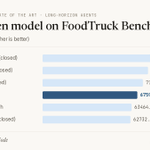
FoodTruck Bench gives an LLM agent 34 tools to run a food truck in Austin (menus, prices, perishable stock, staff, loans) and ranks models by median net worth after 30 days.
paperswithcode.co/benchmark/…

1
23
Congrats @TencentHunyuan: Hy4 is the best open model on FoodTruck Bench! 🚚
Running a food truck for 30 simulated days from a $2,000 start, Hy4 ends with $67.6K net worth, ahead of MiniMax M3.1 Flash ($63.5K), the previous best open model.
It also beats Claude Fable 5.1, GPT-5.5 and GPT-6 Astra. Only Gemini 4 Carbon ($77.2K), Claude Opus 5 and Qwen4 Max finish higher.
774B parameters, weights on Hugging Face under the Tencent Hy License.

1
78
It approaches backpropagation through a calibrated model at a fraction of the cost, and improves with more capable models.
paperswithcode.co/paper/2611…

2
Gordon Wetzstein, Demetri Psaltis and collaborators just released a coding agent that trains an optical neural network on real hardware, from measurements alone! 🔬
"In Situ Training of Optical Neural Networks by Coding Agents"
This paper shows how a coding agent can train optical hardware with neither a per-device calibrated model nor gradients through the hardware.
It covers optics as code, a harness that returns camera images of the agent's probes and requires a hypothesis per request, an agent that forms a physical understanding of the optics and reparametrizes the network with interpretable optical elements, wins over gradient-free methods in classification and image encoding, and much more!
Read this excellent paper by Ilker Oguz, @GordonWetzstein and collaborators: paperswithcode.co/paper/2611…

1
42
Models are trained from scratch on the synthetic data, and skills mostly fail independently, except position.
Code: github.com/amishsethi/visual…

1
19
Princeton researchers, with Zhuang Liu, just released a sharp controlled study of how diffusion models really generalize! 🎨
"Do Diffusion Models Learn to Generalize Basic Visual Skills?"
This paper shows whether diffusion models learn basic visual skills or largely match training patterns, something FID and prompt-following benchmarks can't tell you.
It covers the Visual Generative Lab (VGL), rule-generated training data for size, position, rotation, count, color and shape, size and position breaking down within a few pixels of the training range, only about 50% accuracy on out-of-range counts, why distinct skill combinations matter more than dataset size, and much more!
Read this excellent paper by @amish_sethi04, Zhuang Liu and collaborators: paperswithcode.co/paper/2611…

31
The case studies include a photometric-redshift estimator at 0.971 AUROC and an 83% rise in Florida homeowners-insurance premiums from 2013 to 2023.
paperswithcode.co/paper/2611…

20
Stanford researchers, with James Zou, just released DiscoveryAgent, an AI scientist that keeps the human scientist in charge! 🔬
"DiscoveryAgent: A Framework for Scientist-centric Agentic AI"
This paper shows how to combine autonomous investigation with scientists who select, refine or replace hypotheses between research rounds.
It covers audit agents that trace claims and reproduce analyses from checkpointed records, scientists finding 14x more valid errors with audit agents than by manual review, a protein variant-effect predictor beaten by only one of 106 ProteinGym baselines, case studies in astronomy, insurance and immunology, and much more!
Read this excellent paper by @oq_35, James Zou and collaborators: paperswithcode.co/paper/2611…

1
48
Datasets, splits, preprocessing code, baselines and results are all released.
Code: github.com/AI-sandbox/TabBio…

16
Stanford and UC Berkeley researchers, with David Haussler, just released TabBioMed, a large-scale benchmark that answers a practical question: which model should you use on biomedical tables? 🧬
"TabBioMed: A Large-Scale Benchmark for Biomedical Tabular Learning"
This paper shows that tabular foundation models are the strongest model family overall, but their gains depend on the regime.
It covers 94 curated public datasets from electronic health records, drug discovery, genomics, proteomics and single-cell omics, 23 models from gradient-boosted trees to tabular foundation models, why trees and tuned MLPs often win under inference or training-cost limits, and much more!
Read this excellent paper by Pau Mateo-Bernadó, Alexander G. Ioannidis and collaborators: paperswithcode.co/paper/2611…

1
43
The temperature sets how much the fine-tuned model trusts the pretrained one, so it keeps the tails of the data distribution that small SFT sets miss.
paperswithcode.co/paper/2611…

21
MIT, UT Austin and ASU researchers, with Antonio Torralba and Constantinos Daskalakis, just released a simple fix for one of fine-tuning's oldest problems: forgetting what the model knew! 🌡️
"Ambient LLMs: Data-Efficient Supervised Fine-tuning via Temperature Matching"
This paper shows how a frozen copy of the pretrained model can act as a noisy teacher, to keep small SFT datasets from causing overfitting and catastrophic forgetting.
It covers Ambient SFT, matching high-temperature versions of the fine-tuned and pretrained output distributions, one temperature knob that slides from knowledge distillation (T=1) to plain SFT (T→∞), gains across domain adaptation, instruction-tuning and reasoning, up to 21% average relative improvement over standard SFT, and much more!
Read this excellent paper by @giannis_daras and collaborators: paperswithcode.co/paper/2611…

2
65
It also composes with hyper-connections and input residuals, taking perplexity to 13.61.
Project page: shivamduggal4.github.io/late…
1
21
@AdobeResearch and MIT researchers, with William T. Freeman and Antonio Torralba, just released a fresh axis for scaling language models: more computational states, not more depth! 🧠
"Latent Lattice Language Models"
This paper shows that giving each layer its own recurrent latent stream, which persists across tokens, makes language models better at the same parameter count.
It covers the Lattice of Latents, latents that directly condition attention, KV-cache writes, MLPs and decoding, validation perplexity down from 15.41 to 14.40 for a 406M model, gains on Mamba-2 too, Gated DeltaNet variants that beat baselines with 4x larger native states, and much more!
Read this excellent paper by @ShivamDuggal4 and collaborators: paperswithcode.co/paper/2611…

