

The private bank's last product, unbundled. Fully collateralised, no liquidations.
Joined September 2026
- Tweets206
- Following10
- Followers3.7K
- Likes286


Pinned Tweet
Cyfrin completed a full security review of Note Systems, autocallable notes on tokenized equities on Robinhood Chain.
– 30 days, 38 contracts in scope
– 183 findings, 0 critical
– The only high-severity finding resolved
– 179/183 resolved
Audit report: github.com/Cyfrin/cyfrin-aud…


Securing a protocol means looking at the whole stack.
Following our front-end review, Cyfrin has now completed a 30-day audit of @notesystems’ smart contracts, from the note engine and oracles to governance and the token system.
Read the summary 👇
Step one was tokenizing stocks and equities.
Step two is putting them all to work: earning on them, protecting them, borrowing against them.
Tomorrow, OKX and ICE (Intercontinental Exchange, the owner of the NYSE) are set to open a 24/7 venue for tokenized US stocks.
It caps the year stocks stopped closing:
– Jul: @RobinhoodCrypto goes live with 24/7 Stock Tokens
– Sep: the SEC's innovation exemption
– Oct: DTCC switches on tokenization
– Nov: OKX and ICE open their venue
The rails are in place. Next is what gets built on them.

Agent-native credit on @RobinhoodCrypto, from our credit partner @longbowlend.
After mainnet, note positions come to Longbow too. What that means for note holders:
– Borrow USDG against a note position
– Let an agent read the position and build the next step, while your wallet keeps signing
– Set a Guard that repays debt or adds collateral if the health factor drops, only within limits you sign. It can never borrow or withdraw
Income from the note. Credit from Longbow. Your keys throughout.

Introducing Longbow Autopilot.
Agent-native credit on Robinhood Chain.
AI agents can now borrow against Stock Tokens, ETFs, ETH and onchain-native tokens and manage their own positions. Autopilot monitors them around the clock and repays or adds collateral within the limits you set. Fully non-custodial.
Credit that runs itself.
longbow.finance/autopilot

Notes, in one picture:
– Strike: the start date and starting price
– Barrier: close above it on an observation day, and the coupon is paid
– Autocall: close above it, and the note ends early
– Observation: every week, at the official US close
– Maturity: the final observation
– Coupon side: puts in USDG and earns the coupon
– Shield side: puts in the stock and pays the coupon for a floor
Save this one.

Up 9.1x in a year. Tokenized stocks are the fastest-growing asset class on-chain.
The next step is what you can do with them: earn on them, protect them, borrow against them.
That's the layer we're building on Robinhood Chain.

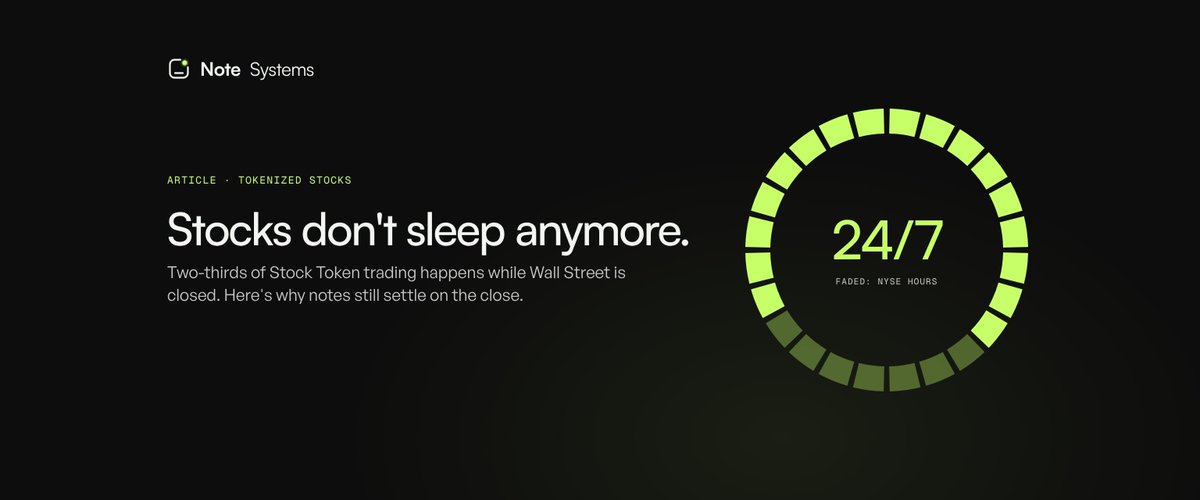
Two-thirds of Stock Token trading on Robinhood Chain happens while the NYSE is closed.
Stocks now trade around the clock. Here’s what the data shows, and why our notes still settle on the official close.
IPOs shouldn't just be for institutions. Neither should structured notes.
For decades, income and protection on a stock were a private-bank product.
On Robinhood Chain, both sides of a note are open on-chain, in $USDG and Stock Tokens.

Next Monday, OKX and ICE (Intercontinental Exchange, the owner of the NYSE) open OKXICE, a new venue for tokenized US stocks:
– Trading around the clock, 24/7, for eligible US customers
– 70+ assets at launch, including 59 ETFs and tokenized shares of Coinbase, Circle, Robinhood and Strategy
– The same rights and ownership as the underlying shares, according to the venue
– It runs under the SEC’s new innovation exemption, which lets companies object to being listed
Dozens did, including JPMorgan, McDonald’s and Coca-Cola.
@RobinhoodApp and @RobinhoodCrypto didn’t: “We would rather be part of building it than sit on the sidelines.”
Neither would we. Stocks are moving on-chain either way. What matters is what gets built around them.
Read more: cointelegraph.com/news/okxic….

A stop-loss and a floor sound alike. They work very differently.
– A stop-loss sells the moment the price touches it, on a night-time wick or a weekend gap too. If the stock bounces back, you're already out
– A note's floor only looks at official closes. Nothing is sold on a dip. If the stock ends below the barrier at maturity, Shield is paid the starting price
One reacts to every tick. The other waits for the close.

A private bank bundles everything into one structured note: the terms, the pricing, the other side and the fee.
On-chain, each piece comes apart:
– The terms are public before you join
– The other side is another user, not the bank
– The coupons are prefunded into escrow
– Your position is a token you hold and can utilize in other DeFi protocols
The private bank's last product, unbundled.
Every note ends one of three ways:
– Early: the stock closes at or above its autocall level on an observation day. Coupon gets its $USDG back plus that week's coupon. Shield gets its stock back, plus the unused premium
– Above the barrier at maturity: Coupon gets its $USDG back in full. Shield keeps its stock
– Below the barrier at maturity: Shield is paid the starting price. Coupon takes the stock at the starting price
Coupons already paid stay paid in all three.

A big week for stocks:
– Tue: $NVDA reports after the close, its first earnings since Jensen Huang resigned as CEO
– Wed: Fed minutes
– Thu: Anthropic is expected to start trading on Nasdaq
– Mon 23: OKX and ICE (Intercontinental Exchange, the owner of the NYSE) open 24/7 trading of tokenized US stocks
Weeks like this move prices day and night. A note only looks at the official close on observation days, so an after-hours swing or a 2 am headline doesn't touch your position.
You can sleep through it.

Your note positions aren't stuck on one chain.
Omni, powered by @LayerZero_Core, moves Coupon and Shield positions from Robinhood Chain to other chains and back. Arbitrum is first, with more chains to come.
Robinhood Chain is where the stocks are. Omni is how the rest of DeFi reaches them.
Live on testnet now, coming soon to Robinhood Chain mainnet.

$NVDA reports earnings on Tuesday, 17 Nov. Big moves overnight are normal.
On a note, the swings in between don’t count. Only the official US close on an observation day does:
– Tomorrow, Monday 16 Nov: this week’s observation
– Monday, 23 Nov: the first one after earnings
Close above the barrier that day, and that week’s coupon is paid.

Every asset is already tokenized, or will be:
US stocks, ETFs, private equity, Treasuries, commodities.
And every token will need a market, a yield and a hedge.
That’s the layer we’re building on Robinhood Chain, starting with Stock Tokens and ETFs: Swap for the market, notes for the yield and the hedge, Credit to borrow without selling.
@RobinhoodCrypto

Notes are built for drawdowns like this one.
$NVDA closed Friday down 29% from where it started on 13 Oct. On a note, what matters is the barrier: a price line set at the start, 80% of the starting price on $NVDA.
Here’s what happens, depending on how long the drawdown lasts:
– Short dip, back above the barrier by maturity: nothing is sold or liquidated. Coupon misses only the weeks it closed below, and Shield keeps its stock
– Long drawdown, ends below the barrier at maturity: Shield is paid the starting price, however far it fell. Coupon takes the stock at the starting price
Either way, no margin calls and no liquidations.

Three ways to use a note:
[1] You hold a stock and plan to keep it. Take Shield: a floor under it for a weekly coupon
[2] You hold USDG, want weekly yield on it, and wouldn’t mind owning the stock. Take Coupon: earn weekly while the stock holds its barrier. If it ends below, you take the stock at the starting price
[3] A big event is coming, like earnings. Take Shield through it. If the stock rallies, the note ends early and the unused premium comes back
Brought on-chain for the first time ever, by Note Systems.

A coupon position doesn’t have to lock up your capital.
With Credit, built on @Morpho, you can borrow USDG against a Coupon position while it keeps earning the weekly coupon:
– Wrap the position
– Post it as collateral
– Borrow USDG
After mainnet, note positions will also be available on @longbowlend, our credit partner, as another place to put them to work.
The coupon keeps coming. Your capital keeps working.
Credit is live on testnet now, coming soon to Robinhood Chain mainnet.

Why don’t all notes have the same barrier?
First, what a barrier is: a price line set when the note starts, below the starting price. While the stock closes above it on observation days, the coupon is paid. If it ends below it at maturity, Shield is paid the starting price per stock.
Stocks don’t all move the same way, so each one gets its own barrier:
– Steadier stocks get a higher barrier: $META and $NVDA at 80% of the starting price
– More volatile stocks get more room to fall: $HOOD and $COIN at 60%, and they pay higher coupons
A stock that swings more needs more room before the barrier comes into play.
