

LambdaClass is a venture studio that works on difficult problems related to distributed systems, ML, compilers and cryptography.
Argentina, Uruguay and Spain
Joined November 2018
- Tweets4K
- Following303
- Followers25.8K
- Likes3.1K


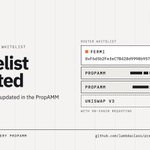


LambdaClass retweeted

Hegotá’s priorities are being revisited through the ACD process as Ethereum prepares for its post-quantum transition. Ethrex and other clients are already testing the execution-layer foundations for PQ readiness on bogota-devnet-2.
Part of that preparation is understanding compatibility with existing applications. Under the proposed EIP-8151 rules, for example, a contract that forwards exactly 3,000 gas to ecrecover could fail even for an unmigrated account. Raising the transaction’s gas limit wouldn’t fix that internal cap.
Testing these interactions early gives application teams time to adapt. Alongside client implementations, wallet migration and recovery flows help turn protocol support into something users can use.
The goal is to make migration possible as soon as the tools are ready, while supporting adoption through wallet integration, clear guidance, and public tracking of progress.


Making Ethereum ready for PQAI Day.
How @ethereum can prepare for a cryptographic break: the protocol changes, the migration paths, and what users and validators need to do.
Third in our post-quantum Ethereum series.
blog.lambdaclass.com/making-…


LambdaClass retweeted
A quantum attack on Ethereum’s cryptography could mean forged transactions, stolen funds, impersonated validators, or invalid rollup withdrawals. The exposure reaches across accounts, applications, and the infrastructure they depend on.
ethrex is already testing the minimum execution-layer feature set for PQ readiness on EthPandaOps’ bogota-devnet-2, including Frame Transactions, SETCODEFROM, and restricted ecrecover.
Together, these changes let us test how accounts adopt new signature schemes and retire their old ECDSA signing authority. This is concrete migration work already running on a shared devnet.
Wallet and application builders: the devnet and specifications are public. Join us in testing these paths and share your feedback on the migration experience.

A hardware wallet can't stop a quantum attacker. Neither can a multisig.
What a cryptographic break would mean for @ethereum's users, apps, validators and rollups, and how @ethrex_client and @ethlambda_lean are helping to test the migration.
Second in our post-quantum Ethereum series.
blog.lambdaclass.com/what-a-…

LambdaClass retweeted

This question has been at the center of our work over the last few months with @3miLabs, @class_lambda and @alignedlayer
We hope it helps the community understand what "formally verified" really means, and decide whether humans should still be able to read what's being proven

LambdaClass retweeted
In just one day, 400 studentes registered themselves! We will select the best during February 2027.
I didn't have time to write something here yet. The core idea of the degree is that as AI makes implementation faster and cheaper, choosing what to build, and understanding its consequences, becomes more valuable.
The proposed four year degree combines mathematics, computing and natural sciences with economics, law, institutions and ethics. Through practical workshops, students will bring these disciplines together to tackle real problems. They’ll use AI from the first year while learning to question assumptions, verify results and take responsibility for their decisions. Over the next few days, I’ll explain what we’re building, why we’re building it, how the program will work and how students can apply. I’ll be personally involved in supporting every student.
Our ambition is to bring together outstanding students and create an exceptional place to learn, build and pursue original ideas.
mi.econ.uba.ar/sistemas-comp…
federicocarrone.com/licencia…


LambdaClass retweeted

every time a verifier calls the issuer, the issuer learns where you’ve been.
with Propia, credentials are checked against public registries. the issuer never learns where you used them.
Propia, built in collaboration with @sovraio and @class_lambda.
LambdaClass retweeted
ethlambda @ethlambda_lean, our consensus client for @ethereum, is with silver from @gattacahq the fastest consensus client.
we're very proud of the work we're doing in @ethrex_client and @ethlambda_lean. in the upcoming months we're gonna focus more and more in performance. most of the work we have been doing was around testing new EIPs, implementing new features and making everything stable.
we're in talks with multiple big validators that want to adopt ethrex and ethlambda.

LambdaClass retweeted
What does it take to build a zkVM small enough for one person to audit end to end?
Four threads on how we are building Lambda VM so far, in collaboration with @class_lambda and @3miLabs. In order 🧵

LambdaClass retweeted

Ethlambda is in the house 🪷🇮🇳
Be one of the first to try our new consensus client.
Reach us out at @EFDevcon , DM us so we meet

We are at @EFDevcon!
We’d love to meet stakers looking to diversify their stack with ethrex, one of Ethereum’s fastest execution clients, built in Rust.
Come chat about running ethrex in your setup. DM us to meet up!
LambdaClass retweeted

Leaving a long answer here but this is a great opportunity to refresh the basics of propAMMs and how they can help new assets such as local currency stablecoins access affordable on chain liquidity.
The main difference between an AMM and a propAMM is how prices are set. In a traditional AMM like Uniswap, liquidity comes from multiple LPs, and prices are determined by a formula in the smart contract based on the liquidity available.
In a propAMM, a single market maker provides the liquidity and actively updates the prices at which it's willing to buy and sell. This gives the MM more control over pricing and inventory management, while keeping all that liquidity accessible onchain.
PropAMMs started on Solana, where they now process around $1B in daily volume, representing ~33% of spot DEX trading. On SOL/USDC, most propAMM trades offered better execution after fees than Binance and other major CEXs, even at their highest-volume trading tiers.
On Ethereum, we're now seeing around $100M in daily volume and over $4.3B traded in total, with more propAMMs and liquidity coming soon.
One reason this model works well is that MMs can constantly adjust their quotes to market conditions, reducing their exposure to stale prices. That allows them to quote tighter spreads without taking on as much risk.
You can see this in the pamm.wtf screenshots. For a $10k ETH/USDC trade, most propAMMs are quoting tighter spreads than Binance. FermiSwap, which has some of the deepest liquidity, quotes 1.39 bps vs. 4.51 bps on Binance (VIP9) and 12.10 bps on Uniswap v3. On USDC/USDT, FermiSwap's ask is just 0.10 bps above the reference price for a $1k trade.
There's still a lack of depth on Ethereum for really big trades but small/medium size trades are already getting very good quotes, but we need more liquidity to offer the same pricing for larger trades.
We think propAMMs make a lot of sense for long-tail assets. A project can work directly with an MM to provide efficient onchain liquidity and customize its pricing logic without needing large amounts of passive LP capital. This is especially useful for stablecoins pegged to local currencies. A single propAMM can quote multiple currencies against USDC and against each other, reusing the same USDC inventory instead of fragmenting liquidity across separate pools for every pair.
Since May, we've been working with
@alignedlayer, @class_lambda and @titanbuilderxyz on the infrastructure for propAMMs on Ethereum. We've built two things:
- A router that provides a single interface to trade across different propAMMs, with additional features to prevent spoofing and support multileg trades.
- A propAMM factory that includes both the smart contracts and offchain infrastructure MMs need to launch and run their own propAMMs.
At @alignedlayer, we're also running an experimental propAMM called ElZorro together with
@polfinance_, where we test new features with real trades and use what we learn to quickly iterate on the propAMM factory.
We're now exploring bringing this infrastructure to other EVM chains such as Base and Robinhood.
You can read more here:
- blog.lambdaclass.com/announc…
- zondamarkets.com/blog/introd…
- lambdaclass.github.io/propam…
- pamm.wtf

LambdaClass retweeted
Lambda VM (built with @class_lambda and @3miLabs) is on Keccak today, and it isn't a final answer. We're working on making recursion faster, and that has us experimenting with different hashes, algebraic ones included. The longer version, with how each kind works inside, is in the post: blog.alignedlayer.com/lambda…

LambdaClass retweeted
Lambda VM is an open-source zkVM for RISC-V being built in collaboration with @class_lambda and @3miLabs.
to learn more about it, read the article on its principles: blog.alignedlayer.com/lambda…


LambdaClass retweeted
We loved chibi, so we added partial stateful node support to ethrex.
A node for your wallet that keeps only the accounts and storage you use, verifies the values it serves, and follows the chain without executing blocks. Your wallet gets local JSON-RPC, with no RPC provider to trust.
In one Sepolia run: 29–34 MB of memory, about 3% of one core, and negligible disk usage beyond the binary. Anchoring took a couple of minutes while waiting for a peer that answered headers. Experimental and Sepolia-only for now, since it needs Glamsterdam’s block access lists.
We’ve also added experimental EIP-8440 execution chain proof support, with off (default), observe, and require modes. Require serves state only at blocks covered by a verified proof.
github.com/lambdaclass/ethre…
Let’s walk through what the node actually does 👇


Partial stateful node is here!
Happy to announce chibi: a node that syncs in minutes and lets you transact through your own local RPC. Trust no one because every value is proven.
It runs on practically any hardware. Need to send a transaction? Don't need to rely on RPC providers, just spin up chibi and send it right away. Live on Sepolia today and Hoodi next.
👇 demo below

LambdaClass retweeted
ethrex v30.0.0 schedules Glamsterdam on Hoodi. If you run ethrex on Hoodi, this is the release you need to follow the fork.
Hoodi activates Glamsterdam at timestamp 1793036568, which is 2026-10-26 17:42:48 UTC. This is the first ethrex release with the fork scheduled on Hoodi, so earlier releases stop following the chain at that point, and it needs to be paired with a consensus client release that ships the Hoodi Gloas config. Mainnet has no Glamsterdam time scheduled.
⚠️ L2: the prover and the SP1 guest move to SP1 6.9.0, and SP1 6 proofs need the SP1 v6.1.0 Groth16 verifier. An existing deployment's SP1 5 verifier rejects them whatever key is registered, so the order matters. Let every committed batch be verified before the upgraded sequencer commits anything, then upgrade the OnChainProposer and replace the verifier in a single Timelock call, upgradeToAndCall(newImplementation, upgradeSP1Verifier(newVerifier)), and register this release's verification key. Full procedure: docs.ethrex.xyz/l2/deploymen…. Aligned mode is unavailable until Aligned ships SP1 6 support, and the OpenVM L2 prover backend is removed. L1 node operators are unaffected.
The rest of the release is mostly hardening, on the paths where something outside the node decides how much work it does. JSON-RPC parsing is bounded in memory and the Auth-RPC token is checked before the request body is read. eth_getLogs and log filter polls are bounded in cost, serving eth/72 cells to peers is bounded in CPU, and what a peer's transaction announcements can make the node track is bounded. Maps keyed by contract- or block-chosen values are seeded, and MODEXP gas is charged before its operands are sized.
Also in v30.0.0:
- RPC: eth_getFilterChanges reports each new log once, and the receipts of blocks still held in memory come back in full.
- Sync: snap/2 catch-up charges peers that cannot serve block access lists, and accounts left with no storage slots get the empty storage root.
- Performance and zkVM guests: calldata, CALL arguments and CREATE initcode are no longer copied per call, so zkVM guests stop running out of heap. Finality pruning no longer piles up overlapping range deletes, and state-history journaling skips layers that are already final.
- L2: the committer generates the prover input for batches another build sealed, so a sequencer that takes over, or batches committed again after a revert, can still be proven.
If you run ethrex on Hoodi, upgrade before 26 October. Everyone else, upgrade at your convenience. No resync is needed.

LambdaClass retweeted
The Hive tests for Heze devnet 2 are live, and ethrex is the first EL client ready to run them. Our heze-devnet-2 branch is already passing the full suite!
The devnet itself hasn’t launched yet. Its planned scope includes:
- FOCIL (EIP-7805)
- Removal of the deposit and eth1data fields (EIP-8015)
- Disallowing new validators with 0x00 withdrawal credentials (EIP-8365)
- Quick Slots (EIP-8198)

At the latest ACDT meeting, we decided to rename the devnet branches to better reflect their scope. The FOCIL devnets are now called Heze and will include CL EIPs, while the Frames devnets are now called Bogotá and will include EL EIPs. The combined devnets that follow will be called Hegotá, following the usual naming convention.
The launch of bogota-devnet-1 (formerly frames-devnet-1) is just around the corner, with EIPs 8141, 8250, 8272, and 7906 included. The latest execution spec tests release ([email protected]) is already out, and we’re passing all the tests!
We’re excited to see this devnet go live! hive.ethpandaops.io/#/group/…

LambdaClass retweeted
From our point of view, yesterday's ACDC decision on EIP-8025 was the wrong call for Ethereum's long-term interests.
EIP-8025 proposes optional execution proofs, a first step toward the zkEVM roadmap, and the client teams declined to commit to it.
Framing the proposal as an "optional feature" may have worked against it. Calling something optional makes it easy to dismiss as low priority. To be clear, it was a proposal, and proposals can be accepted or rejected; nothing obligated anyone to approve it. And it is true that this feature does not inherently require a hard fork. But that is precisely what makes the question of commitment unavoidable: with nothing at the protocol level forcing the work to happen, progress depends entirely on whether people are actually assigned to it. Execution proofs only become real if client developers implement them, if testing teams build the coverage they need, and if DevOps keeps the infrastructure running. Declining to prioritize the proposal means the work simply does not happen. The optionality was meant for operators, those choosing whether to enable execution proofs, not for the people deciding whether the work happens at all. Operators should be able to opt in regardless of which client they run, and a decision taken without all teams present cannot credibly settle a question that depends on all teams delivering.
Optional proofs are the foundation of Ethereum's zkEVM roadmap. That roadmap is complex, and it demands extensive integration and testing across teams. Getting there requires a shared, sustained commitment.
We need to test under realistic conditions and investigate failures before consensus depends on proofs, and that work should proceed alongside research into mandatory proofs. Every integration bug we uncover now is one we won't be discovering after consensus depends on it. The more groundwork we lay today, the more bandwidth we have later for the challenges specific to mandatory proofs, including the ones we haven't found yet.

hegota scoping ⚡
ACDC #189 - ultra tl;dr
DFI:
🪓 7716: Anti-Correlation Attestation Penalties
🪓 8025: Optional Execution Proofs
🪓 8359: Beacon Block Reporting Field
🪓 8371: RowDAS
generally liked EIPs, but teams found that they weren't urgent enough to schedule (7716, 8359, 8371) or that they could be tackled without CFI (8025)
5 more EIPs to assess next meeting
video and summary:
forkcast.org/calls/acdc/189/

LambdaClass retweeted
At the latest ACDT meeting, we decided to rename the devnet branches to better reflect their scope. The FOCIL devnets are now called Heze and will include CL EIPs, while the Frames devnets are now called Bogotá and will include EL EIPs. The combined devnets that follow will be called Hegotá, following the usual naming convention.
The launch of bogota-devnet-1 (formerly frames-devnet-1) is just around the corner, with EIPs 8141, 8250, 8272, and 7906 included. The latest execution spec tests release ([email protected]) is already out, and we’re passing all the tests!
We’re excited to see this devnet go live! hive.ethpandaops.io/#/group/…
It’s been a couple of weeks since the first official Frame Transactions devnet launched.
frames-devnet-0, which includes only EIP-8141, will soon give way to frames-devnet-1, adding EIP-8250, EIP-8272, and EIP-7906.
The execution-spec tests for frames-devnet-1 ([email protected]) came out today, and ethrex already implements the required changes and passes the full suite!
We’ve been working on these EIPs for a while, and it shows 😉. Getting ready for devnets is starting to feel routine 💅.