https://www.nitter.gq/t.co/ee4CrnTjxe | Non Custodial Staking Services
Joined June 2020
- Tweets748
- Following494
- Followers2.3K
- Likes1.2K





Breakpoint 2027 ... In San Francisco!
It's a date!
#bp27 #Breakpoint27 #Breakpoint2027 – at San Francisco, CA

Valid Blocks IBRL/acc retweeted

I could not have said it any better!
Antolynio Schnikovenlo or Tolyone Aklovinko is the only one who knows whats goin on!


20 minutes until @solana Breakpoint 2026 kicks off.
The stage is set. The purple lights are on.
You are NOT prepared for this 👀🔥
#Breakpoint2026 #Solana #Breakpoint26 #bp26
1
8
301
Validators don't sleep at Breakpoint 😤
Block Storm is live on the badge App Store: blast spam, stack valid blocks, outrun MEV bots.
Beat our score 👇 then come find @EddieNuta or @Bunghii and swap X Dex cards to win 1 @SOL. Draw Tue 18:00 UK.
#Breakpoint2026 #Breakpoint26
3
7
377
Breakpoint 2027 challenge for @jump_firedancer:
Run a validator on this badge. 😎
Michael McGee, your move. 🪄


Firedancer validator, running live, single core. 20GB RAM.
From the conference venue!
On a tablet!!
Willy Wonka (aka Michael McGee) working his magic again. 🪄🔥
@jump_firedancer @solana #BlockZero #Breakpoint2026

⚡ BlockZero #5 vibes from London! 🇬🇧
Validators, infrastructure builders, and the people working behind the scenes to keep @solana fast, reliable, and decentralized.
Great energy, great conversations, and an incredible community. 🔥
This is our kind of event!
#Solana #Breakpoint2026 – at London, England
The man. The legend. Michael McGee! 🔥
#Solana #Breakpoint2026

🔥 Firedancer is on fire!
Michael McGee presenting @jump_firedancer at Scale or Die in London.
Pushing @solana's block limits to a whole new level. 🚀
As validators, this is exactly the kind of engineering and ambition we love to see!
#Solana #Breakpoint2026


1
137
⚡ At Scale or Die in London today!
(pre-breakpoint26 still..)
One of the coolest things we've seen: the Solana BP Badge, an ESP32-powered devkit for building, experimenting, and exploring @solana.
Huge shoutout to @flagmonkez from SkyRizz for creating this! 🔥
Love seeing this kind of creativity in the ecosystem.
#Breakpoint2026 #Solana


🇬🇧 Breakpoint week is officially underway in London!
First stop for Valid Blocks: 200ms by @jito ⚡
MEV, market structure, DeFi, and the infrastructure powering @solana.
Great to be where the conversations shaping Solana's future are happening.
More from London soon! 👀
#Breakpoint2026 #Solana


Valid Blocks IBRL/acc retweeted

Introducing Alpine 🌲
A lending protocol designed for perp traders. Borrow against your holdings on @Solana and trade on your favorite perp venues.
Alpha access is now open to select traders. 🧵👇
#Solana
Validator churn ≠ decentralization.
Helping newcomers matters. So does rewarding consistent validator performance and meaningful upgrade contributions.
These are measurable. Alpenglow is a great case study. SFDP should reward proven value, not just rotate stake.

An open letter to the Solana Foundation on the new SFDP rules
On November 6, the Solana Foundation announced new rules for the Solana Foundation Delegation Program: a twelve-month membership term, graduation at 300k SOL of external stake, a hard cap of 100 validators, and the retirement of existing members in weekly tranches.
We are writing because we believe these changes work against decentralization, and because they will push out many of the hardest working and best-faith operators Solana has ever had. These are the quiet ones. They do not run marketing campaigns or pick fights on X for impressions. They run nodes, they run them well, and they make valuable contributions to the network while doing it.
◆ The incubator model has not worked ◆
SFDP was built as a launchpad for new validators, and that was the right goal when the validator set needed bootstrapping. That job is done. The goal posts need to move.
On paper, twelve months of delegation followed by forced graduation is a sink-or-swim model: incubate new operators, let natural selection remove the ones who cannot make it. In practice it will play out differently. Validators will join, collect earnings for twelve months, and leave. That is not a net new independent operator. It is a short-term tenant.
The deeper problem is that attracting stake outside SFDP is close to impossible unless you are already in the superminority. The highest-staked validators keep attracting even more stake, so the superminority is shrinking in count while growing in share. Under these rules it sits on top of a constantly churning set of 100 SFDP nodes. Churn is not decentralization. It is a revolving door with an ever-smaller group of ever-larger operators on the other side.
Meanwhile, the operators who actually push the network forward are the ones being cut. The people who tirelessly tested the new governance system before it went live. The people who moved their nodes to different ASNs, at their own cost, because ASN diversity mattered. The people who lose sleep for urgent upgrades. The people who carried Alpenglow to mainnet, which we come back to below. Those are the operators this program is now designed to remove. The longer you have been on Solana, the worse this program is for you.
◆ The Teraswitch outage is the case study ◆
When Teraswitch went down, the network did not halt. It stayed up because enough stake was spread across enough independent validators on enough different ASNs to keep consensus alive. That distribution did not happen by accident. It existed because SFDP supported the number of validators it did and because SFDP created the ASN rule. And stake on Solana increased after the outage. The market saw a network absorb a major provider failure without blinking, and rewarded it.
Shrink the program to 100 validators and concentrate the rest with a handful of operators, and the next provider outage ends very differently. The Foundation is dismantling the exact safety margin that kept the chain from halting.
The numbers are not abstract. At the operator level, Solana's Nakamoto coefficient is 8 today. It was 6 until Alpenglow raised the liveness threshold from 33% to 40%. At the 20% safety threshold, the coefficient is 3. That is a long way from the 18 or so that gets repeated in marketing. These rules push every one of those figures the wrong way.
◆ Alpenglow was carried by independents, and independents are paying for it ◆
Alpenglow did not reach mainnet on its own. It got there because of the community cluster, and the community cluster was run almost entirely by independent validators. Not a single operator from the superminority participated. The largest validators on the network, the ones about to receive the stake being taken from us, contributed nothing to the most important upgrade Solana has shipped.
The history matters. When independent validators raised concerns about 200ms block times and the operational/financial load it put on smaller operators, the Foundation's answer was to participate in the Alpenglow community cluster and accelerate the migration. So we did. We paid for the extra servers. We stayed up until 2 and 4 AM through dozens of regenesis’s. We absorbed weeks of accelerated block times and accompanying doubling vote costs, on the understanding that Alpenglow would make it worth it.
Alpenglow migrated to mainnet a few weeks ago. Before most of us have earned back a fraction of what that period cost, SFDP is retiring us.
The entire burden of 200ms and the Alpenglow migration on independent validators, and the moment the work was done, the Foundation moved to cut us. At minimum, the operators who carried that upgrade should be allowed to run on Alpenglow mainnet under existing delegation for six months before any retirement takes effect. That way they can recover their costs.
◆ Who actually contributes to the network ◆
Measured against stake, lower-staked validators contribute far more back to the network than their higher-staked counterparts. This is not a matter of character. It is structural.
Large operators have investors and shareholders who expect profit to be maximized. Testnet participation, client diversity work, community infrastructure, and governance testing do not make money. The largest operators are therefore discouraged from doing any of it, and for the most part they do not. Alpenglow is the clearest example.
Independent operators are the opposite. We are expected to contribute, we are judged on it, and we do. SFDP spent years building that expectation into its own criteria. The new rules now retire the operators who met the bar and hand the stake to operators who are built not to.
◆ Institutional delegation is moving stake in the wrong direction ◆
Our understanding is that the Foundation intends to redirect stake toward institutional validators. Institutions outsource risk; that is what they do. We expect the long-term result to be institutions white-labelling through a small number of existing superminority operators. Stake taken from independent validators will end up concentrated with the operators who already hold the most of it.
That is centralization in its purest form. There is a harder truth underneath this. The independent validator set was the proof point. Early community operators were what made Solana credible enough for the people in suits to start paying attention and writing checks. Decentralization was the pitch. Now that the money has started to arrive, the operators who were the pitch are being shown the door to make room for it.
People who gave Solana their everything deserve better than being used as leverage and then being thrown away.
Decentralization is not a vanity metric. It is not a position to take the moral high ground from when criticizing a competitor like Hyperliquid, and it is not a narrative to be respun each time compliance requirements get clarified. Decentralization is why this industry exists in the first place.
Institutions are not bad actors (usually). But they are not network stewards. They have no mandate to care about client diversity, ASN spread, or testnet participation, and no operational capacity to contribute to any of it even if they wanted to. The better outcome for everyone is to route that stake to the independent operators who have already proven they will protect it.
◆ SFDP needs a purpose again ◆
If the program no longer exists to support independent operators or diversity, and the incubator model does not work in practice, it is fair to ask what the program exists for.
We propose it becomes a long-term independent contributor program, where the contribution being measured is network health itself: uptime through upgrades, client diversity, ASN and geographic diversity, supporting new innovative initiatives like community cluster participation, governance testing, etc. The operators who carried Alpenglow testing are exactly the people such a program should be rewarding. Inactivity means removal. Operators who do this work should be rewarded for as long as they keep doing it, not retired on a calendar, and not asked to become something other than validators to stay eligible.
That model aligns the program's incentives with the long-term success of the network. Arbitrarily picking 100 validators and churning them once a year aligns them with nothing.
◆ What we are asking for ◆
1. Pause the weekly retirement tranches until the community has been consulted.
2. Give current members who participated in the Alpenglow community cluster a minimum of six months of continued delegation on Alpenglow mainnet before any retirement takes effect.
3. Publish the analysis behind the arbitrary 100-validator cap, and twelve-month figures.
4. Open a formal consultation with current SFDP members before the rules are finalized.
5. Adopt the contributor model above as a replacement for, or alongside, the incubator model.
Solana's resilience was built by people who showed up when it was hard and did not expect to be thanked. We are asking the Foundation not to design them out of the network.
◆ This is what the independent set actually does ◆
The independent validator set, even within Layer33, has been able to achieve many things. Across this group alone, we have:
◆ Supported the official Solana testnet faucet with validator rewards from over 33 million testnet SOL delegated across more than 5k stake accounts, replenishing roughly 450k testnet SOL per month so new validators and developers can deploy before touching mainnet
◆ Built the devnet faucet and the Solana Hardware Compatibility List that operators use to spec machines
◆ Been among the first mainnet validators to run Frankendancer, and later to adopt full Firedancer, on our own hardware, before client diversity was a talking point
◆ Made open source contributions to solana-program, Firedancer, and DoubleZero, plus open source tooling that lets operators switch clients and handle updates automatically
◆ Built a free public API and chart suite for validator and network data that powers dozens of tools and sites across the ecosystem
◆ Built public dashboards that have repeatedly exposed malicious validator behavior around delayed blocks and held bad actors accountable
◆ Shipped the first UI for diagnosing skipped block issues, and staking tools for tip harvesting and stake account cleanup
◆ Co-authored the Validator Voting Behavior Study
Built Nakaflow, which tracks Solana's Nakamoto coefficient against other chains
◆ Contributed to governance design from the beginning, and are key contributors to the new governance platform launching in 2026
◆ Run the monthly validator community call continuously for more than three years
◆ Co-founded the Block Zero validator conference, and organized and sponsored every edition since inception
◆ Built validator infrastructure in underserved regions, including the only major validator between Dallas and Miami and the oldest Brazil-based validator, both on dedicated hardware
◆ Won multiple Solana hackathons
◆ Still host multiple hackathons across Solana every year
◆ Created one of the first Solana-native transaction indexing platforms, used by consumers and teams to understand on-chain activity at scale
◆ Built early DAO and governance tooling adopted by BONK and other Solana-native projects
◆ Built stake pools and delegation tooling that route stake toward performance and decentralization
◆ Reinvested validator revenue into Solana-native startups, hackathon track sponsorships, free web3 security education, and ongoing donations to animal welfare, clean energy, and men's health charities
◆ Kept genesis validators running on our own fleets across multiple locations, delegating our own stake to other operators who contribute to network health
◆ Made up the bulk of the Alpenglow community cluster, on our own servers and our own time, to get the upgrade to mainnet faster
Several of these have been running for three years or more with no end date. That is what a long-term contributor looks like. A twelve-month clock does not describe it.
None of this was required. None of it counts under the new rules. With these changes actioned, institutions like Figment get propped up and the independent validator set gets dismantled. Under that model, none of the above would have existed, and the next round of contributions like these will not exist either.
The independent validator set is normally quiet. We work siloed in our own day-to-day operations. Decentralized, you might say. We focus on validator and network performance, not for ourselves, but so that Solana thrives. For all of us to come together and speak out against a single change means something is truly broken.
This letter may disappear into the void as the Foundation moves to support the large institutional players, the ones who do not care about Solana, at the expense of the people who do. Even so, we wanted our position on the record.
L33
Valid Blocks IBRL/acc retweeted

🚨JUST IN: A collective of independent @Solana validators, @Layer_33_, has called for a pause in validator removals under new SFDP rules, which remove existing members in weekly groups and limit participation to 12 months, after which validators lose the program’s stake support.
The group warned that the program’s new 100-validator cap and 12-month term “work against decentralization” by pushing out experienced independent operators and concentrating stake among larger validators. “


Valid Blocks IBRL/acc retweeted

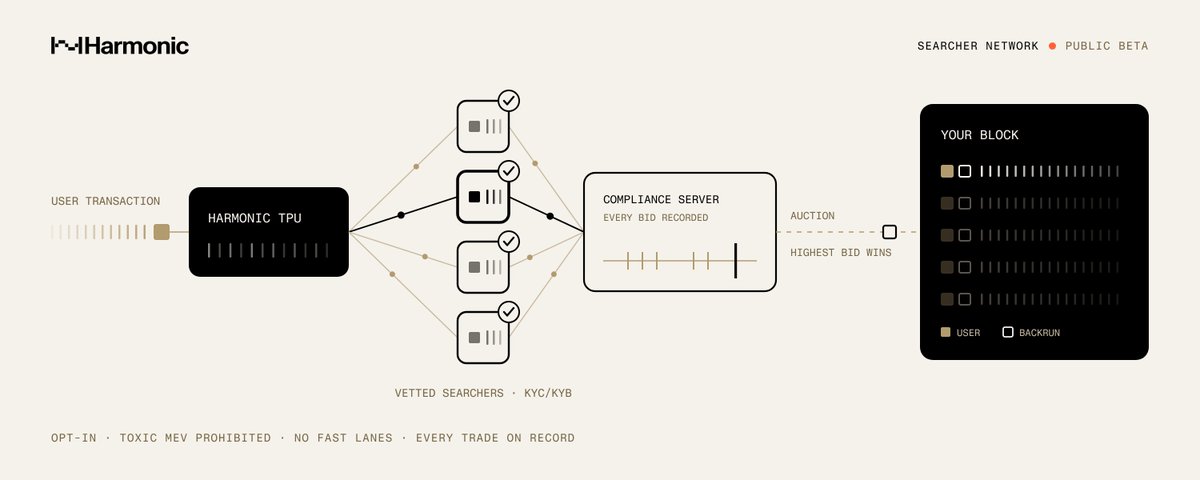
Since early August, the Harmonic Searcher Network has generated over 25,000 SOL for validators and stakers.
Today it opens in public beta: backrunning only, no toxic MEV, and KYC/KYB-vetted searchers monitored by our compliance system.