

Exploring the people, ideas, and stories behind physics research.
- Tweets7.6K
- Following513
- Followers76.6K
- Likes2K


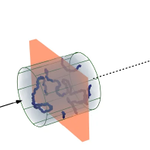




ALT On the left is an illustration showing how, in diamond, if defect-associated spins, shown in purple, are isotropically distributed and uniformly polarized, their dipolar magnetic fields cancel each other out. On the right is an illustration showing how the researchers found that if the spins are wound into a nanoscale spiral, their dipolar fields do not sum to zero.

ALT An illustration of an electron undergoing a variety of scattering events in a conductor. When momentum-conserving interactions with other electrons, shown in blue, dominate over momentum-relaxing interactions with impurities, shown in red, and the boundaries of the conducting channel, shown in yellow, the conductor is in a so-called hydrodynamic regime, where the Gurzhi effect can arise.

ALT Illustration of an experiment that shows a vessel of supercooled potassium atoms on the left, a snapshot being taken at one time point in the center, and the resulting photograph on the right.

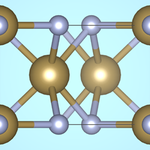
ALT Illustration of a specific crystal form of tantalum nitride.

ALT An image shows the evolution of matter waves created in a resonant cavity by confining ultracold atoms between two sheets of light — nine rows of blue horizontal zig-zag patterns colored blue against a black backdrop. The matter waves initially fill the whole cavity, but moving one of the light barriers at relativistic speeds causes the waves to become concentrated into a single moving pulse — similar to what is observed for light propagating near a black hole.

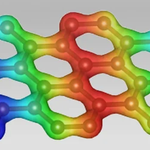
ALT A molecular lattice with rainbow coloring overlaid on top against a gray background.

ALT The Murriyang Parkes Radio Telescope at dusk with a crescent moon above.

ALT A close-up of a superconducting qubit.

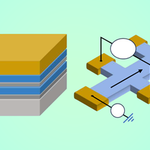
ALT On the left is a rendering of a 3D layered device connected to voltage sources and ground. To the right is a Hall bar device geometry with gold contact pads, measuring instruments, and ground connections.

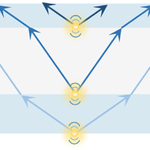
ALT An illustration of three charged particles arranged in a single column with sets of blue arrows pointing up and to the left and right from each particle, forming three V shapes.

ALT Fluorescence microscopy image of two dividing cells, with blue nuclei, orange microtubule filaments, and green cytoskeletal structures against a black background.

ALT A photograph of purple and red flowers in a pot on an outdoor patio.

ALT A photograph of smoke emerging from the top of a volcano as seen from above.

ALT A close-up illustration of a flake of iron chalcogenide connected to bright yellow electrodes against a dark yellow background.

ALT Abstract image featuring a colorful array of dots in warm hues of red, orange, and yellow, with overlapping shapes in shades of blue.

ALT A rendering of three glowing 3D volumetric forms. From left to right, the shapes transition from cone-shaped to bell-shaped and from green to blue.

ALT A rendering of rays of pastel-colored light traveling through two rectangular prisms.

ALT Two examples of rhombus-shaped 4-site atomic clusters on Lieb lattices on a blue background.

ALT A graph of trapped atoms’ optical depth over 200 milliseconds. Red data points showing atoms loaded using the RPGC-molasses rise and level off near 20 during conventional cooling. When gray-molasses cooling begins at 50 milliseconds, blue points climb steeply and level off near 120. A small inset graph shows the effect peaking near zero when two lasers are tuned for this cooling method.

ALT A grid of yellow squares with the letters JTU written in blue and green. An inset black image on the bottom shows JTU again written in white.