




ALT An illustrated diagram from the Review Article "Helicobacter pylori Infection — Advances, Challenges, and the Road Ahead" that shows culture-based and molecular-based antimicrobial-susceptibility testing for H. pylori.

ALT A quote from a Perspective published in the New England Journal of Medicine reads as follows: "Taxpayer-funded credits that subsidize clinical training are an additional medical education cost incurred on top of the tuition that students already pay to receive that training.” The Perspective is titled "The Unexamined Subsidy — Rethinking Incentives for Outpatient Clinical Preceptors” and the authors are Hannah L. Maxey, Ph.D., and Mykayla Moore, M.P.H. The background color is purple and includes the NEJM identity.
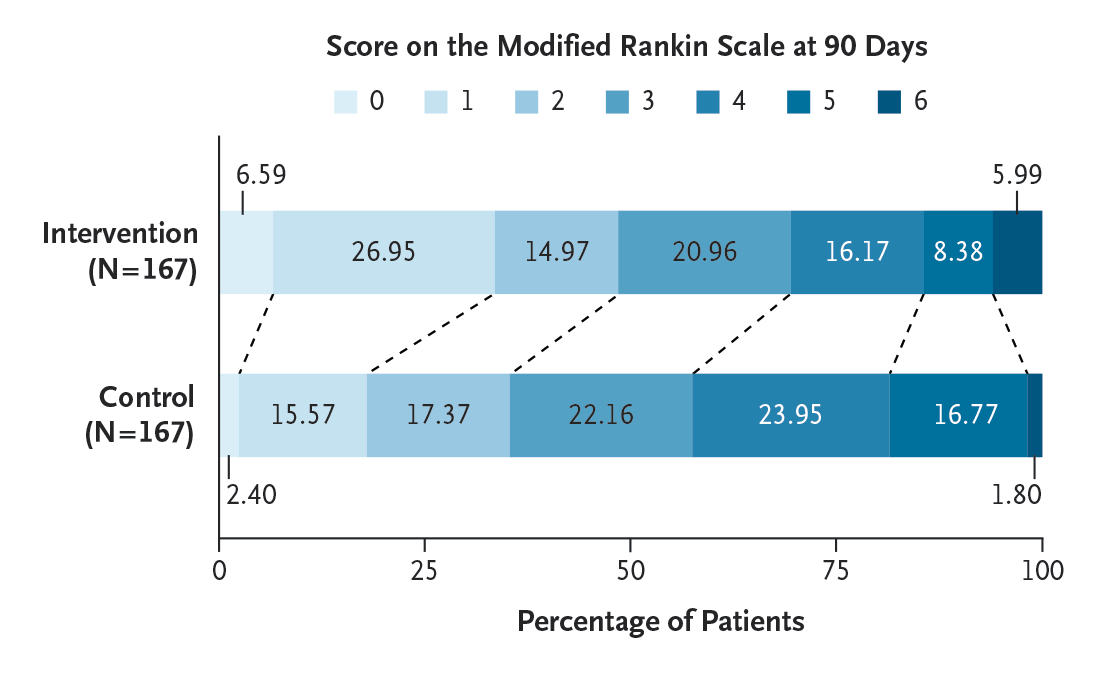
ALT Bar graph showing the percentage of patients on the Modified Rankin Scale, comparing "Intervention" (N=167) and "Control" (N=167). Scores range from 0 to 6. The distribution is labeled with percentages for each category.


ALT Infographic titled "Rare and Undiagnosed Diseases Are Not Rare," by Filippo Pinto e Vairo, M.D., Ph.D. It includes bar graphs and pie charts about the ability to care for patients with such diseases, and clinicians' confidence in recognizing them. Global and U.S. data are presented. The NEJM Catalyst logo is at the bottom.

ALT The image is an illustrated diagram showing the radiologic, physiological, and biologic approaches to subphenotyping ARDS. The top portion of the figure depicts heterogeneity in specific variables for selected current approaches to subphenotyping, along with the stage of clinical evaluation for each approach. Radiologic subphenotypes (left) include diffuse as compared with focal ARDS, typically characterized by chest CT. Physiological subphenotypes (center) include low as compared with high lung compliance (alternatively, the inverse of compliance may be used, which is termed elastance). Biologic subphenotypes (right) include hyperinflammatory and hypoinflammatory, distinguished by very high as compared with modestly elevated levels of inflammatory biomarkers in plasma. The bottom portion of the figure depicts the aspirational goals for subphenotyping in the future.

ALT A visual representation of the MILD-MT trial, which evaluated endovascular therapy for patients with mild stroke with large-vessel occlusion.

ALT Two photos from this week's Image Challenge show the patient’s legs, which are red and swollen. The text “Image Challenge—What is the diagnosis?” sits above the images.

ALT A quote from a Perspective published in the New England Journal of Medicine reads as follows: "Rather than cutting overall research funding or limiting grants to areas aligned with their own policy preferences, funders should support research programs that can generate and disseminate actionable evidence on various policy alternatives.” The Perspective is titled "Reimagining Health Policy Research” and the author is Emma E. McGinty, Ph.D. The text is displayed on a simple white background with yellow border. The NEJM identity sits at the bottom.

ALT Panel A shows the incidence of a composite of death from any cause, stroke, or myocardial infarction (the primary outcome). Panel B shows the incidence of major bleeding (the major secondary outcome), which was defined as a bleeding event of Bleeding Academic Research Consortium type 3 (nonfatal major bleeding) or 5 (fatal bleeding).

ALT Two medical images from the Images in Clinical Medicine article "Functional Fixed Dystonia of the Foot.” Panel A, which was taken during the physical examination, shows the left foot fixed in plantar flexion and inversion. Panel B, which was taken during a follow-up visit 6 months after the initial diagnosis, shows the patient walking normally.

ALT Seven images from the Review Article “Acute Respiratory Distress Syndrome” that show chest imaging consistent with ARDS. Panel A is a chest radiograph showing diffuse bilateral opacities in a nonintubated patient. Panel B is a chest radiograph showing focal bilateral opacities in an intubated patient. Panel C is a chest radiograph showing diffuse bilateral opacities in an intubated patient. Panel D is a CT scan of the chest with bilateral and diffuse distribution of opacities. Panel E is a CT scan of the chest with bilateral and focal distribution of opacities. Panel F is an ultrasonographic image of the lung showing both B-lines (vertical artifacts, decreased lung aeration) and A-lines (horizontal artifacts, normal lung aeration). Panel G is an ultrasonographic image of the lung showing B-lines and an abnormal pleura with subpleural consolidations. The NEJM identity sits at the bottom.

ALT An image announcing a new audio interview with Emma E. McGinty, Ph.D., on Advancing Policy Research. There is a photo of Prof. McGinty over a decorative soundwave graphic.


ALT A forest plot showing subgroup analysis of progression-free survival for patients treated with abemaciclib plus HB1801 versus THP. The left column lists subgroups like age, ECOG performance status, and liver metastasis. The middle columns show patient counts and events. The right column features hazard ratios and confidence intervals.

ALT A collection of small, assorted pumpkins and squash arranged on a surface. A white tag with "THANKFUL" written on it is attached to one of the pumpkins. The image header reads "NEJM Voices | Theodore Iwashyna, M.D. A Thanksgiving Appreciation."

ALT On the left is a quote from a Perspective published in the New England Journal of Medicine, which reads as follows: “Then my professor told us something that has stayed with me for more than 20 years: ‘Getting the computer to play chess was the easy part. I just can’t get the damn robot to stroke its beard.’” The Perspective is titled “What the Robot Still Can’t Do” and the author is Shantanu Nundy, M.D. The NEJM identity sits at the bottom. On the right is an illustration of a person playing chess on a board with a screen showing a digital face composed of binary code.

ALT The image shows an illustration of a person sitting on a hospital bed in an emergency department. Text boxes provide medical history notes, indicating the person has had 10 days of fever, sinus pressure, cough, nausea, and vomiting. It mentions the individual is a 31-year-old from Baltimore, MD, otherwise healthy, with similar symptoms in the spouse and a 1-year-old child.

ALT A quote from a Special Report published in the New England Journal of Medicine reads as follows: “Rural America is not monolithic. Appalachian coal towns, Great Plains farm communities, Native American tribal lands, and former mill towns in the rural South and Northeast all have distinct health needs.” The report is titled “Healing Health Care in Rural America — Toward Community-Centered Learning Health Systems” and the author is Monica M. Bertagnolli, M.D. On the right is a map showing the change in estimated county-level life expectancy at birth, 2000–2019.

ALT Two graphs showing the time to a positive sputum culture. Graph A shows the estimated trends in the time to Mycobacterium tuberculosis positivity on sputum culture, presented on a log10 scale, from baseline to week 12 in the trial groups. Graph B shows the median estimated relative difference in the log10(time to positivity) slope as compared with the HRZE group.

ALT Three images from "Case Records of the Massachusetts General Hospital: A 50-Year-Old Man with Recurrent Cardiomyopathy” that show chest imaging studies obtained at the current presentation. Panel A: A posteroanterior chest radiograph shows a cardiothoracic ratio that exceeds 50%, which indicates enlargement of the cardiac silhouette. Panels B and C: Representative axial images from a pulmonary CT angiogram with lung and bone window settings show enlargement of the pulmonary trunk (3.2 cm in width), which exceeds the upper limit of the normal range (2.9 cm).