

Interesting Engineering is a cutting edge, leading community designed for all lovers of #engineering, #technology and #science
New York, USA
Joined April 2012
- Tweets109K
- Following2
- Followers319K
- Likes2.1K




Pinned Tweet
You've seen IE on your feed. You've only seen part of it. The IE App has every story, every video (even the ones that never make it to social) and a new engineering puzzle every day. Out now on iPhone and Android.
⏩ iOS: apple.co/4wSW6LY
⏩ Android: playgoogle.s.gy/Sfwv1G
China’s expanding drone industry gets another mysterious test aircraft.
bit.ly/3V6MEHY

1
1
1,718
Carbon-carbon composites' high-temperature performance makes them particularly relevant to hypersonic systems.
bit.ly/48zOQec

The contract will demonstrate the TSUNAMI vessel’s versatility and ability to rapidly adapt to evolving mission requirements.
bit.ly/499ALnM

Quantum computers are moving out of the lab and into data centers. ORCA's photonic PT-3 now sits next to NVIDIA hardware at Digital Realty's Innovation Lab in London. The big obstacle on the way to larger machines: photon loss.
bit.ly/4A3BvqB

The US Navy plans to install a massive new missile system aboard USS Michael Monsoor to boost its hypersonic firepower.
bit.ly/4iYG6V2

Aluminum foil can store large amounts of lithium and carry current at the same time, which could remove the copper foils, binders, and energy-intensive coating steps used in conventional batteries. The problem is that pure aluminum becomes porous and weak as lithium moves in and out during charging, and adding silicon traps lithium deep inside the material. Researchers at Tohoku University and UACJ Corporation found that dissolving a small amount of manganese, an element that barely reacts with lithium, into the aluminum slows lithium movement and encourages a fine network of internal boundaries to form. These boundaries help lithium move through more easily, so it can be removed more completely while the aluminum stays dense and stable. The approach improves durability without sacrificing lithium storage capacity. The research is published in Communications Materials.

Oslo-based Stingray Marine Solutions had about 2,565 AI-guided laser units installed in salmon pens by the end of 2025, each one scanning passing fish and zapping sea lice up to five times a second. The pitch is fewer of the rough hot-water and brushing treatments that injure and kill farmed fish, though farm health staff say the lasers' effect is hard to see when lice numbers spike.
NASA’s upcoming COSI mission could help investigate the energies between this survey and the lower-energy gamma-ray sky.
bit.ly/4iWjt3o

A flapping-wing microrobot that weighs less than a paper clip has been given its own sensors and onboard computer by MIT researchers, so it no longer needs a lab motion-capture system to navigate. The team enlarged the soft artificial muscles that drive its wings by 50%, which boosted net lift by 46% and gave a lift-to-weight ratio of 1.9, enough to carry a 244-milligram electronics package. That package includes an inertial measurement unit, an optical flow sensor, and a time-of-flight height sensor, and the sensing algorithm was simplified so position can be estimated quickly. In flight tests, the robot hovered, followed trajectories with errors of only a few centimeters, and was guided around plants before landing on a sunflower. The robot is still tethered to an off-board power source, and the electronics use only about 6% of its total power. The researchers are now working on adding a camera and batteries for untethered flight. The research is published in Science Robotics.

Russian forces struck central Kryvyi Rih with two ballistic missiles before sending jet-powered Shahed drones at arriving rescuers.
bit.ly/4j6bRu1

The seven-seater comes in electric and range-extended versions.
bit.ly/4tdXpol

The seven-seater comes in electric and range-extended versions.
bit.ly/4juUMLE

Speaking at a summit this week, Microsoft CEO Satya Nadella said a lot of critical infrastructure runs on firmware that cannot be patched, from data center chillers to HVAC systems and transportation equipment, and much of it is connected to the internet. He argued that AI now finds vulnerabilities quickly and makes sophisticated attacks easier, so patches must go from release to production almost instantly because flaws are exploited in the wild. That speed, he said, creates its own instability, since companies once had time to test fixes before deploying them. Nadella also described last week’s Outlook outage as the result of a latent bug that created a perfect storm, and said Microsoft will fix it at both the architectural and operational level. Officials have denied that the recent wave of outages was caused by cyberattacks.
📷 Getty Images

Instead of avoiding walls, this soft-armed quadrotor uses physical contact to fold its arms in half.
bit.ly/4ARCQ3T

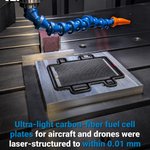
Fuel cells for aerial mobility need to be as light and compact as possible, and the bipolar plates inside the stack are a key part of that. Fraunhofer IWU’s StruBiPlate project explored making these plates from carbon fiber-reinforced polymer instead of metal or graphite. Embossing flow channels directly into the material proved difficult, so the team laminated a prefabricated stainless-steel flow field onto a flat carbon-fiber base, using a laser to roughen the steel about sixfold for strong adhesion. They also used ultrashort-pulse lasers to structure fully cured plates directly, cutting the deviation from the CAD model to 0.01 millimeters. A copper-nickel coating gave corrosion resistance comparable to titanium in one sample, and a prototype stack passed a nitrogen leak test at 1.4 bar. Laser processing is still too slow for series production, since one side of a flow field took several hours.


Researchers examining fossils from the southern North Sea found that large killer whales existed between 2.6 million and 2.1 million years ago.
bit.ly/3VH3UDO

China plans to produce rocket fuel and construction materials from lunar resources.
bit.ly/4kwbBXx

The Japanese-market 2000 Mercedes-Benz G320 features a durable V6 and triple locking differentials, and it was never officially sold in the US.
bit.ly/4zV9WyZ
