Sharing out-of-this-world astrophysics with our on-this-world audience. Brought to you by @CaltechIPAC
Pasadena, CA.
Joined April 2010
- Tweets1.6K
- Following215
- Followers142K
- Likes584
Cold, dark, and keeps to itself? 🖤
Brown dwarfs are “kind of goth,” says @caltechipac's Zafar Rustamkulov. Using NASA’s SPHEREx, scientists studied 37 of these cosmic loners and found water, methane, and clouds that today’s models struggle to match.
spherex.caltech.edu/news/nas…
Something’s grinning in the dark! 🎃
The Jack-o’-Lantern Nebula was carved by a star 15-20x the Sun’s mass, whose radiation hollowed out this cosmic pumpkin. The data now haunts @caltechipac's @NASA_IRSA, free for anyone to explore!
#Astronomy #Halloween
spitzer.caltech.edu/images/6…
Riddle: What acts like a ghost & a skeleton?
Dark matter!
It’s invisible, but its interactions with gravity hold galaxies together. In the Bullet Cluster's mergers, dark matter (blue) was unfazed, like a ghost through a wall 👻
#Astronomy #Halloween
astropix.org/image/stsci/202…
1
8
1,033
🐈⬛ Pspsps… a ghostly black cat prowls the Carina Nebula, 7,500 light-years away. Radiation from massive stars is slowly erasing this cat, so it won’t haunt forever! 🎃 #Astronomy #Halloween
science.nasa.gov/missions/hu…
This infrared image, from NASA's WISE telescope, shows the Witch Head nebula, named after its resemblance to the profile of a wicked witch (or Elphaba without her iconic hat) 🧙♀️
#Astronomy #Halloween #Wicked
astropix.org/image/wise/WISE…
Check out #ExploreExoplanets episdoes 9 & 10, featuring a TESS planet (TOI-700 d) with special guest Dr. Emily Gilbert!
exploreexoplanets.ipac.calte…
Ad astra ⭐
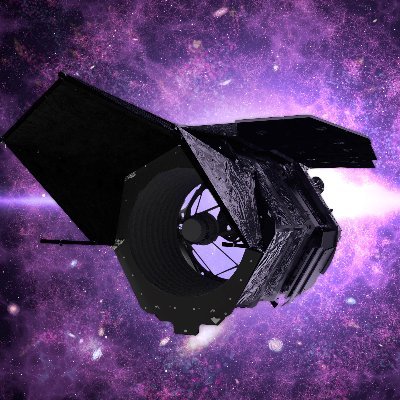
At 7:26am ET (1126 UTC) on Aug. 30, @NASARoman took to the skies en route to its new home 1 million miles away from Earth. It should reach its final destination in one month: go.nasa.gov/4iDR2Hz
ExploreAstro at Caltech IPAC retweeted
The Nancy Grace Roman Space Telescope has officially launched and is heading to its forever home at L2!
Over the next three months, the observatory will perform final checks and power its instruments before revealing its first images by early 2027.
nasa.gov/Roman
ExploreAstro at Caltech IPAC retweeted
XLSSC 122 is the cosmic rule-breaker scientists didn’t see coming 🫣
This is the earliest galaxy cluster to exhibit strong gravitational lensing, bending light from galaxies behind it, and it breaks the previous record by a few billion years!
ipac.caltech.edu/news/new-jw…
ExploreAstro at Caltech IPAC retweeted
Euclid captures the Milky Way’s crowded heart 📸 🧡
The largest and most detailed visible light image ever made of the center of our Milky Way is revealed by @ESA’s Euclid mission 🎉
Quick Release 2 data is now available in @NASA_IRSA!
euclid.caltech.edu/news/esa-…
ExploreAstro at Caltech IPAC retweeted
CoRoT-2 b is flipping the script 😵💫 ❤️🔥
Typically, hot Jupiters are tidally locked, meaning one side always faces their star. But new research from Aurora Kesseli, staff scientist at @NExScI_IPAC, suggests CoRoT-2 b isn't tidally locked!
ipac.caltech.edu/news/oddbal…
ExploreAstro at Caltech IPAC retweeted
The most common types of exoplanets are oddly missing from our own solar system 🤔
Scaling K2, an ongoing project at @NExScI_IPAC, is diving into this enigma:
ipac.caltech.edu/news/findin…
These clouds host molecules like water, carbon dioxide, and carbon monoxide, which are vital to the chemistry that allows life to develop. Researchers believe these ice reservoirs, attached to the surfaces of tiny dust grains, are where the universe’s water is formed & stored.
The first image shows the chemical signatures of water ice (shown in bright blue) and polycyclic aromatic hydrocarbons (orange) in Cygnus X, one of the most active and turbulent regions of star birth in our Milky Way galaxy.
NASA's SPHEREx mission is mapping 'interstellar glaciers' across our galaxy, and these icy regions may be the origins of glaciers—and all water—on Earth 💧
spherex.caltech.edu/news/int…
Amaze! Amaze! Amaze! 🪨🎶🎵
@caltechipac scientist Catherine Clark was quoted in a @PhysicsToday article about the science behind the book and recently released movie @projecthailmary
Check out her quote about Rocky's home planet here:
physicstoday.aip.org/news/sc…
Hello, Moon. It’s great to be back.
Here’s a taste of what the Artemis II astronauts photographed during their flight around the Moon. Check out more photos from the mission: nasa.gov/artemis-ii-multimed…
ExploreAstro at Caltech IPAC retweeted
Caltech and NASA JPL scientists are tracking Artemis II on its way to the Moon. These images were taken using the Hale Telescope at Palomar Observatory, one of the largest telescopes in the world.
A green-tinted double whammy: it's St. Patrick's Day & #MessierMarathon week! 💚
Messier 81 is a sight to behold in this image from NASA's Spitzer Space Telescope. In the night sky, M81 is visible with binoculars! (but it won't look green like in this infrared image 😉)
🧵1/3
This 8-micron image reveals infrared emissions from hot dust, heated by nearby luminous stars. These dust particles absorb ultraviolet and visible light, re-emitting it as longer infrared wavelengths.
🧵2/3
1
2
521