Huge thanks to all our sponsors for helping us bring the Effect community together in Italy this December. 🤍
We're so happy to have you on board!
@zivergetech @EffectfulTech @warpdotco @executorsh @academind_real @Cloudflare @novelcrafter
effect.website/effect-days#s…
Effect | TypeScript for the AI Era retweeted
.@EffectTS_ is making TypeScript what it should be
I feel like people don't get what we mean when we say we're building a framework for @EffectTS_
it's not "just" frontend + backend, think BIGGER
imagine starting a new project and auth, workflows, billing etc are all just... there, and you focus on your business logic
Effect | TypeScript for the AI Era retweeted
Planning content for the @EffectTS_ Days workshop and finding it quite difficult
Agents write most of our code now, so I'm thinking we should focus more on system design, architecture, and choosing the right abstractions with Effect
What do you all think?
Welcome to our live show! www.nitter.gq/i/broadcasts/2nQqNZrqX…
.@maxedapps co-founded @academind_real and has taught coding to over 3 million students.
At Effect Days 2026, he’ll show how his team built an AI-native education platform using the CA(F)E stack (Cloudflare, Alchemy, Foldkit, and Effect) ☕️
Learn more about Effect Days 2026:
effect.website/effect-days
3
524
A running thread of Effect community videos 🧵
Talks, tutorials, demos, podcasts, workshops - in no particular order - we’ll collect useful videos from people across the community building with, teaching, and talking about Effect.
You MUST learn and use Effect now!
By @maxedapps
youtube.com/watch?v=tT_JLVgJ…
Will the client get a pineapple pizza? 🍍🍕
Watch the video below to find out:
youtu.be/xB3YKYwoqxM
What if changing your HTTP API broke your client at compile time instead of in production?
This week learn how to:
→ Define your API once with schemas
→ Derive a server and client from it
→ Reject bad requests before your handlers run
Module of the Week: HttpApi ↓
16
1,311
Effect | TypeScript for the AI Era retweeted
Let's fucking goooooooooooooooo!
Hello friends,
I have some super exciting and probably not-all-that-surprising news to share!
I'm joining Effectful Technologies full time as a core maintainer of Effect, and I'm bringing Foldkit with me. Foldkit will live under the Effect organization.
I started Foldkit in June 2025 to explore what an Effect-native frontend framework could look like. Since then, Foldkit has found production users, grown a community of developers, and reached 1,200+ GitHub stars and around 180k weekly npm downloads.
It's a great start. Now, we're putting the full power of the Effect team behind the project and setting our sights on something much bigger.
Foldkit will move beyond frontend to become Effect's full-stack application framework: a composable, opinionated, agent-friendly stack from browser to database, built directly on Effect primitives.
A few more things I'm particularly excited about:
On the frontend, we're rebuilding Foldkit's foundation from the ground up, and I couldn't be happier about how it's going. We're building composable, Elm-inspired primitives directly into Effect so you can build UIs across different rendering environments. We're taking what we've learned building Foldkit and using it to create something better suited to production applications at scale.
Beyond the frontend, we're bringing that same opinionated, Effect-native approach to data access, auth, email, background work, sync and local-first, and deployment. The pieces will be composable and testable, with observability built in.
The goal is to make building a whole product with Effect feel as cohesive and powerful as writing a single Effect program.
Personally, I'm thrilled to work as part of the Effect team. It's been a dream of mine.
Q&A
What happens to the current Foldkit frontend framework?
Feature development will pause as we shift that work to the new frontend foundation. We'll keep fixing critical bugs at least until it ships with an upgrade guide.
Should I keep building with Foldkit or start a new project with it?
Yes. If you build a Foldkit app today, we'll give you an upgrade path to the new frontend foundation.
What is the new frontend foundation?
The new frontend foundation will be part of Effect itself and the basis for Foldkit's full-stack framework. It will provide composable, host-agnostic, Elm-inspired primitives for building user interfaces with Effect. It keeps what people like about Foldkit today while addressing the rough edges.
Will existing applications need to be migrated or rewritten?
Migrated, yes. Rewritten, no. Moving to the new frontend foundation should feel like a major Foldkit upgrade, not like adopting a new framework. There will be API changes, some of them substantial, and we'll publish upgrade guides as they take shape.
What happens to the Blocks and Layers preview release?
The Blocks and Layers preview won't ship. That work will be absorbed into the new frontend foundation.
Thank you to everyone who's used Foldkit, contributed, shared feedback, or helped spread the word. You've helped shape what Foldkit is today, and I'm incredibly excited about what we'll build next.
We're just getting started.
foldkit.dev/blog/foldkit-joi…
Effect | TypeScript for the AI Era retweeted
You have no idea how good @foldkit is.
But the below should give you a little hint. 👇
Hello friends,
I have some super exciting and probably not-all-that-surprising news to share!
I'm joining Effectful Technologies full time as a core maintainer of Effect, and I'm bringing Foldkit with me. Foldkit will live under the Effect organization.
I started Foldkit in June 2025 to explore what an Effect-native frontend framework could look like. Since then, Foldkit has found production users, grown a community of developers, and reached 1,200+ GitHub stars and around 180k weekly npm downloads.
It's a great start. Now, we're putting the full power of the Effect team behind the project and setting our sights on something much bigger.
Foldkit will move beyond frontend to become Effect's full-stack application framework: a composable, opinionated, agent-friendly stack from browser to database, built directly on Effect primitives.
A few more things I'm particularly excited about:
On the frontend, we're rebuilding Foldkit's foundation from the ground up, and I couldn't be happier about how it's going. We're building composable, Elm-inspired primitives directly into Effect so you can build UIs across different rendering environments. We're taking what we've learned building Foldkit and using it to create something better suited to production applications at scale.
Beyond the frontend, we're bringing that same opinionated, Effect-native approach to data access, auth, email, background work, sync and local-first, and deployment. The pieces will be composable and testable, with observability built in.
The goal is to make building a whole product with Effect feel as cohesive and powerful as writing a single Effect program.
Personally, I'm thrilled to work as part of the Effect team. It's been a dream of mine.
Q&A
What happens to the current Foldkit frontend framework?
Feature development will pause as we shift that work to the new frontend foundation. We'll keep fixing critical bugs at least until it ships with an upgrade guide.
Should I keep building with Foldkit or start a new project with it?
Yes. If you build a Foldkit app today, we'll give you an upgrade path to the new frontend foundation.
What is the new frontend foundation?
The new frontend foundation will be part of Effect itself and the basis for Foldkit's full-stack framework. It will provide composable, host-agnostic, Elm-inspired primitives for building user interfaces with Effect. It keeps what people like about Foldkit today while addressing the rough edges.
Will existing applications need to be migrated or rewritten?
Migrated, yes. Rewritten, no. Moving to the new frontend foundation should feel like a major Foldkit upgrade, not like adopting a new framework. There will be API changes, some of them substantial, and we'll publish upgrade guides as they take shape.
What happens to the Blocks and Layers preview release?
The Blocks and Layers preview won't ship. That work will be absorbed into the new frontend foundation.
Thank you to everyone who's used Foldkit, contributed, shared feedback, or helped spread the word. You've helped shape what Foldkit is today, and I'm incredibly excited about what we'll build next.
We're just getting started.
foldkit.dev/blog/foldkit-joi…
Huge news! @devinjameson, creator of @foldkit , is joining us full-time as a core maintainer of Effect 🚀
Better yet @foldkit is coming along with him, and we have big plans for it…

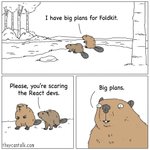
ALT Three-panel "They Can Talk" comic featuring two beavers by a river. Panel 1: Two beavers stand on a riverbank looking out at the water. One says, "I have big plans for Foldkit." Panel 2: The second beaver looks worried and says, "Please, you’re scaring the React devs." Panel 3: Close-up of the first beaver staring intensely with wide, unblinking eyes, saying, "Big plans."
Hello friends,
I have some super exciting and probably not-all-that-surprising news to share!
I'm joining Effectful Technologies full time as a core maintainer of Effect, and I'm bringing Foldkit with me. Foldkit will live under the Effect organization.
I started Foldkit in June 2025 to explore what an Effect-native frontend framework could look like. Since then, Foldkit has found production users, grown a community of developers, and reached 1,200+ GitHub stars and around 180k weekly npm downloads.
It's a great start. Now, we're putting the full power of the Effect team behind the project and setting our sights on something much bigger.
Foldkit will move beyond frontend to become Effect's full-stack application framework: a composable, opinionated, agent-friendly stack from browser to database, built directly on Effect primitives.
A few more things I'm particularly excited about:
On the frontend, we're rebuilding Foldkit's foundation from the ground up, and I couldn't be happier about how it's going. We're building composable, Elm-inspired primitives directly into Effect so you can build UIs across different rendering environments. We're taking what we've learned building Foldkit and using it to create something better suited to production applications at scale.
Beyond the frontend, we're bringing that same opinionated, Effect-native approach to data access, auth, email, background work, sync and local-first, and deployment. The pieces will be composable and testable, with observability built in.
The goal is to make building a whole product with Effect feel as cohesive and powerful as writing a single Effect program.
Personally, I'm thrilled to work as part of the Effect team. It's been a dream of mine.
Q&A
What happens to the current Foldkit frontend framework?
Feature development will pause as we shift that work to the new frontend foundation. We'll keep fixing critical bugs at least until it ships with an upgrade guide.
Should I keep building with Foldkit or start a new project with it?
Yes. If you build a Foldkit app today, we'll give you an upgrade path to the new frontend foundation.
What is the new frontend foundation?
The new frontend foundation will be part of Effect itself and the basis for Foldkit's full-stack framework. It will provide composable, host-agnostic, Elm-inspired primitives for building user interfaces with Effect. It keeps what people like about Foldkit today while addressing the rough edges.
Will existing applications need to be migrated or rewritten?
Migrated, yes. Rewritten, no. Moving to the new frontend foundation should feel like a major Foldkit upgrade, not like adopting a new framework. There will be API changes, some of them substantial, and we'll publish upgrade guides as they take shape.
What happens to the Blocks and Layers preview release?
The Blocks and Layers preview won't ship. That work will be absorbed into the new frontend foundation.
Thank you to everyone who's used Foldkit, contributed, shared feedback, or helped spread the word. You've helped shape what Foldkit is today, and I'm incredibly excited about what we'll build next.
We're just getting started.
foldkit.dev/blog/foldkit-joi…
So far Devin has maintained Foldkit in his spare time on nights and weekends
Now we’re putting the full Effect team behind it and expanding its scope: our goal is to turn Foldkit into Effect’s full-stack framework: composable, opinionated, and agent-friendly
We’ll also be streaming tomorrow at 10AM EST to talk more about what’s ahead for Effect and Foldkit and answer your questions
youtube.com/live/9E4M8I-4yHs…
Welcome to the team, @devinjameson! We’re excited to build with you!
14
876
Effect | TypeScript for the AI Era retweeted
Hello friends,
I have some super exciting and probably not-all-that-surprising news to share!
I'm joining Effectful Technologies full time as a core maintainer of Effect, and I'm bringing Foldkit with me. Foldkit will live under the Effect organization.
I started Foldkit in June 2025 to explore what an Effect-native frontend framework could look like. Since then, Foldkit has found production users, grown a community of developers, and reached 1,200+ GitHub stars and around 180k weekly npm downloads.
It's a great start. Now, we're putting the full power of the Effect team behind the project and setting our sights on something much bigger.
Foldkit will move beyond frontend to become Effect's full-stack application framework: a composable, opinionated, agent-friendly stack from browser to database, built directly on Effect primitives.
A few more things I'm particularly excited about:
On the frontend, we're rebuilding Foldkit's foundation from the ground up, and I couldn't be happier about how it's going. We're building composable, Elm-inspired primitives directly into Effect so you can build UIs across different rendering environments. We're taking what we've learned building Foldkit and using it to create something better suited to production applications at scale.
Beyond the frontend, we're bringing that same opinionated, Effect-native approach to data access, auth, email, background work, sync and local-first, and deployment. The pieces will be composable and testable, with observability built in.
The goal is to make building a whole product with Effect feel as cohesive and powerful as writing a single Effect program.
Personally, I'm thrilled to work as part of the Effect team. It's been a dream of mine.
Q&A
What happens to the current Foldkit frontend framework?
Feature development will pause as we shift that work to the new frontend foundation. We'll keep fixing critical bugs at least until it ships with an upgrade guide.
Should I keep building with Foldkit or start a new project with it?
Yes. If you build a Foldkit app today, we'll give you an upgrade path to the new frontend foundation.
What is the new frontend foundation?
The new frontend foundation will be part of Effect itself and the basis for Foldkit's full-stack framework. It will provide composable, host-agnostic, Elm-inspired primitives for building user interfaces with Effect. It keeps what people like about Foldkit today while addressing the rough edges.
Will existing applications need to be migrated or rewritten?
Migrated, yes. Rewritten, no. Moving to the new frontend foundation should feel like a major Foldkit upgrade, not like adopting a new framework. There will be API changes, some of them substantial, and we'll publish upgrade guides as they take shape.
What happens to the Blocks and Layers preview release?
The Blocks and Layers preview won't ship. That work will be absorbed into the new frontend foundation.
Thank you to everyone who's used Foldkit, contributed, shared feedback, or helped spread the word. You've helped shape what Foldkit is today, and I'm incredibly excited about what we'll build next.
We're just getting started.
foldkit.dev/blog/foldkit-joi…
.@zivergetech is one of the main sponsors of Effect Days 2026!
@zioscala, the library created by Ziverge’s founder @jdegoes, helped shape the early versions of Effect.
Thanks to the Ziverge team for helping bring the Effect community together in Italy this December! 🇮🇹
Effect | TypeScript for the AI Era retweeted
Same for our MCP server. In the last few months, my agents worked on:
- exhaustive @sentry tracing
- fully rebuilding everything on @EffectTS_
- moved all tools into @𝚗𝚎𝚘𝚗/𝚝𝚘𝚘𝚕𝚜 and made them highly configurable (redact secrets, read-only mode, etc)
- server now exposes 99% of Neon API capabilities
- added scoping via MCP server URL query params and OAuth UI (project-only, read-only, custom pg role, no secrets vs. yolo mode, filter tools by categories)
And just getting started - it's now turning into a factory! Traces, evals and user feedback -> open PRs for my review. Will also tackle more scoping options and perf enhancements next.
My agents have been grinding away on Neon DX:
• Building new management SDKs (@𝚗𝚎𝚘𝚗/𝚜𝚍𝚔, @𝚗𝚎𝚘𝚗/𝚝𝚘𝚘𝚕𝚜, @𝚗𝚎𝚘𝚗/𝚎𝚏𝚏𝚎𝚌𝚝) from scratch
• Adding CLI support for 99% of Neon's API methods
• Building out our AI SDK provider and @𝚗𝚎𝚘𝚗/𝚏𝚞𝚗𝚌𝚝𝚒𝚘𝚗𝚜 SDK
• Creating a new config-as-code system (𝚗𝚎𝚘𝚗.𝚝𝚜)
• Refactoring big parts of the 𝚗𝚎𝚘𝚗 𝚒𝚗𝚒𝚝 onboarding flow
• Adding Sentry to the CLI
And much more.
Getting this much done in a few months would've been impossible before agents. So freaking cool.
What if changing your HTTP API broke your client at compile time instead of in production?
This week learn how to:
→ Define your API once with schemas
→ Derive a server and client from it
→ Reject bad requests before your handlers run
Module of the Week: HttpApi ↓
Read the full post by @maxwellbrown here:
effect.website/blog/module-o…