

An ideas advocacy org building economic power for all. ⬇️https://www.nitter.gq/t.co/sZdNuWXk6D
Joined November 2016
- Tweets8.6K
- Following1.2K
- Followers11.9K
- Likes5.3K





In a new Inside Philanthropy article, ESP Executive Director @taylorjo reflects on a decade of experimentation with #GuaranteedIncome and describes cash as “a powerful tool for stabilization at points of transition,” whether that's starting a family, leaving foster care, or navigating changes in work.
As AI rapidly changes our future and raises questions about the future of work, direct cash assistance has been embraced by some of the most high-profile AI leaders like Anthropic and Elon Musk. But we know cash cannot be just a consolation prize for the losers, as Taylor Jo notes: “Any playbook that rests on the idea of, ‘I’m going to destroy the fundamentals of a healthy economy and hope paying someone out is going to work in my favor’ is not going to stave off the pitchforks.”
She goes on to clarify that philanthropy’s role is to show that cash works as a powerful stabilizer during moments of transition. Public investment is what brings that stability to more people through our tax and benefits systems and addresses the deeper economic inequalities that leave families struggling.
Read the full piece: insidephilanthropy.com/home/…

187
Companies are using what they know about you — your shopping history, your location, your age — to quietly raise prices. It’s called surveillance pricing.
ESP’s Erion Malasi spoke with @WGNNews Investigates about the risks of surveillance pricing and what it means for families trying to afford everyday essentials. With your personal data and even your phone’s location, companies can figure out the most you’re willing to pay and charge you that, making it harder to compare prices, plan a budget, or know if you’re getting a fair deal.
That means two people shopping for the exact same groceries could see different prices without ever knowing it. And families could end up paying more than $1,200 extra a year. Families deserve protection from corporations looking to turn their private information into bigger profits.
Learn more here: wgntv.com/news/wgn-investiga…
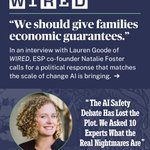
ESP co-founder @nataliefoster recently spoke with journalist @LaurenGoode for @WIRED about what AI means for working families, and why our political response needs to match the scale of the change it will bring. As she put it: “If AI is going to be one of the most significant advances in human civilization, then we should have an equally advanced political response.”
That means giant, no-regrets moves that give people and families the economic resilience to withstand what’s coming. Guarantees like universal childcare, affordable housing and healthcare.

Read the full piece:
wired.com/story/the-ai-safet…

84
Americans are tired of the affordability crisis, and the 2026 midterms showed it.
Rising prices on the basics like food, gas, healthcare, and childcare were a key driver, sending young people and families to the polls for change. Before Election Day, 84% of voters said the economy was very important to their vote. Exit polls confirmed this, with 89% of voters saying the cost of living was important to their vote.
Across the country, a relentless focus on kitchen table costs powered winning campaigns, here’s how:
- Calling out a broken, expensive healthcare system and making the case for care that works for families boosted campaigns in South Carolina, Michigan, and Ohio.
- Universal childcare and ideas to lower costs for families proved popular in Iowa, Pennsylvania, New Jersey, and California.
- Fighting high prices and grocery consolidation proved popular in Illinois, Mississippi, and Kentucky.
- The Child Tax Credit and direct cash took center stage in Georgia, Texas, and Ohio.
Young voters were at the center of the shift. After drifting towards Trump in 2024, they swung more than 20 points toward Democrats in 2026, the largest shift of any age group. This seismic swing was driven by concerns that the cost of living is preventing Gen Z from achieving major life milestones, like buying a home and having kids.
Americans can’t afford this economy. And newly elected statehouses and Congressmembers must meet the moment with real solutions to the affordability crisis, from expanding the Child Tax Credit to guaranteeing healthcare for all families.

The cost of living is on the ballot today. 🗳️
Here's what rising costs look like for families across the country:
- Healthcare: The cost of a benchmark ACA plan jumped from $497 in 2025 to $625 a month in 2026.
- Housing: Rent for a new lease is now nearly $2,000 a month nationwide.
- Gas: Prices reached a national average of $4.27 a gallon in October 2026.
- Groceries: Since December 2024, coffee prices have risen 37.7% and ground beef prices have climbed 21.2%.
- Childcare: Prices increased 7.1% between December 2024 and September 2026.
With paychecks losing purchasing power and the costs of everyday essentials continuing to rise, families are feeling the pressure.
That's why election day matters. Everybody deserves a say in our economic future. Find your polling place and vote today: vote.org/

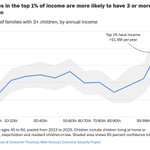
Having a third child is becoming a luxury.
Research from @mtkonczal finds 49% of top-1% families have 3+ kids, versus 40–43% across most other income groups.
The takeaway: families need more financial stability and support to afford the kids they want.

1
1
233
The @washingtonpost reports on @mtkonczal's findings and what they reveal about the rising cost of raising a family:
washingtonpost.com/business/…

Read Mike's original analysis, including the data and charts behind the findings:
newsletter.mikekonczal.com/p…

1
63
Economic Security Project retweeted

New research from the @EconomicSecProj looked at outcomes across 40 guaranteed income pilots and found that full-time employment rose, with the gains holding after the pilots ended.
Cash works — and paired with coaching, it lasts.
Read the report: economicsecurityproject.org/…

Economic Security Project retweeted

PCE inflation broken down by contribution. Core services and housing alone are about 2.5 percentage points of inflation across different windows.
Over the past 12 months, inflation has been a full percentage point higher than it was in 2024. Things have gotten worse.


Reentry is one of life’s most critical transitions, and most people return to their communities from incarceration with less than $50 in their pocket.
ESP’s new memo, “A Path to Safer, Stronger Communities: The Case for Guaranteed Income in Reentry,” looks at what happens when returning citizens receive direct cash. Across pilots in Florida, North Carolina, Illinois, and California, cash reduced recidivism, supported full-time work, and helped families cover bills and essentials. It’s also a smart public investment, costing a fraction of what states spend on incarceration.
Cash gives people the stability to show up for themselves and their families. As one Chicago Future Fund participant put it, “It’s like an extra push to keep going.”
Across the pilots, we found cash works best when other policies reinforce it, and our memo lays out key recommendations for how policymakers can build on these results, including:
- Reallocating funding from prisons to guaranteed income for returning citizens
- Providing cash at scale during reentry, including through cannabis revenue or by expanding “gate money” into recurring monthly payments
- Ending SNAP and TANF bans for people with records
- Removing criminal-record barriers to public and subsidized housing
- Abolishing criminal justice fines and fees
- Enacting fair chance hiring laws, paired with records expungement and access to ID and fee-free bank accounts
Mass incarceration reaches whole families. The financial precarity it creates makes children of returning citizens more likely to encounter the justice system themselves. Guaranteed income addresses that precarity directly, helping break the cycle for the next generation.
Read our memo here: economicsecurityproject.org/…
1
2
239
Economic Security Project retweeted

Thank you to everyone who joined us for @EconomicSecProj's conversation with @realtahiramin and @gabyaboulafia on how corporate power is driving the healthcare affordability crisis!


California’s next governor will decide the state’s AI future, and will have a long list of priorities to tackle upon taking office. In a new @Capitol_Weekly OpEd, our VP of States Strategy Teri Olle and James Irvine Foundation CEO Don Howard argue that the future of AI and how it will impact California’s workforce should be at the top of the list.
They ask three key questions the next governor needs to answer: As AI transforms the state’s workforce, which public support systems need fixing in order to support displaced workers? Who’s going to pay and who’s going to benefit from this rapid change? And most importantly: who should decide all of this?
The midterms are a week away. California can be both the epicenter of AI development and the model for AI accountability, but only if the next governor treats this as the emergency it already is.
Read the op-ed: capitolweekly.net/ai-is-cali…

ESP co-founder @chrishughes's new @BrookingsInst paper shows that even the Fed’s most technical decisions are choices about who the economy works for. His Elastic Reserves proposal would shrink the Fed’s footprint to its smallest share of GDP since 2008 and cut the interest it pays banks by about two-thirds. brookings.edu/articles/the-c…

347
Direct cash should be part of the toolkit for addressing America's housing crisis. Philadelphia put it to the test.
Nearly half of all American renters are burdened by housing costs—and the federal voucher program, the country's rental assistance program, reaches only about 25% of eligible households.
PHLHousing+ tried something different. The pilot put cash in the hands of 301 low-income renter families with children, and who were on the voucher waitlist, to help with high housing costs. Unlike traditional housing vouchers, the assistance went directly to families, and 100% of households offered the cash were able to use it.
Preliminary findings from the University of Pennsylvania show that after at least a year of receiving cash, families experienced up to 75% fewer forced moves than families receiving no assistance. Cash also reduced homelessness by over 50% and improved housing quality concerns.
Earlier this year, ESP released Building Affordability, our policy agenda for tackling America’s housing crisis. One of its core recommendations is providing supplemental cash to families facing severe housing insecurity. Philadelphia’s results show that cash belongs in the toolkit to make housing more affordable, right alongside modernizing vouchers, more housing, and stronger renter protections.
Read our report: economicsecurityproject.org/…

Economic Security Project retweeted
What distinguishes the 1% from the merely affluent? How about having a third child.
New post on a topic I've long been fascinated by (the economics and financing of having a third kid) where I finally felt bold enough to go into the latest SCF microdata to get a good answer. /1
