
Free online community for data builders. Learn data, ML, MLOps, LLMs, RAG, and AI engineering. Join free hands-on courses, events, workshops, and podcasts.
Joined October 2020
- Tweets2.7K
- Following6
- Followers11.4K
- Likes1.3K



Pinned Tweet
Want to talk about data?
Data science, career questions, practical machine learning, and more?
Join @DataTalksClub! The link is in the profile description.
Learn more about our activities in the thread! 🧵

DataTalksClub retweeted
Batch-generating a lot of videos? Don't send each file back in the API response.
Mikhail Rozhkov from Nebius explained why in our pre-course Q&A for Production AI Agents for Generative Media.
For a prototype, it's fine. But what if you start getting more traffic?
In our workshop "Build a Media Agent", Alexey Grigorev listed what changes.
- Scale: more endpoints, many GPUs
- Failures: send 10,000 requests at once and probably a few will fail, so retry them
- Evaluation: which prompt did the agent use, did it use the right tool?
- Monitoring, optimization, orchestration
1
1
71
The proof of concept is just the tip of the iceberg.
Watch the recording:
youtube.com/watch?v=XzS6MrNf…
75
DataTalksClub retweeted
Why run media models on your own GPUs when services like Higgsfield AI and Runway give you an API?
Mikhail Rozhkov compared both approaches. Running the model on your own cloud GPU came out cheaper and more customizable.
1/4
DataTalksClub retweeted
A provider that bills per second, or your own GPU for a media model?
Alexey Grigorev asked this in our workshop "Build a Media Agent". Mikhail Rozhkov from Nebius said there is no universal recipe: try it and evaluate it for your use case.
Batch-generating a lot of videos? Don't send each file back in the API response.
Mikhail Rozhkov from Nebius explained why in our pre-course Q&A for Production AI Agents for Generative Media.
DataTalksClub retweeted
Run the same image prompt twice, and you can get two different images. The reason is the seed.
In this clip, Mikhail Rozhkov shows how to make an image model give you the same result every time.
1/3
Why run media models on your own GPUs when services like Higgsfield AI and Runway give you an API?
Mikhail Rozhkov compared both approaches. Running the model on your own cloud GPU came out cheaper and more customizable.
1/4
When you host a model, you can fine tune it and put the behavior you want into the weights. When the model is hosted somewhere else, you do not have this control.
3/4
1
40
This clip is from Production AI Agents for Generative Media, our free course.
Apply here:
courses.datatalks.club/regis…
4/4
30
DataTalksClub retweeted
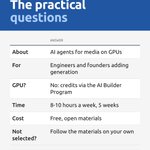
You can build AI agents that generate images, video, and audio without owning a GPU.
That's the setup in the Production AI Agents for Generative Media course.
Before you apply, here are the 3 questions we get most:

A provider that bills per second, or your own GPU for a media model?
Alexey Grigorev asked this in our workshop "Build a Media Agent". Mikhail Rozhkov from Nebius said there is no universal recipe: try it and evaluate it for your use case.
- Run the model on 1,000 images for some minutes or a couple of hours, then estimate the cost at scale
- To start, API providers can be cheaper and faster
- Once you fine-tune, for example for a specific style, you need to serve your own adapter
1
1
51
Watch the full answer in the workshop recording:
youtube.com/watch?v=XzS6MrNf…
58
DataTalksClub retweeted
If your pipeline calls a closed model through an API, the provider decides how long that model stays available.
1/4
Run the same image prompt twice, and you can get two different images. The reason is the seed.
In this clip, Mikhail Rozhkov shows how to make an image model give you the same result every time.
1/3
He generates three images with a fixed seed. Each one takes 1.2 seconds, and the hashes of the three files are identical, so the images are exactly the same.
Change the prompt or remove the seed, and the result changes. To make your results consistent, fix the seed.
2/3
1
49
This clip is from Production AI Agents for Generative Media, our free course.
Apply here:
courses.datatalks.club/regis…
3/3
40