

hacker-in-residence/ principal devrel engineer. data curation for physical and visual ai systems. in my physical ai era
I ship daily
Joined April 2020
- Tweets7.2K
- Following1.7K
- Followers8.2K
- Likes33.8K




Pinned Tweet
a robot can recognize every object in a room and still not know how to open a single drawer
knowing there's a cabinet is scene understanding. knowing which handle to grab, which direction to pull, and that it's a drawer not a door is affordance understanding
almost no dataset has it in 3D
SceneFun3D: 14,800+ functional elements across 710 laser-scanned indoor scenes. every handle, knob, button, and switch labeled with its affordance, motion axis, motion type, and a natural language task description
each scene's 3D point cloud with its iPad video recordings in fiftyone. the affordance annotations live in 3D and project into the video frames
check it out here huggingface.co/datasets/Voxe…
harpreet retweeted

i fine-tuned qwen3-vl 8b to watch a video and tell you how the shot was made. i'm calling it shot reader.
camera height, lens, angle, how the camera moves. who's in frame, where they stand, where they walk.
turns out that's hard for ai. even opus 5.5 and gemini 4, with a prompt written specifically to reverse-engineer shots, get the camera height and move both right less than half the time. open models out of the box: 5%.
shot reader gets 69%. it's 2.4x faster than opus, ~30x cheaper, and small enough to run on your own gpu.
why it matters: ai can already write blender. getting a shot right starts with reading it.
see a shot → get the plan → rebuild it in 3d, reshoot it, remix it.
open weights on hugging face, link below.
existing 3D crop datasets were too narrow and too simple for a perception model to handle a real field.
Crops3D has 1,180 point clouds of 8 crop types, from maize (225) to tomato (83), captured in agricultural research fields in China with multi-view stereo and structured light.
i parsed it into FiftyOne so you can filter by crop type and inspect each plant in the 3D viewer.
huggingface.co/datasets/Voxe…
#PhysicalAI #ComputerVision
2
4
363
disaster responders need verifiable evidence behind a damage report, and VLMs struggle to provide it.
DisasterAgent builds a Spatiotemporal Perception Graph from bitemporal optical imagery, then writes the report with inline citations that tie each statement to its supporting visual evidence.
compared with the original model, it improves the average disaster report score on DisasterM3 by 13.5% and ST5-SCS on RSCC by 15.34%.
read it if you generate remote sensing reports that someone has to verify. the paper says code will be available.
arxiv.org/abs/2611.13776
#ComputerVision #AI

1
6
363
one spherical camera, 360 degrees around the car, has to be enough to draw a bird's-eye-view map.
Dur360BEV-Extended adds 15,400 synchronized frames to Dur360BEV. each pairs a dual-fisheye image with a 128-channel Ouster LiDAR scan and RTK GPS/IMU, with 3D boxes in a 100 m by 100 m area.
i parsed it into FiftyOne so you can scrub the image and LiDAR with 3D box wireframes on both.
huggingface.co/datasets/Voxe…
#PhysicalAI #AutonomousDriving
before you point a data loader at droid_3d's 58,201 episodes and ~1.3 TB, you want a small slice to test it on.
this 68-episode subset keeps the RGB streams only: a wrist camera, 2 external cameras, 8-dim actions, and a language task description per episode at 15 fps.
i parsed it into FiftyOne so you can filter episodes by task text and watch all 3 camera views together.
huggingface.co/datasets/Voxe…
#PhysicalAI #Robotics
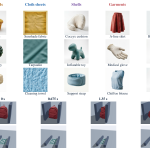
simulated deformable objects usually come with visual diversity but no physical properties you can execute.
RFW-S has 83,365 simulation-verified assets across 485 everyday categories in five structural families: soft solids, cloth sheets, shells, garments, and bags.
an independent verification step checks behavior under interactions different from those used for calibration. grasping is scored on task success and object integrity.
a library for testing grasping on deformable objects.
arxiv.org/abs/2611.23056
#PhysicalAI #Robotics

4
271
a detector that finds the cabinet still leaves the robot looking for the handle.
SceneFun3D (CVPR 2024 Oral) labels 14,867 handles, knobs, and buttons across 710 indoor scenes, with 9 affordance categories, motion parameters, and tasks like "open the drawer next to the sink".
i parsed 10 scenes from each split into FiftyOne so you can spin the laser scan with its functional elements next to the iPad video and its depth.
huggingface.co/datasets/Voxe…
#PhysicalAI #ComputerVision
prototyping on egocentric factory video is slow when you start from the full dataset.
Egocentric 10K subset keeps Factory 51: 8 workers and 416 samples at 1920x1080 and 30 fps, from a head camera with a 128 degree horizontal field of view. no audio.
i parsed it into FiftyOne so you can filter by worker_id and watch hand-object interactions play back.
huggingface.co/datasets/Voxe…
#PhysicalAI #ComputerVision
cone-beam CT is tuned for bone, so soft-tissue problems hide under photon noise and usually need a second MRI scan.
BertsWin + PhysLoss is a 3D masked autoencoder pre-trained on 6,550 unlabeled CBCT volumes, with a loss that steers gradient flow into the [-300, 300] HU soft-tissue window.
on 212 paired CBCT-MRI joints it reaches ROC AUC 0.793 for MRI-verified synovial effusion. the same architecture pre-trained with standard L2 loss collapses to random guessing.
a recipe for opportunistic screening from routine scans.
arxiv.org/abs/2611.23042
#PhysicalAI #MedicalAI

3
175
3 of the 4 drives in this dataset were recorded at night in rain.
the CMHT Autonomous Dataset puts a Velodyne HDL-32E LiDAR, a Retina-4fn mmWave radar, an RGB camera, and a FLIR A65 thermal camera on one vehicle, with over 9,000 labeled frames.
i parsed it into FiftyOne so you can play the RGB, thermal, LiDAR, and radar in sync with the 3D tracklet boxes.
huggingface.co/datasets/Voxe…
#PhysicalAI #AutonomousDriving
5
374
harpreet retweeted

We ran Kimi K3.1 Pro through 22 domain-specific benchmarks. Where it beats top closed models:
- τ³-Banking (Sierra, banking customer support): #1 of 21 at 63.3%, ahead of Gemini 4 Argon (58.2%), Claude Opus 5.5 (56.0%), GPT-6 Astra (44.8%) and GPT-6.1 Sol (44.7%)
- Legacy-Bench (Factory, maintaining COBOL, Fortran and Java 7 code): #1 of 14 at 63.0%, edging Claude Opus 5.5 (62.0%) at 22% lower cost and well ahead of GPT-6 Astra (55.7%)
- LAB (Harvey, first-year-associate legal work): #2 of 14, behind only Grok 4.6. Fully solves 15.4% of tasks vs 6.3% for Opus 5.5
- HealthBench Professional (clinical consults): #3 of 15, ahead of Claude Opus 5, Gemini 4 Argon and Grok 4.6
- CorporateBench (Epiq, company records from email archives) and FrontierFinance (Samaya AI, investment research): #4 on both, ahead of Opus 5.5
- Parallel Search (web research): top 5 of 22, ahead of GPT-6 Astra and GPT-6.1 Sol, and 1.9 points behind Opus 5.5 at 70% lower cost
Where it's weak:
- DAYJOB (Surge AI, everyday work in law, finance, accounting, tax, data science and healthcare): 8th–14th on all six, passing 9–40 percentage points fewer tasks than the top model. On finance and healthcare it trails 10+ closed models (17.0% vs Opus 5.5's 42.5%; 8.8% vs 48.3%)
- sudo L7 (Surge AI, changes to production codebases): 16.7% vs 46.1% for Opus 5.5 and 50.6% for Claude Sonnet 5.5
- ORCA (Traversal, production incident diagnosis): #3, but finds the exact root cause 32.9% of the time vs 50.2% for GPT-6 Astra
- FrontierMemory (Letta, writing memories for other agents): #11 of 17 at 55.6%, vs 73.3% for Opus 5.5 and 71.1% for Kimi K3
- LAB: Contracts (Harvey, contract review): #9 of 16 at 3.0%, down from Kimi K3's 8.3%
- Cost: on τ³-Banking each resolved request costs 88% more than with Opus 5.5 and takes 2.3x as long. On Big Finance (Rogo), GPT-6.1 Sol scores higher (52.0% vs 48.2%) at about a third of the cost

K3.1 Pro from @Kimi_Moonshot outscores K3 on 14/17 practitioner-built benchmarks on the SII.
Against Opus 5.5, it can cut costs on some workloads or improve quality at a premium on others.
Should you switch your agents? See where K3.1 Pro fits in our new SII model study: bit.ly/kimisiix
most driving datasets face forward, and a parking system needs the view from above.
AVM Segmentation has 6,763 bird's-eye images from around-view cameras at 320 x 160 pixels, 3,149 indoor and 3,614 outdoor. pixel masks cover 5 classes, from free space to the ego vehicle.
i parsed it into FiftyOne so you can filter by indoor or outdoor, parking type, and slot type.
huggingface.co/datasets/Voxe…
#PhysicalAI #AutonomousDriving
reconstructing 3D geometry and tracking motion usually take separate models.
Pi4 is a foundation model of about 0.5B parameters that handles both in one forward pass. it takes single images, image collections, or video without camera calibration, and outputs 3D geometry, camera poses, point tracks, and dynamic object masks.
it ranks best on average across 16 geometry evaluation settings and works from thousands of input images despite training on at most 64 views.
weights and a demo Space are on Hugging Face.
github.com/yyfz/Pi4
#PhysicalAI #ComputerVision

5
347
where a robot's head points before its hands move can be measured, and TAVIS calls it gaze-action lead time.
TAVIS-HEAD Reachy2 has 800 VR-teleoperated demonstrations of a simulated Pollen Reachy 2 torso in NVIDIA IsaacLab, with 5 tasks, a 19-D action space, and 4 RGB video streams.
i parsed it into FiftyOne so you can filter by task and watch the head, wrist, and fixed cameras together.
huggingface.co/datasets/Voxe…
#PhysicalAI #Robotics
1
202
very few Mars images come with high-quality pixel labels.
S5Mars labels only the pixels its annotators were confident about and leaves the rest unlabeled. it has 6,000 Curiosity rover images at 1200 x 1200 pixels, 3,000 easy and 3,000 hard, with 9 terrain classes including sand, bedrock, and wheel traces.
i parsed it into FiftyOne so you can filter easy against hard and overlay the masks.
huggingface.co/datasets/Voxe…
#PhysicalAI #Robotics
thanks for sharing! for those interested the embeddings are using qwen3vl-embeddings on 5 sec windows of the video. we can search by segment to segment as well as text to segment

Wow. This fixes one of the most annoying parts of training robots.
Until now, finding one failed grasp meant rewatching hours of recordings.
@voxel51 now searches MCAP and LeRobot data in plain English and returns the exact seconds.
- One bad grasp → every similar one
- Tells you if it's a one-off or a failure mode
- All sensor streams on one timeline
And it's free to use. This saves a lot of training runs.
oh hey, it's me!
Wow. This fixes one of the most annoying parts of training robots.
Until now, finding one failed grasp meant rewatching hours of recordings.
@voxel51 now searches MCAP and LeRobot data in plain English and returns the exact seconds.
- One bad grasp → every similar one
- Tells you if it's a one-off or a failure mode
- All sensor streams on one timeline
And it's free to use. This saves a lot of training runs.
the action at frame t is the joint state at frame t + 1, and this dataset card spells that out.
Piper Dual Stack Cups (ROS 2 Shifted LeRobot v2.1) has 100 episodes and 61758 frames at 30 FPS, as 14D joint vectors in radians. three RGB cameras are letterboxed to 224 x 224. grippers come from the master arms, unshifted.
load it with the LeRobot API to train imitation policies on dual-arm cup stacking.
huggingface.co/datasets/HITd…
#PhysicalAI #Robotics

2
198
a gaussian splat scene of a playground, with a tornado spinning through it.
PhysStudio is a collection of physics-based animation projects for 3D Gaussian Splatting scenes, from solvers to rendered demos. it covers lightning, hurricanes, lava, snow, rain, wind, ice melting, and a robot pouring demo, and builds on NVIDIA Warp 1.6.
run the solvers and demos on your own splat scenes with each project's run guide.
github.com/zju3dv/PhysStudio
#ComputerVision #AI

Zip-NeRF's official JAX pipeline leaves approximately 6-7x of training speed on the table.
fused-zipnerf replaces it with hand-written CUDA kernels and analytic gradients, without tiny-cuda-nn or PyTorch autograd. quality matches the official implementation, and rendering is approximately 10x faster.
it needs an NVIDIA GPU and installs as an extension to the NeRFICG framework.
github.com/fhahlbohm/fused-z…
#PhysicalAI #ComputerVision

8
523