

Toronto, Ontario
Joined September 2020
- Tweets1K
- Following422
- Followers3.3K
- Likes3.1K







It's crazy how you can just find excellent paper ideas by scrolling Twitter. I would like to see a proper study of looping following these experiments

To Loop or Not 🧵
@thinkymachines just released the incredible Inkling 2 Mini based on looped Transformers. It's in my view the best model release of the year in its class.
So looping clearly wins somewhere, but should we loop every model ?
I also don't know the answer to this question, but there are scientific ways to test it out.
Before getting into it, let's first understand what looping is.
Looping reruns the same block of layers several times per token.
k unique layers × L loops = the compute of kL layers with the weights of k.
One way to think about it is the connection with MoE. Well, it's basically MoE in reverse. MoE buys parameters without FLOPs. Looping buys FLOPs without parameters.
Based on evidence from previous papers, it is already clear that looping is the right choice for memory-capped deployment (laptops, phones, edge), or fixed parameter budgets or data-limited training. Some models like NVIDIA's Dory report drastic verbosity reductions up to 2.5 times less at 4 loops.
Despite these amazing results, It's not evidently clear whether we should loop for every model. Here's my suggested tests:
Test 1: iso-throughput pretraining
Run a looped vs non-looped study with same data, same measured tokens/s on the same hardware (not FLOPs). Report reasoning and knowledge evals separately (see the caveats at the end to know why).
Do you get more gains by running a looped model vs a non-looped model that takes the same amount of time to run on your hardware ?
Test 2: Does looping introduce new gains ?
Comparisons of looped vs normal transformers usually change three things at once:
(1) Weight sharing: every pass reuses the same weights.
(2) The boundary operator: before each pass, it normalizes the hidden state and adds the original input back in, so every pass still sees the input.
(3) Growth: start shallow and add passes midway through training.
Also. let's distinguish what ties vs untied means. A tied model stores one copy of the block's weights and reuses it on every pass. An untied model has the same number of layers, but each pass has its own weights. At the same depth they cost the same FLOPs per token, but untied has more parameters.
Now, let's define a design space here between two classes of models. Ties vs untied.
For each, let's try 2 variants:
(1) No operator, no growth
(2) Operator + growth
Now this is a 2x2 grid. We can define these experiments navigating this space. All of them have the same depth and training tokens, so all four cost the same FLOPs:
Experiment (A): plain looped model
Experiment (B): looped model (e.g. Dory's recipe)
Experiment (C): plain deep transformer
Experiment (D): B without weight sharing
The most important comparison of the batch is B vs D. It lets us understand whether weight sharing is the reason behind the gains.
Test 3: loop dial vs thinking budget at equal serving cost.
At inference, both looping and thinking tokens attemtp to achieve better performance by allocating more compute. Looping spends it on depth so each token costs more. Thinking spends it on length so the model write more tokens. If the plain model can match a looped one just by thinking longer at the same cost, looping adds nothing that models can't already do at test time.
Pretrain two models on the same data with the same recipe. The first is a looped model whose loop count is sampled at random from 1 to 4 during training, so one checkpoint can run at any of those counts. The second is a plain, non-looped model with the same number of unique parameters. Both get the same reasoning post-training, and the plain model is also trained to follow a thinking budget. We then sweep two dials. We run the looped model at 1, 2, 3 and 4 loops with the thinking budget held at the default, in two versions. One that keeps a separate KV cache for each loop and one that shares it across loops.
We sweep the plain model's thinking budget from low to high, so its costs cover the same range as the loop sweep. We evaluate every configuration on two workloads. The first one is the Long-prompt agentic tasks (for example SWE-bench Verified and Terminal-Bench, with contexts in the tens of thousands of tokens) and the second one is short-prompt reasoning (for example AIME and GPQA Diamond).
All runs use the same hardware, inference stack, prefix caching and concurrency. For each run we record accuracy, GPU-seconds per task, time to first token and tokens per second. Cost per solved task is total GPU-seconds divided by the number of tasks solved.
Test 4: loop dial vs thinking budget at equal serving cost.
Looping's strongest case is memory. It adds depth without adding parameters. But quantization also saves memory and both can be combined. Inkling 2 Mini for example trains its expert layers in NVFP4 from pretraining through RL and also loops. So the real question is whether we should do quantization or looping first.
We fix a weight-memory budget, for example 8 GB, and build a grid of bit-widths (16, 8, 4, 3 and 2) by loop counts (1, 2 and 4). At each bit-width we size the model so its weights fill the budget exactly. 4B parameters at 16-bit, 8B at 8-bit, 16B at 4-bit, about 21B at 3-bit and 32B at 2-bit At each bit-width we train two models on the same data and token budget, both at that precision, using quantization-aware training below 16-bit. One is a plain model. The other is a looped model trained with random loop counts so it can run at 2 or 4 loops.
So, this would be 10 training runs and we report the training FLOPs of each. We evaluate all configurations on reasoning tasks (for example AIME and GPQA Diamond) and on closed-book knowledge tasks (for example SimpleQA and TriviaQA). We measure decode latency at batch size one on the device the budget is meant for, such as a laptop. We then plot quality against latency separately for reasoning and knowledge, find the Pareto frontier
Now that we finished the experiment, I would like to also talk about some caveats:
1. KV Cache sharing: In a standard looped model, each loop keeps its own KV cache, so memory grows linearly with the loop count. This makes long contexts and high concurrency expensive, which is why competitive looped models share the cache. PLT (arxiv.org/pdf/2510.24824) shares the KV cache from the first loop with all later loops. NVIDIA's Dory can keep only the final loop's KV cache, which holds memory at the non-looped size while keeping most of the accuracy gain.
But there is no free lunch. You can do KV cache sharing but you should also expect some accuracy loss. A separate cache per loop gives the best quality,so when you share you are approximating, because sharing KV states across loops can discard loop-specific information when representations differ across loops. Also let's not forget that sharing also saves memory, but not compute. You still have to run every token through every loop. Dory, for example, executes 96 layers per token at 4 loops versus 36 at 1, while storing only 36.
2. Looping adds no knowledge: yes, the truth is that looping adds reasoning but not knowledge because stored knowledge scales with parameters and we don't change the number of parameters in looping. That's why I recommended to report reasoning and knowledge evals separately in experiment 1.
Whether looping come victorious from these set of experiments or not, it is still an exciting idea and has already earned in its place for certain applications in LLM architecture design. But for now, we should put our scientific goggles on and investigate.
Disclaimer: I wrote every token you see in this post. No AI was ever used.

MANKIND WITH THE COMEBACKKKKKKKK

Someone just shared this with me lol
math216.wordpress.com/2026/1…
But LR decay is already doing weight-averaging?
You can prove every averaging scheme corresponds bijectively to some LR decay.
Averaging last N is then just staggered (staircase) decay, and averaging per-step is LinearDecay2Zero
Proof:


Could be the start of a trend in new pre-training recipes: no LR decay phase anymore. (Also seen in Kolibri.)
Instead: constant LR + averaging the last N checkpoints (or a running weight average).
I guess that makes it easier in practice because you don't have to commit to a total training length upfront.
A little meta analysis based on those who share training details:
- Classic cosine: Llama 3, OLMo 2, OLMo 3, GLM-4.5, GLM-5, Kimi K3, Phi-4
- WSD ("Warmup-Stable-Decay"): DeepSeek V3, DeepSeek V4, DeepSeek V4.1-Flash, Kimi K2, Kimi Linear, Nemotron 3 Nano, Nemotron 3 Super, SmolLM3, MiniMax M2
- No decay (constant LR plus checkpoint averaging): Kolibri-1, DatologyAI's models

I really like their blog! Some thoughts:
9M hours at 12.5Hz taking ~180k steps => assuming bf16, they trained on approx 40-50 TB VRAM (3-4 GB200 racks). This is 13 TPP in total, or 135 TPAP.
Plateau at ~3.6M hours and 31B a3B, napkin math gives ~16 active experts per layer


You’re unable to view this Post because this account owner limits who can view their Posts. Learn more
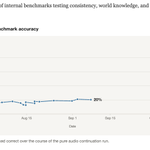
I'm curious how (if) u can have a good knowledge benchmark with continuation models? You judge if it creates another spkr answering the question you had or sth? is it an LLM judge?
also ECAPA-tdnn is a bad model, it gets only 0.8 on real continuations, the generations in the blog are better than what it suggests


1
237

I have a feeling Muon based optimizers work much better for voice modelling, I haven’t formulated thoughts on this yet but distributing your gradient across more SV subspaces should help with vocal fidelity
3
17
1,274
I can’t imagine the beast anthropic can have in their RL environments now since they’re the only ones able to use Fable/Opus as a judge
2
267


Core Automation is literally assembling the avengers of optimization theory, John Langford is the core contributor for the Microsoft Dion repository (he also merged a PR of mine once ^-^)


John -> Core Automation coreauto.com/
After Microsoft (hunch.net/?p=13764006), I was attracted to a place which was very willing to try new things and exceptionally enabling in doing so.
CM retweeted

introducing caramel, my attempt at training a dessa (by @jack) like conversational model purely on speech. caramel sounds very human, but can't hold a coherent conversation (yet). the model + training recipe are open source. enjoy!
samples of caramel talking to itself:

As AI models deal more frequently with humans, it's increasingly important for them to have strong emotional understanding--it's a safety risk that they don't.
We all imagine dystopian scenes of robots harming humans due to misunderstandings, S2S is a step towards solving that

Block's @RagavanThurair tested AI voice models by making sounds of pain. They thought he was stretching or waking up.
He warns that this could become a serious safety problem as AI-powered robots gain more autonomy:
"I tried to make sounds of pain. I had this experience recently where my toddler stepped on a sensitive part of my body, and I couldn't say words. All I could do is make sounds of pain. Imagine a Unitree robot steps on me the same way. I can’t say words to say, get off of me."
"These models fail at that. It's like, oh, it sounds like you're stretching. Did you just wake up? It doesn't understand crying and things like that. There's a reason why we can hear emotion in voice."
"I think it's actually a huge safety issue as well. These AI models are taking more and more control of things."
"They're extremely smart, but if they don’t understand what we actually want or what we're trying to communicate, they can end up doing things we don't want."
@blocks
4
335
CM retweeted

Block trained its new voice AI entirely on speech, without using any text.
Dessa lead @RagavanThurair says even his team didn't expect it to develop such strong language understanding:
"It's trained entirely on speech, which is crazy. This company's training it just on speech, they have less data, it's a lot harder, how the hell are they gonna learn language like that? But somehow ours ended up better."
"I thought we would have to have text to get to this level of conversation understanding. We didn't expect it would learn language this good."
"People have done this before, like GSLM and Hertz-dev. The big gap is ours has a really strong understanding of language and you can actually have a realistic conversation with it."
@blocks

CM retweeted

I'll be on MTS live today!
Tune in if you want to hear more about Dessa
MIDTERMS WRAPPED | FAL, BLOCK, CORE AUTO ON MTS www.nitter.gq/i/broadcasts/2VNLMMEqe…

