

Literature Teacher sharing info/news on Rapid Extinction & Earth Systems Collapse. Urging radical, systemic, political-economic change to try to limit the doom.
- Tweets70.8K
- Following38.8K
- Followers124K
- Likes48.8K

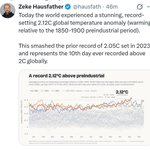



ALT Z Hausfather post: Today the world experienced a stunning, record-setting 2.12C global temperature anomaly (warming relative to the 1850-1900 preindustrial period). This smashed the prior record of 2.05C set in 2023, and represents the 10th day ever recorded above 2C globally.

ALT Guest post: Climate adaptation becomes less effective as the world warms 15.03.24 Adaptation By: Dr Tabea Katharina Lissner, Tessa Möller, Dr Martina Angela Caretta, Dr Aditi Mukherji


ALT Ecosystems from the tropics to the Antarctic are collapsing, scientists warn 26 February 2021 Iconic ecosystems are threatened with partial if not total collapse.
ALT Z Hausfather post: Today the world experienced a stunning, record-setting 2.12C global temperature anomaly (warming relative to the 1850-1900 preindustrial period). This smashed the prior record of 2.05C set in 2023, and represents the 10th day ever recorded above 2C globally.


ALT Cooling the Planet Could Come at a Devastating Cost By University of California - Santa BarbaraApril 13, 20269 Comments6 Mins Read

ALT As carbon dioxide emissions continue to rise, more policymakers, scientists, and environmental advocates are exploring geoengineering as a potential way to limit climate change. These large-scale interventions could affect everything from rainfall patterns to global food production, making the risks and consequences significant. In theory, adjusting parts of Earth’s climate system could help offset some warming. However, the planet’s complexity makes predicting the outcomes of these efforts extremely challenging. Researchers at the University of California, Santa Barbara examined two methods designed to reduce the amount of sunlight reaching Earth’s surface: cloud seeding over the eastern Pacific Ocean and the release of aerosols into the stratosphere. Using models of ocean and atmospheric interactions, they found that the first approach could severely disrupt a major climate system, the El Niño Southern Oscillation, while the second had little measurable effect. Their findings, publ

ALT A Missing Piece in Climate Models: Nature’s Own Emissions Rising temperatures are set to drive up emissions from wildfires, fermenting wetlands, and melting permafrost, but these feedback loops are poorly captured in climate models. Scientists are racing to
ALT Cooling the Planet Could Come at a Devastating Cost By University of California - Santa BarbaraApril 13, 20269 Comments6 Mins Read
ALT As carbon dioxide emissions continue to rise, more policymakers, scientists, and environmental advocates are exploring geoengineering as a potential way to limit climate change. These large-scale interventions could affect everything from rainfall patterns to global food production, making the risks and consequences significant. In theory, adjusting parts of Earth’s climate system could help offset some warming. However, the planet’s complexity makes predicting the outcomes of these efforts extremely challenging. Researchers at the University of California, Santa Barbara examined two methods designed to reduce the amount of sunlight reaching Earth’s surface: cloud seeding over the eastern Pacific Ocean and the release of aerosols into the stratosphere. Using models of ocean and atmospheric interactions, they found that the first approach could severely disrupt a major climate system, the El Niño Southern Oscillation, while the second had little measurable effect. Their findings, publ

ALT This Underlying cause has deep historical roots and has widespread impacts through colonialism slavery modernity capitalism and growth-driven economies

ALT Pic of IPBES 2024 REPORT: Underlying Causes of Biodiversity Loss


ALT This Underlying cause has deep historical roots and has widespread impacts through colonialism slavery modernity capitalism and growth-driven economies
ALT Pic of IPBES 2024 REPORT: Underlying Causes of Biodiversity Loss


ALT From IPBES REPORT Thematic Assessment Report on the Underlying Causes of Biodiversity Loss and the Determinants of Transformative Change and Options for Achieving the 2050 Vision for Biodiversity

ALT A Missing Piece in Climate Models: Nature’s Own Emissions Rising temperatures are set to drive up emissions from wildfires, fermenting wetlands, and melting permafrost, but these feedback loops are poorly captured in climate models. Scientists are racing to