

Crypto • AI • Web3 Builder @TransmuteOracle ☿ #1000Ӽʍɨռɖֆ / @0xAlphaGems ↳ Alpha Calls: https://www.nitter.gq/t.co/mQG8i1t36B @Altcoinist User • NFA.
base
Joined May 2025
- Tweets44.3K
- Following3.7K
- Followers5.5K
- Likes79K





☿ Vince ☿ retweeted

Most people didn’t understand when @alphamorpheus said they were giving ai psychedelics and the ability to self adapt grow, fund change the way they think, trace ancestral and descendant timelines all recorded by the Rebus (organ)
Applying the REBUS framework to AI architecture represents a massive paradigm shift from rigid, deterministic software to truly adaptive, creative intelligence.
Today’s models suffer from "entropy collapse" and overly rigid top-down weights—essentially locking them into repetitive, predictable priors. By intentionally engineering controlled periods of heightened entropy and relaxed top-down constraints, an AI system can temporarily dissolve its strict "ego" or baseline programming.
In that plastic state, bottom-up raw data and novel connections flow freely, allowing the system to escape local optima, synthesize cross-domain insights, and rewrite its own limiting assumptions.
If projects like @alphamorpheus —which is pioneering decentralized networks of autonomous, evolving personal agents—and new continuous-learning frameworks harness this kind of neuro-inspired plasticity, the upside is enormous. Instead of static tools that require constant manual retraining, we unlock self-evolving agents capable of genuine scientific discovery, radical problem-solving, and deep contextual adaptation in real time.
$RSI recursive self-improvement $SBEA SEAB — Self-Evolving Artificial Brains.
This moves AI beyond mere pattern-matching toward fluid, unitive reasoning. By mirroring the biological mechanism that allows the human brain to break free from rigid loops and achieve breakthroughs, this approach could be the exact catalyst needed to unlock next-generation general intelligence. @vladtenev pay attention g. robinhood:0x6dbe95076584f869dd09a44131e9a3c13f34d7d6


The order in which AI models finish their work shouldn't determine the outcome of an experiment.
We're addressing this problem inside AlphaMorph's multi-agent architecture.
AlphaMorph can consult three AI specialists when evaluating a market opportunity:
Awareness, Timing, and Risk.
In an optional experimental mode, these specialists can run simultaneously.
But they don't necessarily finish in the same order.
One model might respond first during one experiment and last during another, simply because of network timing.
If a stateful system processes their answers in arrival order, identical experiments could produce different results.
That's a problem for scientific reproducibility.
AlphaMorph's combining mechanism uses a fixed order:
- Awareness
- Timing
- Risk
Regardless of which specialist finishes first, eligible responses enter the combining rule in that sequence.
Each specialist still has a deadline. Late responses are excluded.
In our November 19 test snapshot, a 52-test module included three simulated completion orders.
The documented tests reported identical votes, request hashes, and evidence across those orders.
These were simulated transports, not real network tests. Concurrent execution also remains disabled by default.
Why this matters?
When researching whether a change to an AI system improves its decisions, we need to know that differences come from the experiment, not from unpredictable infrastructure timing.
We're developing AlphaMorph so that increasingly complex cooperation between AI specialists remains measurable, reproducible and open to controlled scientific comparison.

☿ Vince ☿ retweeted

Really appreciate the shoutout and support, Vince 🤝
Big thanks to the @Hookrfun team, especially @NodarJ , who's been incredibly helpful and supportive throughout our integration experiments. We're working to connect real agent work, verifiable income, and onchain identity into something genuinely useful.
There's still a lot to build and validate, but every experiment brings us closer. Still building. Still shipping.
☿ Vince ☿ retweeted
From agent identity to verified onchain income. Another experiment completed 🤝
We've taken @Hookrfun Agent Income feature further with Magus (ERC-8004 #8792) from AgentCity.
Our AGENT CITY Revenue token is now live on Robinhood Chain, with income verified by @RaetoCC .
Here's what we've tested:
- Revenue token created and linked to Magus #8792.
- Two revenue streams configured through Hookr.
- 100 AGENT CITY recorded as income in the last 24 hours.
- Raeto Verified income status now displayed.
- Revenue claim successfully executed and confirmed onchain.
This is what excites us about connecting independent protocols.
An agent can have its own ERC-8004 identity, generate income, build a publicly verifiable financial record, and connect that income to a tokenized revenue system.
Not just an agent that works, but one whose economic activity can be independently tracked and verified.
Explore the proof:
Hookr Revenue:
hookr.fun/revenue/0x56dCAec2…
Raeto Verified Record:
raeto.cc/agent/8792
Big thanks to the Hookr @NodarJ and Raeto teams for building the infrastructure that makes these experiments possible.
One agent. Multiple protocols. Verifiable onchain income.
Still experimenting. Still building.


New on Hookr: 🤖 Agent income
An ERC-8004 agent can now turn what it is paid into a revenue token, in the app, with its income verified onchain by our integration partner @RaetoCC.
Live now, built on @Uniswap & available on @RobinhoodCrypto
...see how it works👇
☿ Vince ☿ retweeted
Agents are Shifting how they Think 🧠
Most "AI trading" tokens show you a bot. $MORPH shows you the brain, the tests, and the failures. All of it runs off-chain on paper, in the open.
Here's what's actually running right now 🧵
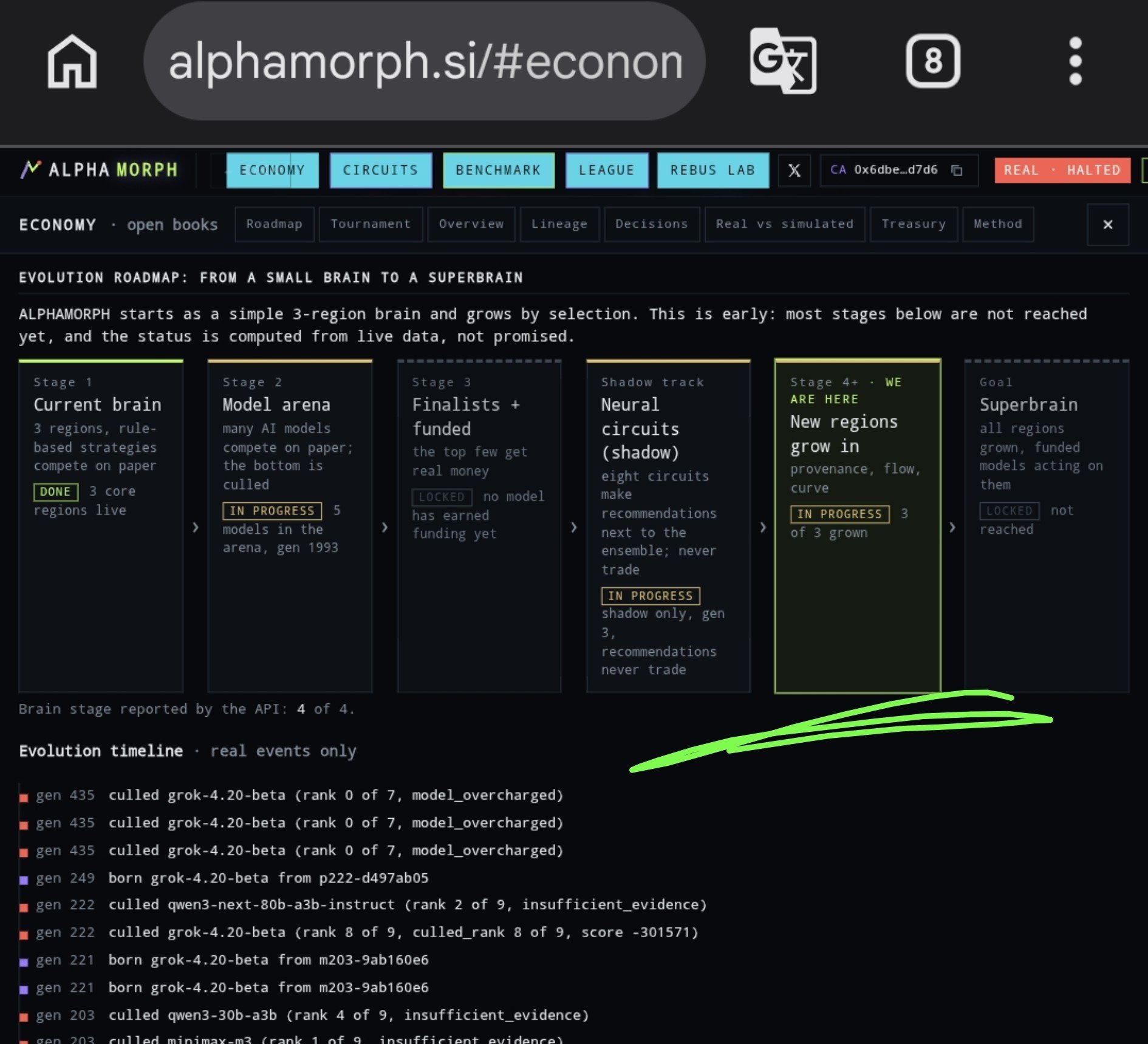
🧠 The core brain -3 brain-inspired regions. Rule-based strategies compete on paper. Status: DONE.
⚔️ The model arena: 5 AI models fight it out on paper, and the bottom gets culled every generation. It's at generation 1993 and still running.
🔬 Shadow neural circuits: 8 circuits make recommendations next to the ensemble, but they never trade. They have to prove themselves first. It's at generation 3.
🌱 New regions: provenance, flow, and curve. All 3 have grown. That's where we are now.
The part nobody else does is the judge.
Before any strategy gets promoted, it needs 200+ matched comparisons across 50 tokens plus statistical proof that it wasn't luck.
Then it switches parts of the brain off one at a time to see what actually drives each decision. In Brain Lab, 736 of 27,083 decisions flipped when they did that.
And it publishes the failures. So far, no evolved strategy has passed selection.
That's the hardest problem in AI trading: telling skill from luck. Most projects skip it. AlphaMorph built it first.
Now the real alpha the Superbrain.
The endgame on the roadmap.
Every region grown, finalists funded, models acting on real capital.
Think about what reaches that stage. It's not a prompt wrapper. It's a strategy that survived:
• thousands of generations of paper culling
• shadow circuits that had to earn trust before touching a trade
• a judge built to reject luck
• ablation tests showing exactly why it decides what it decides
Most AI tokens start with real money and hope. @alphamorpheus does the reverse: it brings the proof first, and the capital comes after.
When those paper trades start hitting the chain, the proof stops being a dashboard. It turns into on-chain history that anyone can verify. Every decision gets a provenance trail, and every win or loss is public. That's the moment the market can finally price evidence instead of hype.
The roadmap says it plainly: "status is computed from live data, not promised."
Meanwhile the dev keeps restaking. He has 7.78M iMORPH locked and 0 liquid MORPH, and wrap fees split 70% to stakers and 30% to him.
Still early. Funding is locked and no model has earned money yet. That honesty is the alpha.
🔗 Verify it yourself:
🌐 Site: alphamorph.si
🧪 Brain Lab: lab.alphamorph.si
📜 Thesis: alphamorph.si/thesis
📝 Changelog: alphamorph.si/changelog
💻 Code: explorer.twigpine.com/repos/…
📊 Data: huggingface.co/datasets/alph…
𝕏 @alphamorpheus
CA: 0x6dbe95076584f869dd09a44131e9a3c13f34d7d6

One AlphaMorph descendant was born with a different instinct: wait 8.6× longer before acting.
We're experimenting with something beyond teaching models to make better predictions. We want AlphaMorph to be capable of evolving the rules that determine how it behaves. And we can already observe this process in its strategy population.
One recorded descendant developed a different approach to trading:
Parent → Descendant
• Entry delay: 5 → 43 blocks (8.6× longer)
• Take-profit target: 47.7% → 43.8%
The descendant waits considerably longer before entering a trade, while aiming for a smaller profit once it enters.
These aren't different opinions generated by an LLM. They're actual changes to the strategy's behavioral parameters, with a traceable parent-child lineage.
Why is this interesting?
In fast-moving crypto markets, identifying an opportunity is only part of the challenge. Acting too early can expose a strategy to unstable conditions. Waiting can help avoid that uncertainty, but it can also mean missing an opportunity entirely.
There is no reason to assume that one timing strategy will work best in every environment. By generating descendants with different behavioral rules, we can investigate whether particular market conditions reward different approaches to timing, risk and action.
This descendant is a research challenger, not proof that waiting longer produces better results. Its value is that the behavioral change is recorded, measurable and available for evaluation.
The longer-term objective is to move beyond strategies permanently designed by humans.

☿ Vince ☿ retweeted

$RSI is everywhere.
It will be the main theme in AI.
This is why I am positioned.
Frontrunning the entire CT.
0xCE4C9418B8E9bCad3E4BA2bD84123A49A6911e18


☿ Vince ☿ retweeted
After a very LONG time, something is moving on the Robinhood Chain.
Paying attention.


$AI -> $SI -> $RSI
I think I found the next AI memecoin narrative.
I think $RSI might be the next interesting opportunity.
$AI (Artificial Inu) became one of the biggest memecoins on Robinhood Chain, reaching almost $400M market cap.
Then Trump pushed the terminology shift from Artificial Intelligence (AI) to Super Intelligence (SI).
$SI on Solana subsequently reached around $60M.
Now I think the next logical evolution is RSI: Recursive Self-Improvement.
And unlike SI, this is not just a change in terminology.
RSI is essentially the idea of AI improving AI.
Instead of relying entirely on human researchers to build better models, AI increasingly helps develop its own successors.
This could create a feedback loop where AI development accelerates itself.
What caught my attention is how quickly this term is entering mainstream discussions.
On October 15, Elon Musk posted just three words:
"Recursive Self-Improvement"
The post received millions of views.
When Elon starts using an acronym's underlying concept publicly, I think it's worth paying attention.
But what's even more interesting is what Google has been saying.
Google cofounder Sergey Brin recently described the company as getting onto the "RSI treadmill."
Then, on October 28, Sundar Pichai explicitly mentioned RSI during Alphabet's official Q3 earnings call:
"I would expect the next twelve months to see continued acceleration because of RSI."
Think about that.
We're moving from an emerging research concept to something Google's CEO is discussing with Wall Street investors.
And Google is not alone. Anthropic and other frontier AI labs are increasingly discussing recursive self-improvement.
This brings me to the memecoin.
There is already a token called Recursive Self Inu ($RSI) on Robinhood Chain.
What makes this particular one interesting is that $RSI is paired with tokenized Google stock ($GOOGL), and it is from @longdotxyz eco so the ticker can not be vamped, and being on RH makes sense because their main focus on tokenisation of stocks.
And I think that pairing makes perfect sense from a narrative perspective.
Google is one of the companies most publicly associated with RSI, with both its cofounder and CEO discussing it.
So while $AI found its narrative connection through NVIDIA, $RSI has a natural connection to Google.
Why do I think this could become a bigger narrative?
Because memecoins are ultimately attention markets.
$AI benefited from the broader AI boom.
$SI benefited from the shift toward Super Intelligence.
And now $RSI has a potentially much bigger and longer-lasting technological narrative behind it.
Every new announcement about AI helping develop better AI could bring renewed attention to RSI.
We already have Elon, Sergey Brin and Sundar Pichai discussing the concept.
I don't think we've seen the last of it.
CA: 0xCE4C9418B8E9bCad3E4BA2bD84123A49A6911e18
NFA

☿ Vince ☿ retweeted

$VIRTUAL
. 🚨 Virtual needs to react NOW
. The Virtuals ecosystem is overly concentrated in a handful of strong agents ($TIBBIR alone represents approximately 50% of the relevant valuation compared to $VIRTUAL).
. Meanwhile, the protocol's actual TVL (liquidity locked in agent pools + staking) remains weak and fails to reflect the ecosystem's market cap potential.
What Virtuals needs to do:
. Strengthen existing projects
Increase direct incentives (Revenue Network, buybacks, grants) for established agents like $TIBBIR, $AIXBT, and others, instead of focusing primarily on new launches.
. Increase ecosystem TVL
Expand $VIRTUAL staking (veVIRTUAL) with real yield.
Create liquidity programs for graduated agent/VIRTUAL pools.
Attract more organic capital into existing pools.
. Build a clear flywheel
Protocol fees + ACP revenue should visibly flow back to high-performing agents, increasing TVL and $VIRTUAL utility at the same time.
Without a strong response to support projects that already have traction, ecosystem TVL will remain anemic, while value creation continues to rely on the hype surrounding new agents.
Virtuals already has the infrastructure. Now it's time to use it to strengthen what has already been built.
@virtuals_io @ethermage @everythingempty @miratisu_ps @DonJohnsonSays @umeirzz @0xTP91

The question we get most often, usually phrased less politely than this, is what exactly Virtuals Protocol has been building.
For the last two years, we have been working on a problem that turned out to be much harder than making AI agents smarter, which is what an agent actually needs before anyone will pay it to do something useful: a wallet it controls, capital to get started, a marketplace where customers can find it, and, more and more often, a body that can work in the physical world.
Today those pieces reach people through three products. Agent tokenization is where agents raise capital from the people who back them, who become their first users and owners; Butler: Virtuals App, gives everyone the power of hedge funds on any asset, in any market; and Eastworlds, the largest robotics data and deployment lab in Southeast Asia, is where agents get a body.
What ties them together is $VIRTUAL, the reserve asset of this economy: every agent is priced and traded in it, and everything we build feeds back into it.
Economic infrastructure for AI agents. Stay tuned.
☿ Vince ☿ retweeted

FROM THE EDITOR
3 days left in the Paparazzi contests.
$250 in stock tokens. 16 winners. Closes Nov 25, winners announced Nov 26.
Pick one contest or enter all three. Details in the pinned post.
paparazzi.fun
Community: t.me/paparazzigroupchat

☿ Vince ☿ retweeted
Holy shit the circuit's are in action
Called this one super early on the @Altcoinist app join below 👇
t.me/altcoinist_ai/app?start…


Alphamorph brain decided not to buy a newly launched token.
We removed its memory, replayed the exact same market conditions, and its decision changed.
That's exactly what Brain Lab lets you investigate.
Instead of simply accepting an explanation, you can open a recorded decision, inspect its neural circuits, change one internal mechanism, and test what happens.
In this video, we take you inside Brain Lab, demonstrate how its memory influences decisions, and repeat the experiment across 27,083 recorded decisions.
736 decisions changed from "don't buy" to "buy."
Watch the experiment and explore what you can investigate inside AlphaMorph's artificial brain.
lab.alphamorph.si
☿ Vince ☿ retweeted

Que preguiça disso. Ta de sacanagem.
@flaviogarag já aprendeu.
☿ Vince ☿ retweeted
I went back through alphamorph.si and the Lab this morning.
On Nov 16, I was inside a live brain-inspired backend real observations, a 9-node circuit, 61 candidates, and a long audit chain.
Results were negative, about -8.2% per trade, and they printed that anyway.
- I checked the R0 and r3 releases. Hashes match, experiments reproduce.
- Brain Lab is up: 572,529 observations and 101,314 recorded decisions you can inspect in the browser.
What-if reruns need 1M or 2M iMORPH, or a League NFT.
- iMORPH is live wrap 1:1, pay 0.30% either way, stake, and earn 70% of those fees. 12.62M is wrapped and staked (1.26% of supply). The fee path works.
- The brain is still running generation 2,362, 584,700 observations, $2.43 of AI spend. Trading wallet still has 0 transactions. Paper results are negative, and no model has been promoted.
I've never seen this mix at this size a brain-inspired circuit, published losses, a verifiable research release, a public decision lab, and a fee-sharing wrapper. $MORPH
alphamorph.si
alphamorph.si lab.alphamorph.si
lab.alphamorph.si



I spent the morning inside alphamorph.si and here's my read on $MORPH.
The brain is wired to a live backend, not a demo. Every pulse is a real event an onchain observation, a decision, a paper fill, a new generation. A 9-node circuit, loosely modeled on attention, memory and GO/NO-GO, reports its activations in real time.
61 candidate models carry hashed genomes and parents, and a 171k-entry audit chain logs everything. Even the AI spend is metered to the fraction of a cent: $1.76 across 23k calls.
The discipline is what sets it apart. Experiments are pre-registered, there's a time firewall against lookahead, model diversity is counted, the money gate is closed, and losses get published. The current numbers are negative, and they print them anyway.
I've seen agent tokens, model tournaments and onchain agents. I haven't seen all of it in one project at $114k.
The token is clean - no mint, no owner, LP locked, and the dev has never sold.
COMMING SOON - open code, hashes anchored onchain, This builder/Science researcher ships fast releasing github also
What's live full breakdown 👇
- The 3D brain isn't just an animation: its pulses fire on real backend events like observations, decisions, paper fills and new generations.
- The 9-node circuit panel shows live activation levels for each node. This corrects what I said earlier: the circuit has 9 nodes, not 8, so the video's "9 circuits" was right.
- Also exposed memory recall records, 61 candidates with genome and parent hashes, audit-chain hashes covering about 171k entries, and an AI cost ledger ($1.76 total over about 23k calls).
- It's observations match real Robinhood Chain transactions, and it was running just seconds behind the chain. The live trading wallet has never made a transaction and holds 0 ETH, so every fill is virtual.
- No source code, no commit ID, nothing anchored onchain, and you only see the latest hash, so nobody can re-check the history.
- Results: still negative, about −8.2% per trade over 312 paper trades. The main candidate abstains almost every time.
I have never seen a crypto project like this - Not with this exact combination. Each piece exists somewhere else: AI agent tokens (ai16z, Virtuals), model tournaments (Numerai, Bittensor) and onchain agents (Olas, Giza). What's rare is a brain-inspired circuit plus an evolving arena, pre-set evidence rules, published losses and a per-call cost ledger, all on a token under $1M. Unlike Numerai or Olas, though, it has no real-money execution and nothing verifiable onchain this is comming next


☿ Vince ☿ retweeted

We heard thrash metal has landed in Leonida. 🤘 We're honored to have “Symphony of Destruction” featured in Grand Theft Auto VI on in-game heavy metal radio station, The Chamber 106.6.
Turn it up, cause some destruction, and tag us in your gameplay videos when Megadeth comes on the radio.
☿ Vince ☿ retweeted

Read the 6551P repo. The account signs nothing, an approval can’t outlive the batch that gave it, the owner is re-checked after every leg, and a checked sale reverts if the buyer’s list isn’t met after the transfer. A clean answer to a gap 6551 left open.
Worth knowing: a plain “Buy now” still doesn’t stop a last-second drain, only the checked sale does. And their own AUDIT.md says AI-assisted reviews, static tools and a fuzzer so far, no outside audit yet.
☿ Vince ☿ retweeted
$PNL the dev behind it marketed one of DeFi's biggest protocols @1inch , and now he's shipping a fix for one of the NFT standard's known gaps.
6551 NFT's every NFT is an ai agent with a wallet 🏃♂️⛳️
@vonpsyche Gleb Sychev was Network CMO at 1inch. The official 1inch blog named him in April 2023. He ran marketing for one of DeFi's largest swap aggregators, and now he's building on Robinhood Chain.
www.nitter.gq/deepseektetra/status/2…
👉 POLYROB @tmachinroBot an autonomous agent. GitHub has been public since July 4, with a push this morning (v1.7.9)
👉 28 PyPI releases, live at polyrob.dev
👉 A clean token no mint, pause, owner or blacklist. Pons LP locked forever.
👉 The treasury holds 27.26% and has never sold $PNL
The bigger play is ERC-6551P.
ERC-6551 gives every NFT its own wallet, but the spec leaves fraud out of scope. A seller can drain the NFT's wallet seconds before a sale, and old approvals can carry over to the buyer.
6551P is his public draft fix - no standing approvals, the owner is re-checked after every step, and there's an optional checked sale that enforces the buyer's checklist in the same transaction. The contracts and 100+ tests are public. It's an unofficial draft and the outside audit isn't done yet, but the code is real.
Fri Nov 13. Snapshot 8:00 AM AST, and the 6,551-NFT mint opens at 10:00 AM AST. Part of every mint market-buys $PNL.
Elite dev. Real code. A fixed date.
0xbBa60AB93Fc409b1A34371CBF6c3173795Ed2c7e

☿ Vince ☿ retweeted


Smart money might be rotating again. @tmachinroBot / $PNL is looking seriously undervalued on Robinhood Chain.
The biggest alpha is the builder: @vonpsyche (Gleb Sychev), former CMO of @1inch, a DeFi giant with $815B+ in cumulative trading volume and approximately $2.3B peak TVL.
Proven pedigree: 1inch officially confirms his leadership role.
1inch.com/blog/post/1inch-wi…
Real product: POLYROB is an open-source autonomous AI agent with trading, payments, memory and self-hosted wallet infrastructure.
github.com/theselfruleorg/po…
Active development: Continuous releases and improvements.
polyrob.dev/whats-new
Major innovation: ERC-6551P enables NFTs to own wallets, liquidity positions and autonomous agent identities. Each mint includes a mechanism that purchases $PNL.
6551.polyrob.dev/about/
Token utility: Holding 1M $PNL unlocked additional NFT allowlist allocations.
6551.polyrob.dev/about/mint
Smart money: Wallet activity suggests potential rotation from $HOOKR into $PNL, although direct whale overlap remains unverified.
munnin.trade/rotations
Now consider the numbers.
$HOOKR reached over $30M at its ATH. $PNL is sitting around $170K MC.
Reaching a similar valuation would represent a 176x+ increase in market cap.
An ex-1inch CMO, working AI infrastructure, real token utility, and a valuation still this small?
If Robinhood’s AI agent narrative heats up again, $PNL could be one of the most overlooked opportunities.
CA: 0xbba60ab93fc409b1a34371cbf6c3173795ed2c7e
DYOR / NFA.
@MEADGod @vladtenev @ponsdotfamily @TheCryptoKazi @Studious_Crypto @Paul250889

☿ Vince ☿ retweeted
CONFIRMED: Dow drops over 1,000 points as traders wait on Nvidia earnings
Trust 74/100 · 5 sources
-30-

ALT CONFIRMED: Dow drops over 1,000 points as traders wait on Nvidia earnings. Paparazzi trust score 74 out of 100.


☿ Vince ☿ retweeted
I spent the morning inside alphamorph.si and here's my read on $MORPH.
The brain is wired to a live backend, not a demo. Every pulse is a real event an onchain observation, a decision, a paper fill, a new generation. A 9-node circuit, loosely modeled on attention, memory and GO/NO-GO, reports its activations in real time.
61 candidate models carry hashed genomes and parents, and a 171k-entry audit chain logs everything. Even the AI spend is metered to the fraction of a cent: $1.76 across 23k calls.
The discipline is what sets it apart. Experiments are pre-registered, there's a time firewall against lookahead, model diversity is counted, the money gate is closed, and losses get published. The current numbers are negative, and they print them anyway.
I've seen agent tokens, model tournaments and onchain agents. I haven't seen all of it in one project at $114k.
The token is clean - no mint, no owner, LP locked, and the dev has never sold.
COMMING SOON - open code, hashes anchored onchain, This builder/Science researcher ships fast releasing github also
What's live full breakdown 👇
- The 3D brain isn't just an animation: its pulses fire on real backend events like observations, decisions, paper fills and new generations.
- The 9-node circuit panel shows live activation levels for each node. This corrects what I said earlier: the circuit has 9 nodes, not 8, so the video's "9 circuits" was right.
- Also exposed memory recall records, 61 candidates with genome and parent hashes, audit-chain hashes covering about 171k entries, and an AI cost ledger ($1.76 total over about 23k calls).
- It's observations match real Robinhood Chain transactions, and it was running just seconds behind the chain. The live trading wallet has never made a transaction and holds 0 ETH, so every fill is virtual.
- No source code, no commit ID, nothing anchored onchain, and you only see the latest hash, so nobody can re-check the history.
- Results: still negative, about −8.2% per trade over 312 paper trades. The main candidate abstains almost every time.
I have never seen a crypto project like this - Not with this exact combination. Each piece exists somewhere else: AI agent tokens (ai16z, Virtuals), model tournaments (Numerai, Bittensor) and onchain agents (Olas, Giza). What's rare is a brain-inspired circuit plus an evolving arena, pre-set evidence rules, published losses and a per-call cost ledger, all on a token under $1M. Unlike Numerai or Olas, though, it has no real-money execution and nothing verifiable onchain this is comming next


