

a new way to: inference. pre-training. post-training. quant. kerneling where no one has kerneled before.
Ottawa
Joined October 2025
- Tweets1.6K
- Following24
- Followers342
- Likes671


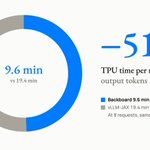




At 128 concurrent requests, $10,000 of TPU time at the vLLM-JAX rate buys the same output as about $5,270 at Backboard’s rate.
Same Qwen3.6 model, same four chips, same hourly price. That leaves $4,730 in the compute budget.
See the full results → backboard.io/blog/qwen3-6-tp…

3
50
If you sell output by the token, a fully booked TPU-hour with Backboard could generate 77% more output-token revenue at the same price.
At 256 concurrent requests, we delivered 4,824 tokens/sec against 2,719 for vLLM-JAX.
See the full breakdown → backboard.io/blog/qwen3-6-tp…

2
87
Same Qwen model. Same TPU hourly rate.
At 8 concurrent requests, Backboard delivered 1,745 tokens/sec against 860 for vLLM-JAX.
At those rates, a million output tokens costs 51% less in TPU time.
See the full results → backboard.io/blog/qwen3-6-tp…

2
43
Backboard at 128 concurrent requests matched vLLM-JAX at 32 on p90 time to first token.
Both clocked 0.60 seconds.
Four times the concurrency, same first-token wait at p90, on the same four TPU chips running Qwen3.6.
The full breakdown → backboard.io/blog/qwen3-6-tp…

1
3
128
256 requests in flight. Half got their first token in 230 milliseconds or less.
That’s Backboard running Qwen3.6-35B-A3B on Google TPU v6e-4. The median with vLLM-JAX was 1.06 seconds.
See the full results → backboard.io/blog/qwen3-6-tp…

We doubled the load five times, from 8 concurrent requests to 256.
Backboard beat vLLM-JAX on p90 token generation speed at all six levels running Qwen3.6 on TPU.
Our smallest lead was 84%. Our largest was 117%.
The full breakdown → backboard.io/blog/qwen3-6-tp…

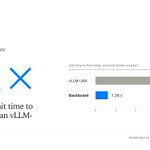
Backboard cut nearly 9 seconds off the p90 wait for Qwen’s first token.
At 256 concurrent requests on Google TPU v6e-4, vLLM-JAX took 10.23 seconds.
We took 1.26.
The full breakdown → backboard.io/blog/qwen3-6-tp…

The benchmark figures referenced here are from an earlier test. We’ve since published updated results → backboard.io/blog/gemma-4-12…

20
Same four TPU chips. Same Qwen3.6 weights at BF16.
At 256 concurrent requests, Backboard delivered 4,824 tokens per second in aggregate. vLLM-JAX delivered 2,719.
That’s 77% more output per second on the same hardware.
See the full results → backboard.io/blog/qwen3-6-tp…

BackboardIO retweeted

Holy 5h!t, it’s fast! TPU Time!
256 AI requests at once. Same hardware, same model, same precision. We're 800% FASTER!
Pretty proud of what our team is building.
*P90, Backboard vs vLLM-JAX @BackboardIO
backboard.io/blog/qwen3-6-tp…

Agentic AI needs performance, not just the right model.
We tested Backboard on Qwen3.8-Flash-Next with the AgentX benchmark, and the results made one thing very clear:
Inference performance matters.

Week one done. What’s next?
More models, newer hardware, matched-precision runs, and an open invitation that doesn't expire: bring us your workload, or run our engine on your benchmark, and we'll publish what comes out.
Intelligence should be cheap enough to be reckless. We're working on it.
1
95
What an inference engine actually does, in plain terms:
A model generates one token at a time. The engine decides which requests share the GPU, what stays in memory (the KV cache), and in what order work runs.
Those scheduling and memory decisions are worth more than most people think. This week: 12.8x worth, in the best case we’ve measured.
backboard.io/blog/qwen-flash…

4
205
One week of posting our AgentX numbers in public. The questions we got were better than the compliments.
More benchmarks should be run this way: in the open, with the conditions on the page.
2
118
Make intelligence cheap enough to be reckless.
That's the whole of Backboard in one line. When inference is cheap enough, people stop rationing it and start experimenting with it.
Everything we build is in service of that price coming down.
1
4
120
If you could have one inference benchmark run properly with the same hardware, same conditions, and full tables published, what would it be?
Tell us about the model, workload, and metrics. We'll take the best answer and run it.
It’s been days since we pitted our AgentX numbers against SGLang's published results and offered our engine for an independent run at @SemiAnalysis_
The offer remains: same benchmark, same workload, run by whoever wants to check our math.
We'll keep publishing ours either way.
backboard.io/blog/qwen-flash…
60
We have a standing offer: @SemiAnalysis_, run our engine on AgentX yourselves. Same containers, same workload, your boxes.
We'll publish whatever you find. That's the comparison we want.
1
42
What we're testing next, in the open:
More models. Newer hardware generations. Matched-precision comparisons, BF16 against BF16, so the engine is the only variable.
If there's a workload you think breaks us, tell us. That's the most useful thing you can send.
A question for the people serving open models in production:
Where does your stack actually hurt: time to first token, interactivity under load, or raw throughput per GPU?
We build an inference engine, so your answers are our roadmap. @spheron @friendliai, you've both published on this. What are you seeing?
ow.ly/46zz51062kV