

The system of record for stablecoins, tokenized assets, & onchain finance. Access standardized & comparable data for asset issuers, DeFi venues, & blockchains.
New York
Joined December 2019
- Tweets45.3K
- Following1.6K
- Followers166K
- Likes23.2K






Token Terminal 📊 retweeted

🚨 TODAY: Only 8.2% of the $49.6B in tokenized assets is deployed in DeFi, which leaves about $45.5B unused onchain, per Token Terminal.

Token Terminal 📊 retweeted
Only 8.2% of tokenized assets are deployed in DeFi today
Asset issuers and DeFi venues have an opportunity to work together to put the remaining $45.5B of tokenized assets to productive use onchain


Great to share perspectives at Link:NYC on what it will take for tokenized funds to move beyond issuance and deliver value to investors. We discussed the importance of interoperability, infrastructure and collateral mobility across a hybrid financial system. Thanks to @chainlink

Token Terminal 📊 retweeted

40x more holders in 12 months, and the biggest listings now arrive onchain on day one.
$ANT was live as a dShare™ from Anthropic's first trade, in every partner app running on the Dinari API.
Higher.

Token Terminal 📊 retweeted

tokenization adds little utility for an asset that settles just fine on traditional rails
where does the gain show up? when the token can be pledged, lent against, or composed into a vault
Token Terminal 📊 retweeted

anthropic raised $81B on thursday, by saturday @solana was pricing it with nasdaq shut
flagship IPOs are now launching onto 24/7 global markets where 63% of volume already trades outside US hours
every major listing from here is going to trade onchain from the opening bell

7 minutes after Anthropic's Nasdaq debut, ANT went live on @Solana via @sunrise
ANT kept trading through the weekend - $15.7M on Saturday, more than any other tokenised stock on solana (@tokenterminal)
Issued by @BackpackOnchain
Trade stocks 24/7 on Kamino Swap

Token Terminal 📊 retweeted
Multiple issuers can build a sizable onchain market for the same US stock
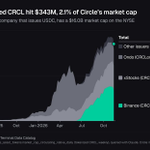
Tokenized shares of Circle, the issuer of USDC, reached $343M in market cap, equal to 2.1% of Circle’s NYSE market cap
Binance accounted for $136M, xStocks $111M, and Ondo $73M

Token Terminal 📊 retweeted
Stablecoin market cap recovered from four crises to reach $285B
Terra’s algorithmic UST failed and the 1:1 reserve-backed model prevailed, with USDT and USDC now at 86% of the market
Most tokenized stocks use the same model, with shares held in custody

Only 8.2% of tokenized assets are deployed in DeFi today
Asset issuers and DeFi venues have an opportunity to work together to put the remaining $45.5B of tokenized assets to productive use onchain
Great to share perspectives at Link:NYC on what it will take for tokenized funds to move beyond issuance and deliver value to investors. We discussed the importance of interoperability, infrastructure and collateral mobility across a hybrid financial system. Thanks to @chainlink
Token Terminal 📊 retweeted

Tokenized stocks could be the next stablecoins. Here's why you should pay attention.
In March 2020, stablecoins were a $4.8 billion market.
Today, they're worth $285 billion — nearly 59x growth.
According to Token Terminal, tokenized stocks have now reached that same $4.8 billion milestone.
But what exactly are tokenized stocks, and why does this matter?
Let's break it down in simple terms. 👇
1. What is a tokenized stock?
Imagine you want to buy a Tesla share worth $400.
Traditionally, you purchase it through a stockbroker.
With tokenization:
→ An issuer purchases a real Tesla share.
→ A regulated custodian holds that share.
→ The issuer creates a token on the blockchain.
→ You purchase and hold that token in your crypto wallet.
If Tesla's share price increases from $400 to $450, your token is designed to track that increase.
However, dividend rights, voting rights and legal ownership depend on the issuer's structure.
2. Why compare tokenized stocks with stablecoins?
The underlying mechanism is similar.
USDC → Backed by dollar-denominated reserves.
Tokenized Tesla → Backed by Tesla shares.
Stablecoins brought traditional money onto the blockchain.
Tokenized stocks are bringing traditional equities onto the blockchain.
3. The numbers are getting interesting.
According to Token Terminal's November 2026 analysis:
• Market cap: $4.8B (9.1x annual growth)
• Token holders: 5.9M (40x growth)
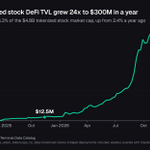
• DeFi deposits: $300M (24x growth)
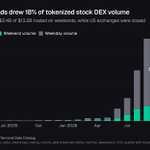
• Monthly weekend DEX volume: $2.4B (83x growth)
Time taken to grow from $1B to $4.8B:
• Stablecoins: 11 months
• Tokenized stocks: 8 months
Unlike stablecoins in 2020, tokenized stocks already have an established ecosystem of wallets, exchanges, blockchains and DeFi protocols.
4. Why would people buy tokenized stocks?
24/7 trading
Imagine Nvidia announces something significant on Saturday.
Traditional stock exchanges are closed.
Tokenized stocks could allow investors to trade immediately on supported platforms, subject to liquidity.
Fractional ownership
Imagine Nvidia's stock costs $200, but you only have $10.
You could purchase 0.05 tokenized shares and potentially use them across compatible blockchain applications.
DeFi lending
Imagine you hold $10,000 worth of tokenized Tesla shares but need $5,000 without selling your investment.
You could potentially:
→ Deposit your tokenized stocks into a lending protocol.
→ Borrow 5,000 USDC.
→ Repay the loan with interest.
→ Withdraw your tokenized stocks.
Your stocks become programmable collateral, although falling prices could trigger liquidation.
5. Why might the US government support tokenized stocks?
Imagine investors from India, Brazil and Indonesia purchasing tokenized Apple shares.
The tokenization platform sources real US shares, which are then held by a custodian.
According to the article:
• 88% of tokenized stock market cap tracks US-listed stocks and ETFs.
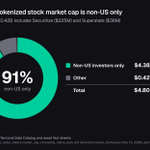
• 91% consists of tokens offered exclusively to non-US investors.
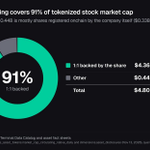
• 91% is backed one-for-one by underlying shares.
• 86% lists Alpaca as a custodian.
Just as stablecoins extend the global reach of the US dollar, tokenized stocks could extend the reach of US equity markets.
6. How big is the opportunity?
Foreign investors reportedly hold $25.2 trillion in US equities.
Imagine if a portion of that moved onchain:
• 0.1% = $25.2 billion
• 1% = $252 billion
• 5% = $1.26 trillion
• 10% = $2.52 trillion
Even 1% would represent a market 52.5x larger than today's reported tokenized stock market.
These are hypothetical scenarios, not predictions.
7. Tokenized stocks vs perpetual futures
Both can provide exposure to Tesla's stock price, but there's a fundamental difference.
A fully backed tokenized stock has real shares behind it.
A perpetual futures contract (perp) can track Tesla's price without requiring ownership of its shares.
If regulators restrict backed tokenized stocks, investors may move towards perpetual futures instead.
That demand would not necessarily translate into purchases of actual US equities.
This creates an interesting economic incentive for supporting regulated tokenization.
8. Who is building in this space?
• Ondo Finance — Tokenized stocks, ETFs and real-world assets.
• xStocks — Blockchain-based stock exposure.
• Alpaca Securities — Brokerage and custody infrastructure.
• Hyperliquid — Decentralized trading and perpetual futures infrastructure.
9. Where does the technology get interesting?
I've been working on bond tokenization, and many of the technical building blocks are relevant to stock tokenization as well.
→ Token factories for deploying security tokens.
→ Investor eligibility registries.
→ Automated compliance contracts.
→ Wallet whitelisting.
→ Jurisdiction-based transfer restrictions.
→ Asset allocation.
→ DvP settlement (simultaneous exchange of securities and payment).
Standards like ERC-3643 are particularly relevant for building permissioned, compliance-aware securities.
Stock tokenization introduces additional challenges:
• Dividend distribution
• Stock splits
• Corporate actions
• Custody reconciliation
• Proof of reserves
• Minting and redemption against underlying shares
Putting a stock on a blockchain is only one part of the problem.
Making it secure, compliant and legally enforceable is the bigger engineering challenge.
10. Where are the opportunities for developers?
If you're exploring blockchain, AI or fintech, these are some areas worth paying attention to:
• RWA tokenization infrastructure
• Automated regulatory compliance
• Cross-border financial settlement
• Proof-of-reserves systems
• DeFi lending against real-world assets
• Automated dividend and coupon payments
• AI agents for RWA portfolio management
• Onchain financial analytics
• Smart contract security
My takeaway:
Cryptocurrencies introduced native digital assets.
Stablecoins brought traditional currencies onchain.
RWA tokenization is bringing stocks, bonds, gold, real estate and investment funds onchain.
The next opportunity could be building an interconnected financial ecosystem where traditional assets become programmable.
The biggest opportunity may not be buying tokenized assets.
It may be building the infrastructure that enables trillions of dollars in traditional financial assets to operate securely and compliantly onchain.
I'm increasingly interested in the intersection of AI, blockchain, DeFi and RWA tokenization.
If you're building in this space, let's connect and exchange ideas. 🤝
Data source: Token Terminal
tokenterminal.com/explorer/t…

Token Terminal 📊 retweeted

Tokenized stocks are the next stablecoins


Token Terminal 📊 retweeted

.@tokenterminal producing some pretty cool data on tokenized stocks.

Tokenized stocks, all time, in 5 charts
Three issuers hold most of the market: @ondo and @bstocksfinance at +$1.3B each, @xStocksFi at +$1.0B
@BNBCHAIN leads by chain at +$1.5B, ahead of @solana at +$1.1B
SHVon by @ondo is the largest single stock at +$408.5M
About 90% is 1-to-1 backed, +$4.0B
Most issuers are based in the British Virgin Islands, the UAE and Jersey
Data: @tokenterminal


Token Terminal 📊 retweeted
How much does the average tokenized stock holder own?
@Ondo ~$2,440
@xStocksFi ~$1,000
@bstocksfinance ~$810
@coinbase ~$650
@RobinhoodApp ~$104
@Backpack ~$65
Market cap divided by holders. Across all tokenized stocks, the average is about $740.
Data: @tokenterminal

Token Terminal 📊 retweeted
Tokenized stocks, all time, in 5 charts
Three issuers hold most of the market: @ondo and @bstocksfinance at +$1.3B each, @xStocksFi at +$1.0B
@BNBCHAIN leads by chain at +$1.5B, ahead of @solana at +$1.1B
SHVon by @ondo is the largest single stock at +$408.5M
About 90% is 1-to-1 backed, +$4.0B
Most issuers are based in the British Virgin Islands, the UAE and Jersey
Data: @tokenterminal
Token Terminal 📊 retweeted

@tokenterminal on why tokenized stocks are following the same path stablecoins took from $4.8B to $285B.
www.nitter.gq/tokenterminal/status/2…
Tokenized stocks reached $4.8B in market cap, where stablecoins were in March 2020
In 12 months, market cap grew 9.1x and holders grew 40x to 5.9M
Stablecoins extended the dollar’s reach abroad
Tokenized stocks could bring more foreign demand to US equities

trade[XYZ] equity perp open interest grew 55x to $1.54B in a year
If the US restricts share-backed tokens, foreign demand could shift to perps, which require no underlying shares
Supporting backed tokens helps keep that demand in US equities

1
794
Read the full article: Tokenized stocks are the next stablecoins
www.nitter.gq/tokenterminal/status/2…
747